Digital money and youth spending behavior in Ebonyi State, Nigeria
Keywords:
Digital money, Youth, Spending behavior, Ebonyi State, Nigeria.Abstract
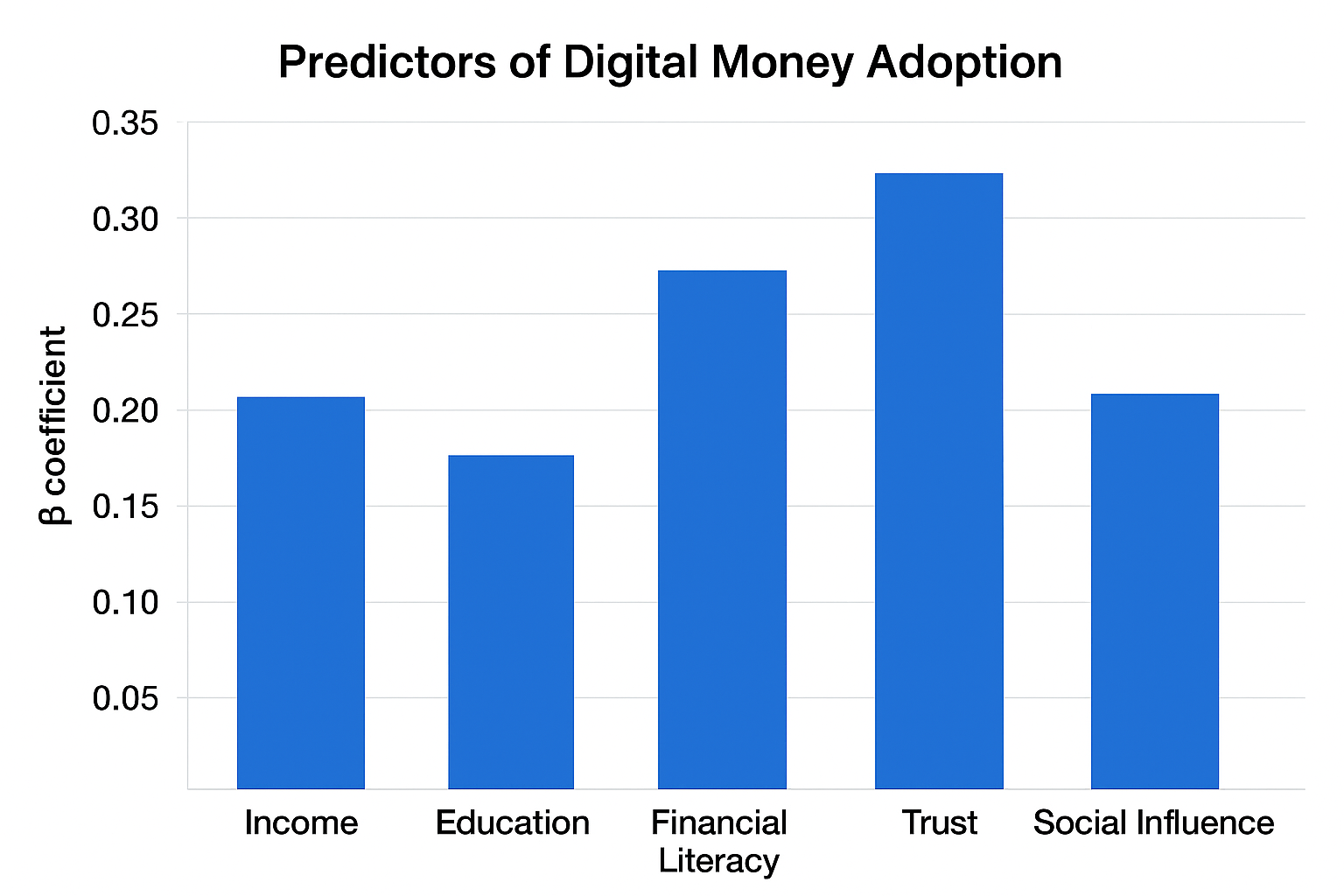
This paper examines digital money adoption and use among youths in Ebonyi State, Nigeria, and how it influences their spending behavior. A convergent mixed-methods design was adopted, and data were collected through structured questionnaires administered to 400 respondents and 20 in-depth interviews. The study used both qualitative and quantitative data-collection methods. Thematic analysis was used to analyze the qualitative data, whereas descriptive statistics, multiple regression, and correlation analysis were used to analyze the quantitative data. The findings reveal a high adoption rate of 72% among youths, driven by education, income, financial literacy, social influence, and trust. Digital money use substantially increased spending, especially on mobile data, airtime, and peer-to-peer transfers. Adoption is constrained by trust and risk concerns, and youths deploy various strategies to mitigate these risks. The paper recommends adequate financial education, infrastructural improvement, and stricter financial regulatory interventions to strengthen trust and promote responsible use. These findings contribute to understanding digital money adoption and its behavioral implications in sub-national Nigerian contexts.
References
[1] L. O. Oyelami, S. O. Adebiyi & B. S. Adekunle, ``Electronic payment adoption and consumers' spending growth: Empirical evidence from Nigeria'', Future Business Journal 6 (2020) 14. https://doi.org/10.1186/s43093-020-00022-z.
[2] C. G. Nkechika, ``Digital financial services and financial inclusion in Nigeria: Milestones and new directions'', Economic and Financial Review 60 (2022) 151. https://dc.cbn.gov.ng/efr/vol60/iss4/12/.
[3] P. M. Mezoh & X. Zhou, ``Exploring the advantages of cashless payment systems: A comprehensive review'', International Journal of Research and Innovation in Social Science 8 (2024) 553. https://doi.org/10.47772/IJRISS.2024.8100047.
[4] I. A. Busari & A. O. Jayeoba, ``Impact of mobile money services on financial inclusion and profitability of deposit money banks in Nigeria'', MANSA: International Journal of Business, Economics, and Finance 5 (2025) 20. https://doi.org/10.62154/mansa-0501-012.
[5] N. U. Iheji, C. I. Ezeanyeji & C. O. Obi, ``Effect of financial technology on poverty alleviation in Nigeria'', International Journal of Finance, Accounting and Management Studies 1 (2025) 158. https://www.ijfams.com/index.php/ijfams/article/view/59.
[6] E. Esendemirli, A. A. Olawale & S. Celik, ``Digital banking adoption: Evidence from the Nigerian youth market'', International Journal of Contemporary Economics and Administrative Sciences 14 (2024) 14. https://doi.org/10.5281/zenodo.13871769.
[7] I. U. Etuk, N. N. Aripko & E. J. Edim, ``Factors influencing consumers' adoption of mobile financial technology (FinTech) services in Calabar, Nigeria'', African Journal of Management and Business Research 18 (2025) 131. https://doi.org/10.62154/ajmbr.2025.018.010614.
[8] Q. M. Ajao, O. Oludamilare & L. Sadeeq, ``Drivers of mobile payment acceptance: The impact of network externalities in Nigeria'', Open Access Library Journal 10 (2023) e10240. https://doi.org/10.4236/oalib.1110240.
[9] I. Y. Aruwa, V. O. Afolabi, K. I. Obaitan, O. S. Shokunbi & U. Uwuigbe, ``The role of digital payment solutions in enhancing financial inclusion in Nigeria: A case study of agency banking and mobile money operations'', International Journal of Research and Innovation in Social Science 9 (2025) 3795. https://ideas.repec.org/a/bcp/journl/v9y2025issue-6p3795-3809.html.
[10] O. S. Adanigbo, A. A. Soladoye, K. M. Olagunju, O. O. Asaolu, P. E. Alfa, B. A. Omodunbi, A. O. Oladipo & G. O. Ajagbe, ``Examining challenges to adopting digital payments in Nigeria and the UK using the unified theory of acceptance and use of technology'', NIPES Journal of Science and Technology Research 7 (2025) 1401. https://journals.nipes.org/index.php/jstrissue/article/view/2288.
[11] A. Fatma, ``The impact of digital payment systems on consumer buying behavior in developing economies: A comprehensive review'', International Journal of Progressive Research in Engineering, Management and Science 5 (2025) 129. https://www.ijprems.com/uploadedfiles/paper/issue_5_may_2025/40874/final/fin_ijprems1746464692.pdf.
[12] M. N. A. Mensah & A. Jumah, ``Electronic money and consumer spending behaviour: Evidence from Ghana'', Advances in Management & Applied Economics 11 (2021) 105. https://doi.org/10.47260/amae/1136a.
[13] O. K. Tiony & Y. Yin, ``The impact of digital financial services on financial inclusion in Kenya'', American Journal of Industrial and Business Management 13 (2023) 593. https://doi.org/10.4236/ajibm.2023.136036.
[14] E. Mogaji & N. P. Nguyen, ``The dark side of mobile money: Perspectives from an emerging economy'', Technological Forecasting and Social Change 185 (2022) 122045. https://doi.org/10.1016/j.techfore.2022.122045.
[15] L. Hornuf, K. Safari & J. Voshaar, ``Mobile fintech adoption in Sub-Saharan Africa: A systematic literature review and meta-analysis'', Research in International Business and Finance 73 (2025) 102529. https://doi.org/10.1016/j.ribaf.2024.102529.
[16] N. Sultana, R. S. Chowdhury & A. Haque, ``Gravitating towards Fintech: A study on undergraduates using extended UTAUT model'', Heliyon 9 (2023) e20731. https://doi.org/10.1016/j.heliyon.2023.e20731.
Published
How to Cite
Issue
Section
Copyright (c) 2026 Sylvester Agbo Igwe, Jeremiah Chukwu (Author)

This work is licensed under a Creative Commons Attribution 4.0 International License.