Machine learning-based prediction of climate-driven sickle cell anemia crises across Nigerian regions using synthetic multimodal data
Keywords:
Sickle cell anemia, Machine learning, Vaso-occlusive crisis, Synthetic multimodal data, Climate scienceAbstract
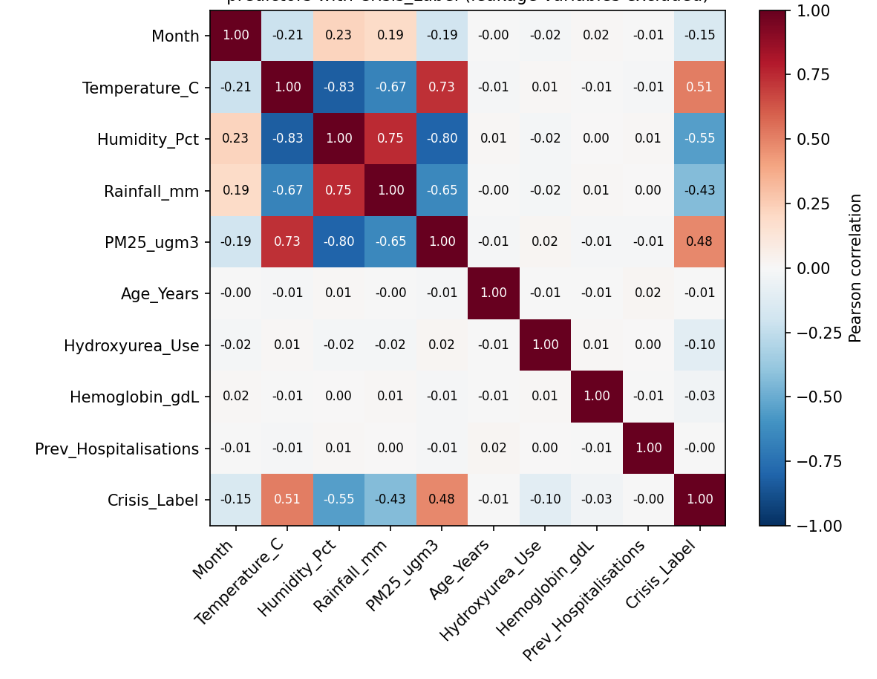
Sickle cell anemia (SCA) is a genetic hemoglobinopathy that imposes a major health burden in sub-Saharan Africa, particularly in Nigeria. Vaso-occlusive crises (VOCs), the principal acute manifestations of SCA, may be influenced by environmental factors such as temperature, low humidity, harmattan dust, and rainfall. Although associations between VOCs and environmental conditions have been reported, prediction models remain difficult to develop for data-constrained clinical settings. We developed a proof-of-concept VOC prediction framework for six Nigerian ecological regions using a synthetic multimodal health--environment dataset comprising 12,000 patient-month observations. Random Forest, support vector machine (SVM), XGBoost, neural network, and logistic regression models were evaluated. Logistic regression achieved the best overall performance (accuracy: 0.78; F1-score: 0.74; area under the receiver operating characteristic curve [ROC-AUC]: 0.84), followed by Random Forest (0.77, 0.72, and 0.83), SVM (0.78, 0.73, and 0.82), neural network (0.77, 0.72, and 0.82), and XGBoost (0.76, 0.70, and 0.82). Regional analysis showed a north--south gradient in simulated crisis occurrence: the North-East had the highest probability (80.1%), associated with temperature and particulate matter with aerodynamic diameter below 2.5, mu m (PM2.5), whereas the South-South had the lowest probability (10.4%). Temperature, PM2.5, humidity, and previous hospitalization were the most influential predictors. These findings establish the methodological feasibility of a climate-sensitive prediction pipeline that should be externally validated with clinical and meteorological data before use in health-surveillance applications.
References
[1] P. Wasnik, P. Das, A. Kumar, P. K. Kannauje, R. R., V. Pandit, T. Sahu & J. Sahu, ``Hospitalization events among adolescents and adults with sickle cell disease in a tertiary care center in central India'', Cureus 16 (2024) e61185. https://doi.org/10.7759/cureus.61185.
[2] E. I. Obeagu & G. U. Obeagu, ``Implications of climatic change on sickle cell anemia: a review'', Medicine 103 (2024) e37127. https://doi.org/10.1097/MD.0000000000037127.
[3] N. J. Desai, A. L. Gonzalez-Herrera, S. Malay, T. Brown, A. Owusu-Ansah & S. Ahuja, ``Influence of weather on sickle cell disease vaso-occlusive episodes and acute chest syndrome: a nationwide sample analysis'', Pediatric Blood & Cancer 72 (2025) e31504. https://doi.org/10.1002/pbc.31504.
[4] O. P. Adigwe, G. Onavbavba & S. O. Onoja, ``A critical review of sickle cell disease burden and challenges in sub-Saharan Africa'', Journal of Blood Medicine 14 (2023) 367. https://pmc.ncbi.nlm.nih.gov/articles/PMC10239624/.
[5] A. M. Thomson et al., ``Global, regional, and national prevalence and mortality burden of sickle cell disease, 2000--2021: a systematic analysis from the Global Burden of Disease Study 2021'', The Lancet Haematology 10 (2023) e585. https://doi.org/10.1016/S2352-3026(23)00118-7.
[6] A. Issa, O. R. Ibrahim, R. M. Ibraheem, A. F. Lawal, M. Abdulbaki, M. B. AbdulKadir, B. S. Alabi & K. S. Ernest, ``Prevalence of sickle cell disease and sickle cell traits among children and adolescents in Nigeria: a systematic review and meta-analysis'', Systematic Reviews 15 (2026) 32. https://doi.org/10.1186/s13643-025-03029-1.
[7] B. Jonani, E. C. Kasule, B. R. Herman, J. F. Arturo, M. C. Mugambwa, S. Stephen, J. B. Mundaka, R. Kwizera, G. Mboowa & F. Bongomin, ``Burden of sickle cell anemia in Africa: a systematic review and meta-analysis'', PLOS ONE 20 (2025) e0337090. https://doi.org/10.1371/journal.pone.0337090.
[8] S. Sahu, S. Bhavanam, S. Younas, S. Gold-Olufadi, D. Saparov, H. Becerra, K. Kriplani, U. Soni & P. G. Bhasin, ``Sickle cell disease in the global south: mapping the unmet burden using global burden of disease DALY estimates and its relevance to United States hematologists'', Blood 146 (2025) 2601. https://doi.org/10.1182/blood-2025-2601.
[9] C. N. Amarachukwu, I. L. Okoronkwo, M. C. Nweke & M. K. Ukwuoma, ``Economic burden and catastrophic cost among people living with sickle cell disease, attending a tertiary health institution in south-east zone, Nigeria'', PLOS ONE 17 (2022) e0272491. https://doi.org/10.1371/journal.pone.0272491.
[10] C. Kamya, R. Idro, D. Kalibbala, K. S. Phiri, T. Nkosi-Gondwe, P. Akun, J. Kirikumwino, O. Kaarboe & R. Bjarne, ``The economic burden and catastrophic health expenditures among children with sickle cell anaemia on households in malaria-endemic areas: insights from Uganda and Malawi'', BMC Public Health 25 (2025) 2070. https://doi.org/10.1186/s12889-025-23209-x.
[11] B. I. Beli, L. I. Ali, C. C. Onuoha, M. Z. Jasseh, M. Zentari & N. Belakoul, ``Socio-economic burden of sickle cell disease on families attending sickle cell clinic in Kano State, northwestern Nigeria'', IJID Regions 12 (2024) 100385. https://www.sciencedirect.com/science/article/pii/S2667009724000617.
[12] S. N. Karatas, V. De Pierrefeu, S. Moutereau, N. Hebert, T. Mikobi, D. Baigl & P. Bartolucci, ``Antibody- and equipment-free, ultralow-cost point-of-care sickle cell disease diagnostic: an equitably accessible powerful assay'', Blood 146 (2025) 1171. https://doi.org/10.1182/blood-2025-1171.
[13] F. A. Ussher, E. F. Laing, A. B. Atta-Owusu, E. K. Kontor, N. Jain, S. Y. Lokpo, E. A. Adu, S. Ametepe, R. Tetteh, Y. Dei-Adomakoh & R. A. Ngala, ``Identification of hematological biomarkers and assessment of machine learning models for sickle cell anemia severity classification'', Journal of Sickle Cell Disease 2 (2025) yoaf020. https://doi.org/10.1093/jscdis/yoaf020.
[14] K. Z. Summers, O. Agrippa, D. Ade-Odunlade, K. A. Anie, P. Telfer, S. Lugthart & S. Kim, ``Enhanced artificial intelligence (AI)-driven prediction of vaso-occlusive crises in sickle cell disease: precision through advanced machine-learning frameworks and digital remote monitoring'', Blood 144 (2024) 522. https://doi.org/10.1182/blood-2024-209961.
[15] J. Patel, H. Muralikrishna, K. Chadaga, A. Thalengala & N. Sampathila, ``Sickle cell disease detection in low-resource conditions using transfer-learning and contrastive-learning coupled with XAI'', Scientific Reports 16 (2026) 6104. https://doi.org/10.1038/s41598-026-35831-9.
[16] L. A. De Ligt, E. Brandsma, A. E. Gaartman, G. Van Gameren, C. Blans, M. Veldthuis, H. Matlung, B. J. Biemond, E. Nur, E. Van Den Akker & R. van Bruggen, ``Artificial-intelligence driven quantification of sickle red blood cell morphology as an objective disease marker'', Blood 144 (2024) 4996. https://doi.org/10.1182/blood-2024-199994.
[17] T. F. Machado, F. das C. Barros Neto, M. dos S. Goncalves, C. G. Barbosa & M. E. Barreto, ``Exploring machine learning algorithms in sickle cell disease patient data: a systematic review'', PLOS ONE 19 (2024) e0313315. https://doi.org/10.1371/journal.pone.0313315.
[18] S. S. Jennifer, M. H. Shamim, A. W. Reza & N. Siddique, ``Sickle cell disease classification using deep learning'', Heliyon 9 (2023) e22203. https://doi.org/10.1016/j.heliyon.2023.e22203.
[19] R. S. Zahr, A. Mohammed, S. Naik, D. Faradji, K. I. Ataga, J. Lebensburger & R. L. Davis, ``Machine learning predicts acute kidney injury in hospitalized patients with sickle cell disease'', American Journal of Nephrology 55 (2024) 18. https://doi.org/10.1159/000534864.
[20] G. O. Ghosheh, C. L. Thwaites & T. Zhu, ``Synthesizing electronic health records for predictive models in low-middle-income countries (LMICs)'', Biomedicines 11 (2023) 1749. https://doi.org/10.3390/biomedicines11061749.
[21] V. C. Pezoulas, D. I. Zaridis, E. Mylona, C. Androutsos, K. Apostolidis, N. S. Tachos & D. I. Fotiadis, ``Synthetic data generation methods in healthcare: a review on open-source tools and methods'', Computational and Structural Biotechnology Journal 23 (2024) 2892. https://doi.org/10.1016/j.csbj.2024.07.005.
[22] Z. Qian, T. Callender, B. Cebere, S. M. Janes, N. Navani & M. van der Schaar, ``Synthetic data for privacy-preserving clinical risk prediction'', Scientific Reports 14 (2024) 25676. https://doi.org/10.1038/s41598-024-72894-y.
[23] O. P. Adigwe, G. Onavbavba & S. O. Onoja, ``Improving access to healthcare services for sickle cell disease patients in Nigeria: perspectives and views of healthcare professionals'', Frontiers in Health Services 5 (2025) 1466299. https://doi.org/10.3389/frhs.2025.1466299.
[24] Cleveland Clinic, ``Sickle cell crisis: how to know you are having one (and what you can do about it)'', 2024. Available online: https://my.clevelandclinic.org/health/diseases/sickle-cell-crisis.
[25] A. Kaponda, K. Muya, J. Panda, K. K. Koto & B. Bonnechere, ``Unraveling the complexity of vaso-occlusive crises in sickle cell disease: insights from a resource-limited setting'', Journal of Clinical Medicine 13 (2024) 2528. https://doi.org/10.3390/jcm13092528.
[26] D. S. Darbari, E. Sheehan & V. R. Bhatt, ``Vaso-occlusive pain crisis in sickle cell disease: definition, pathophysiology, and management'', European Journal of Haematology 105 (2020) 237. https://doi.org/10.1111/ejh.13430.
[27] F. Sophocleous, N. M. Archer, C. W. Lederer & International Hemoglobinopathy Research Network, ``Genetic modifiers associated with vaso-occlusive crises and acute pain phenomena in sickle cell disease: a scoping review'', International Journal of Molecular Sciences 26 (2025) 4456. https://doi.org/10.3390/ijms26094456.
[28] S. Ndour & B. Bonnechere, ``The vaso-occlusive pain crisis in sickle cell patients: a focus on pathogenesis'', Current Research in Translational Medicine 73 (2025) 103512. https://doi.org/10.1016/j.retram.2025.103512.
[29] C. Y. Wright, T. Kapwata, N. Naidoo, K. P. Asante, R. E. Arku, G. Ciss'e, B. Simane, L. Atuyambe & K. Berhane, ``Climate change and human health in Africa in relation to opportunities to strengthen mitigating potential and adaptive capacity: strategies to inform an African brains trust'', Annals of Global Health 90 (2024) 7. https://doi.org/10.5334/aogh.4260.
[30] D. Ishaku, E. T. Umaru, A. A. Adebayo, R. L"owner & A. A. Okhimamhe, ``Analysis of the observed trends in rainfall and temperature patterns in North-Eastern Nigeria'', Climate 12 (2024) 219. https://doi.org/10.3390/cli12120219.
[31] B. M. Akatah, H. Onyeaka, I. Onungwe, P. P. Akpan, K. T. Igulu & E. P. Elenwa, ``Climate change-induced heatwaves in Nigeria: causes, challenges, and adaptive strategies'', Journal of Environmental Management 394 (2025) 127433. https://doi.org/10.1016/j.jenvman.2025.127433.
[32] A. Mohammed, P. S. Podila, R. L. Davis, K. I. Ataga, J. S. Hankins & R. Kamaleswaran, ``Using machine learning to predict early onset acute organ failure in critically ill intensive care unit patients with sickle cell disease: retrospective study'', Journal of Medical Internet Research 22 (2020) e14693. https://doi.org/10.2196/14693.
[33] R. S. Chandrasekar, M. Kane & L. Krishnamurti, ``Machine-learning predictive tool for the individualized prediction of outcomes of hematopoietic cell transplantation for sickle cell disease: registry-based study'', JMIR AI 4 (2025) e64519. https://doi.org/10.2196/64519.
[34] N. G. Goswami, A. Goswami, N. Sampathila, M. G. Bairy, K. Chadaga & S. Belurkar, ``Detection of sickle cell disease using deep neural networks and explainable artificial intelligence'', Journal of Intelligent Systems 33 (2024) 20230179. https://doi.org/10.1515/jisys-2023-0179.
[35] S. Marino, R. Cassidy, J. Nanni, Y. Wang, Y. Liu, M. Tang, Y. Yuan, T. Chen, A. Sinha, B. Pandian, I. D. Dinov & M. L. Burns, ``Medical data sharing and synthetic clinical data generation: maximizing biomedical resource utilization and minimizing participant re-identification risks'', npj Digital Medicine 8 (2025) 526. https://doi.org/10.1038/s41746-025-01935-1.
[36] O. P. Adigwe, G. Onavbavba & S. O. Onoja, ``Impact of sickle cell disease on affected individuals in Nigeria: a critical review'', International Journal of General Medicine 16 (2023) 3503. https://doi.org/10.2147/IJGM.S410015.
[37] K. A. Ahmed, H. Bello-Manga & L. C. Jordan, ``Sickle cell anemia and early stroke detection and prevention in Nigeria'', Frontiers in Stroke 3 (2024) 1368576. https://doi.org/10.3389/fstro.2024.1368576.
[38] R. Mishra, A. K. Tiwari, C. Srivastava, P. Singh, P. Srivastava & R. K. Pandey, ``Disease prediction and medicine recommendation using HistGradientBoosting and Random Forest algorithm'', in Proceedings of Data Analytics and Management, ICDAM 2025, Lecture Notes in Networks and Systems, vol. 1608, Springer, Cham, Switzerland, 2026, pp. 444--451. https://doi.org/10.1007/978-3-032-03740-4_36.
[39] G. Khyathi, K. P. Indumathi, A. J. Hasin, M. L. F. Jency, S. S. Siluvai & G. Krishnaprakash, ``Support vector machines: a literature review on their application in analyzing mass data for public health'', Cureus 17 (2025) e77169. https://doi.org/10.7759/cureus.77169.
[40] C. C. Chung, E. C. Y. Su, J. H. Chen, Y. T. Chen & C. Y. Kuo, ``XGBoost-based simple three-item model accurately predicts outcomes of acute ischemic stroke'', Diagnostics 13 (2023) 842. https://doi.org/10.3390/diagnostics13050842.
[41] M. Rakovics, F. A. Meznerics, P. Fehérvári, T. Kói, D. Csupor, A. Bánvölgyi, G. A. Rapszky, M. A. Engh, P. Hegyi & A. Harnos, ``Deep neural networks excel in COVID-19 disease severity prediction: a meta-regression analysis'', Scientific Reports 15 (2025) 10350. https://doi.org/10.1038/s41598-025-95282-6.
[42] S. Jinad, M. O. Kama, M. Baba-Adamu, A. C. Ikegwu & O. Machete, ``Analysis of malaria and climate in Damaturu City of Nigeria using predictive supervised learning'', Discover Sustainability 6 (2025) 1239. https://doi.org/10.1007/s43621-025-02168-8.
Published
How to Cite
Issue
Section
Copyright (c) 2026 Mary Ofuru Kama, Ifeyinwa Angela Ajah, Sylvester Agbo Igwe, Anayo Chukwu Ikegwu, Chinatu Michael Anyanwu (Author)

This work is licensed under a Creative Commons Attribution 4.0 International License.