A design science approach to semantic alignment: quantifying the curriculum–market gap using NLP-driven vectorization
Keywords:
Set-theoretic analysis, NUC 70:30 policy, Curriculum agility, Artificial intelligence, CCMASAbstract
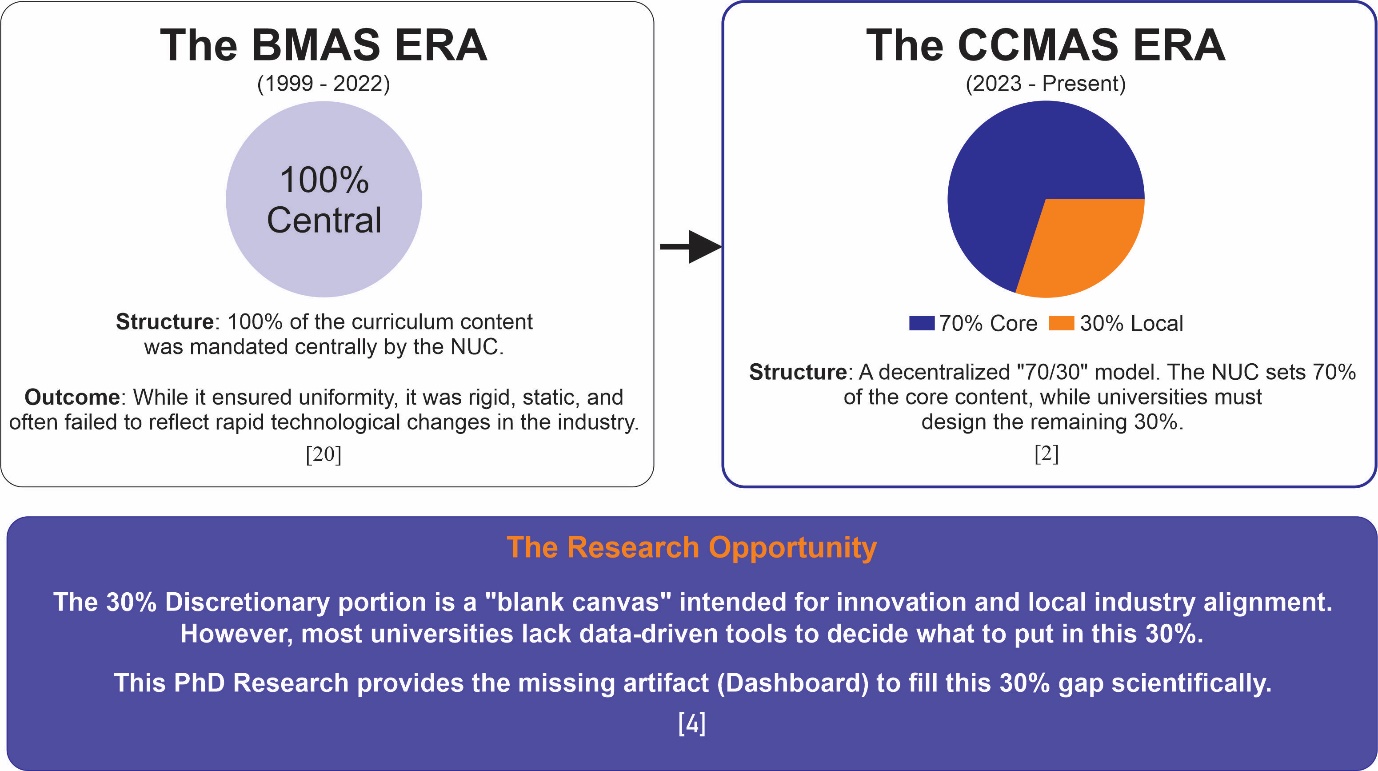
The demands of modern society have increased expectations about the quality of university graduates, especially in technology-driven disciplines. Nigerian graduates appear to be struggling to meet labour-market expectations as emerging technologies continue to evolve. Graduates of Information and Communications Technology (ICT) programmes are expected to acquire employable digital skills, yet curriculum reform has not always kept pace with industry requirements. The National Universities Commission (NUC) introduced the Core Curriculum and Minimum Academic Standards (CCMAS) 70:30 policy, which permits universities to use a 30% institutional window to introduce innovative and market-responsive content. Since the policy was unveiled in 2023, however, limited use has been made of this provision. This study found that market-validated innovation was approximately 1%, far below the 30% allowance. The researchers developed a diagnostic artifact that processes curriculum learning outcomes and industry job postings through a four-stage natural language processing (NLP) pipeline comprising compound normalisation, whitelist filtering, rule-based semantic inference, and set-intersection scoring. The artifact computes a Programme Alignment Score (PAS) for each university. The study analysed learning outcomes from 150 university handbooks and 1,500 real-time ICT job postings. The results reveal statistically measurable misalignment, with a national average PAS of 28% and a legacy burden of 69%, indicating that most technical skills required by the modern workforce are absent from Nigeria's formal ICT curricula.
References
[1] National Universities Commission (NUC), Core Curriculum and Minimum Academic Standards (CCMAS) for Nigerian Universities, NUC Press, Abuja, Nigeria, 2023. Available online: https://www.nuc.edu.ng/ccmas/.
[2] M.O. Ogunjimi, S. Lawal & I.O Ifinju ``Lecturers' commitment and perceived challenges of implementing core curriculum and minimum academic standards in Kwara State, Nigeria'', Journal of Science, Technology and Education 11 (2023) 114. Available online: https://www.researchgate.net/publication/403697845.
[3] E. Bainomugisha, K. L. Bradshaw, M. M. Ujakpa, J. Nakatumba-Nabende, L. Nderu, N. Mduma, P. Kihoza & A. Irungu, ``Computer science education in selected countries from Sub-Saharan Africa'', ACM Inroads 15 (2024) 64. https://doi.org/10.1145/3643037.
[4] N. F. Mohd Salahuddin, N. S. Mahpar & M. F. Ishak, ``The relationship between employability skill and job mismatch towards graduates' unemployment'', Information Management and Business Review 15 (2023) 96. https://doi.org/10.22610/imbr.v15i3(I).3519.
[5] P. A. Okebukola & R. A. Rufa'i (Eds.), CCMAS Fundamentals of Education (Book 1), National Universities Commission, Abuja, Nigeria, 2023. Available online: file:///C:/Users/NSPS_2/Downloads/FINAL-CCMASBook-FundamentalsofEducationBook-1-May-1-2023.pdf.
[6] World Economic Forum, The Future of Jobs Report 2023, World Economic Forum, Geneva, Switzerland, 2023. Available online: https://www.weforum.org/publications/the-future-of-jobs-report-2023/.
[7] B. Yaprak, S. Ercan, B. Coc{s}an & M. Z. Ecevit, ``Curriculum--skill gap in the AI era: assessing alignment in communication-related programs'', Journalism and Media 6 (2025) 171. https://doi.org/10.3390/journalmedia6040171.
[8] F. Ezeokafor, ``Academic accounting curriculum and industry skill demands in Nigeria: bridging the practice gap'', Journal of African Innovation and Advanced Studies 10 (2025) 55. https://doi.org/10.70382/ajaias.v10i2.051.
[9] U. N. Onwubuya, G. C. Alonta & C. M. Amobi, ``Integration of machine learning as correlate of core curriculum and minimum academic standards (CCMAS) implementation for business education in South-East, Nigeria'', Current Science Research Bulletin 2 (2025) 66. https://doi.org/10.55677/csrb/05-V02I02Y2025.
[10] A. R. Hevner, S. T. March, J. Park & S. Ram, ``Design science in information systems research'', MIS Quarterly 28 (2004) 75. https://doi.org/10.2307/25148625.
[11] O. J. Onifade, O. O. Gambo, A. T. Ogunleye & P. O. Ajayi, ``Assessing the relevance of the undergraduate computer science curriculum of Nigerian universities: insights from industry'', Educational Dimension 14 (2026) 171. https://doi.org/10.55056/ed.864.
[12] T. Tuunanen, R. Winter & J. vom Brocke, ``Dealing with complexity in design science research: a methodology using design echelons'', MIS Quarterly 48 (2024) 427. https://doi.org/10.25300/MISQ/2023/16700.
[13] R. Dazeley, A. Goriss-Hunter, G. Meredith, P. Sellings, S. Firmin, J. Burke & B. Panther, ``Agile backward design: a framework for planning higher education curriculum'', Australian Educational Researcher 52 (2025) 1489. https://doi.org/10.1007/s13384-024-00772-7.
[14] T. T. Ngat, ``Data-driven and AI-based higher education accreditation: international experiences and implications for Vietnam'', Journal of Management Research and Review 2 (2026). https://doi.org/10.65150/ep-jmrr/v2e5/2026-08.
[15] G. Ramaswami, T. Susnjak, A. Mathrani & R. Umer, ``Use of predictive analytics within learning analytics dashboards: a review of case studies'', Technology, Knowledge and Learning 28 (2023) 959. https://doi.org/10.1007/s10758-022-09613-x.
[16] J. W. Lai, L. Zhang, C. C. Sze & F. S. Lim, ``Learning analytics for bridging the skills gap: a data-driven study of undergraduate aspirations and skills awareness for career preparedness'', Education Sciences 15 (2025) 40. https://doi.org/10.3390/educsci15010040.
[17] R. Z. Markus, F. Mustapha & N. Ishak, ``How does artificial intelligence (AI) affect education in Nigeria? Implications for nursing education'', International Journal of Epidemiology and Health Sciences 7 (2026) e732737. https://doi.org/10.51757/IJEHS.7.2026.732737.
[18] L. Aja, O. S. Abonyi, J. I. Elom & F. Ikporo, ``Assessing the correspondence of the basic science curriculum across the different classes with core curriculum specifications in Ebonyi State, Nigeria'', Cogent Education 12 (2025) 2572385. https://doi.org/10.1080/2331186X.2025.2572385.
[19] S. A. Oladipo, ``Data analytics in Nigerian tertiary institution management for global competitiveness: a case study of University of Lagos, Nigeria'', The Korean Conference on Arts & Humanities 2024 Official Conference Proceedings, 2025, pp. 117--130. https://doi.org/10.22492/issn.2759-7571.2024.11.
[20] Y. Lu, L. Tong & Y. Cheng, ``Advanced knowledge tracing: incorporating process data and curricula information via an attention-based framework for accuracy and interpretability'', Journal of Educational Data Mining 16 (2024) 58. https://doi.org/10.5281/zenodo.13712553.
Published
How to Cite
Issue
Section
Copyright (c) 2026 Teddy Aitan, Ishaq Oyefolahan, Abdullahi Mohammed, Johnson Opateye (Author)

This work is licensed under a Creative Commons Attribution 4.0 International License.