Optimization of HEMA composition in polymer gel dosimeters for cost-effective radiation measurement
Keywords:
HEMA, Polymer Gel Dosimeter, Monomer Optimization, Tissue Equivalence, Radiological PropertiesAbstract
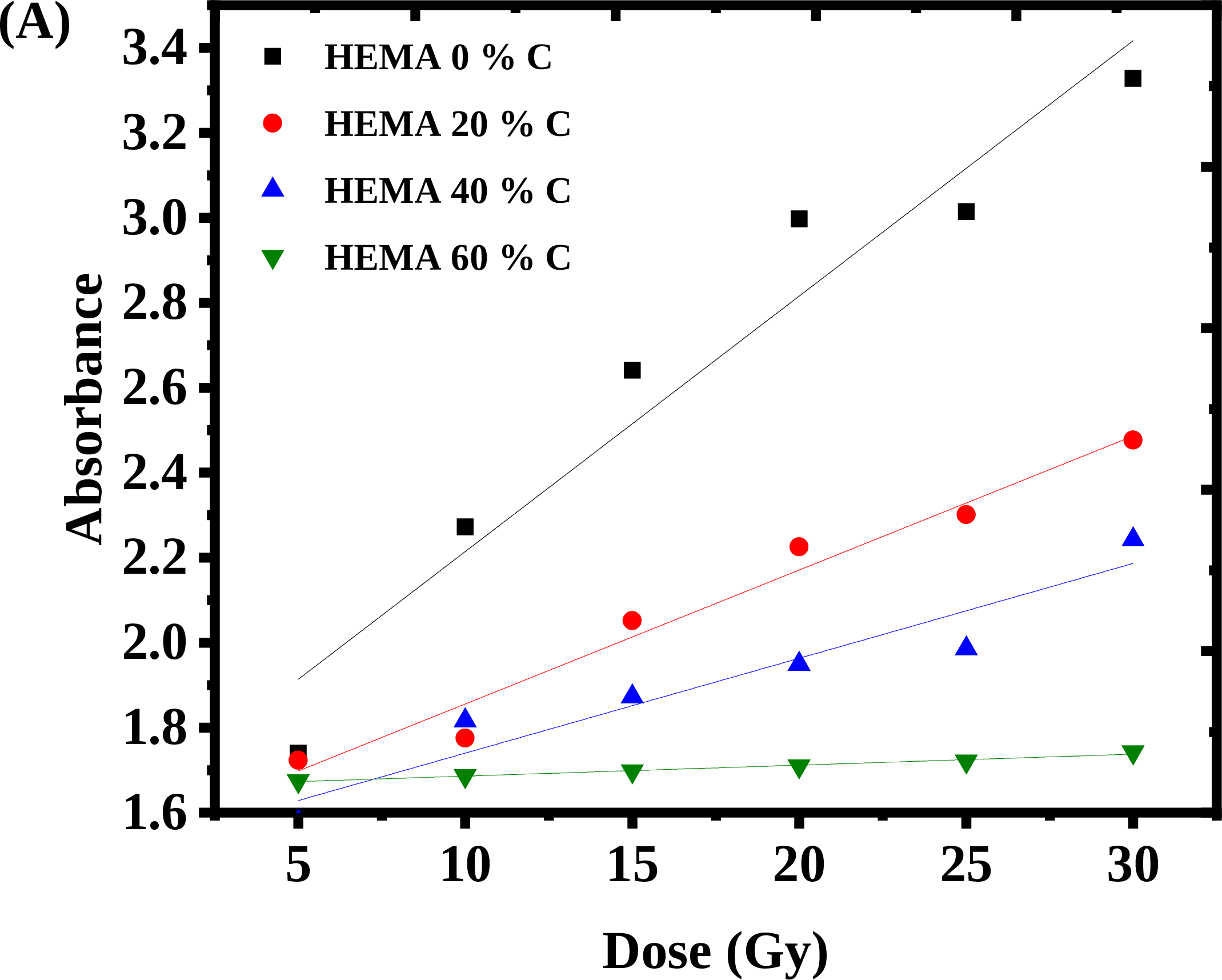
Polymer gel dosimeters (PGDs) are potential tools for radiation measurement in radiotherapy treatment planning systems (TPSs) and nuclear energy monitoring. Optimization of monomer composition is an essential aspect of PGD formulation because it helps achieve optimal dosimetric performance. In this study, 2 hydroxyethyl methacrylate (HEMA), in combination with N,N'-methylene-bis-acrylamide (Bis), was optimized to improve dose-evaluation efficiency and cost-effectiveness. The results show that the HEMA-free formulation containing 2% (w/w) Bis had the lowest sensitivity. When Bis and HEMA were both added, sensitivity increased linearly with increasing total monomer percentage (%T). However, when the weight fraction (WF) of Bis was fixed and the co monomer percentage (%C) of HEMA increased from 0 to 60%, sensitivity decreased beyond the optimal value because of exhaustion of the vinyl groups in Bis. The mass density of the HEMA--Bis PGDs (≈ 1.04 g cm−3), their electron density (ρe = 3.42 × 10²³–3.43 × 1023 cm−3), their number of electrons per unit mass (ne = 3.28 × 10²³–3.30 × 10²³ g−1), and their effective atomic number (Zeff = 7.3624–7.4176) are comparable to those of water and muscle tissue, indicating water and tissue equivalence. These findings not only yield a more efficient HEMA-based PGD but also improve cost-effectiveness, thereby increasing affordability for healthcare applications.
References
[1] A. Muhammad, A. R. Azhar, M. I. Shahrim, A. Aziz & M. Zahri, ``Impact of maltose additive on improving the radiation sensitivity of HEMA polymer gel dosimeter for radiotherapy'', Engineering Headways 15 (2025) 79. https://doi.org/10.4028/p-xU3Z3U.
[2] A. O. Oke, S. M. Iskandar, A. R. Azhar, A. Lutfi, E. Godwin, N. Seth, H. Salah, I. M. Fadhirul, A. Muhammad & O. Samuel, ``Optical investigation of novel butterfly pea flower extract (BPFE)-modified MAGAT polymer gel for 3D dosimetry and radiotherapy applications'', Radiation Physics and Chemistry 239 (2026) 113298. https://doi.org/10.1016/j.radphyschem.2025.113298.
[3] Y. De Deene & A. Jirasek, ``Gel dosimetry: an overview of dosimetry systems and readout methods'', Radiation Measurement 179 (2024) 107321. https://doi.org/10.1016/j.radmeas.2024.107321.
[4] M. D. Salman, Y. Radzi, A. A. Oglat, R. W. Kolaib, A. Saleh, A. Idris, M. Alhassan, W. Abdullah, A. Azhar & A. Rahman, ``Enhancing the acoustic properties for a novel radiation dosimetry PMMAG by optimizing the stability of copper oxide nanoparticles'', Bionanoscience 15 (2025) 278. https://doi.org/10.1007/s12668-025-01900-y.
[5] M. Alhassan, A. A. Rahman, I. S. Mustafa & K. Alhaji Bala, ``Factors influencing the thermal stability of HEMA polymer gel dosimeters for clinical radiotherapy'', Journal of the Nigerian Society of Physical Sciences 8 (2026) 3063. https://doi.org/10.46481/jnsps.2026.3063.
[6] J. J. Luci, H. M. Whitney & J. C. Gore, ``Optimization of MAGIC gel formulation for three-dimensional radiation therapy dosimetry'', Physics in Medicine and Biology 52 (2007) 241. https://doi.org/10.1088/0031-9155/52/10/N03.
[7] M. Lepage, P. M. Jayasakera & C. Baldock, ``Dose resolution optimization of polymer gel dosimeters using different monomers'', Physics in Medicine and Biology 46 (2001) 2665. https://doi.org/10.1088/0031-9155/46/10/310.
[8] Z. Alyani Nezhad & G. Geraily, ``A review study on application of gel dosimeters in low-energy radiation dosimetry'', Applied Radiation and Isotopes 179 (2022) 110015. https://doi.org/10.1016/j.apradiso.2021.110015.
[9] K. A. Rabaeh, A. A. Basfar, A. A. Almousa, S. Devic & B. Moftah, ``New normoxic N-(hydroxymethyl)acrylamide-based polymer gel for 3D dosimetry in radiation therapy'', Physica Medica 33 (2017) 121. https://doi.org/10.1016/j.ejmp.2016.12.019.
[10] Z. A. Nezhad, G. Geraily, W. Parwaie & S. Zohari, ``A novel investigation of the effect of different concentrations of methacrylic acid on the dose response of MAGAT gel dosimeter in intraoperative radiotherapy'', Radiation Physics and Chemistry 179 (2021) 109214. https://doi.org/10.1016/j.radphyschem.2020.109214.
[11] D. Adliene, K. Jakstas & N. Vaiciunaite, ``Application of optical methods for dose evaluation in normoxic polyacrylamide gels irradiated at two different geometries'', Nuclear Instruments and Methods in Physics Research Section A: Accelerators, Spectrometers, Detectors and Associated Equipment 741 (2014) 88. https://doi.org/10.1016/j.nima.2013.12.057.
[12] S. M. M. Abtahi & H. Sadeghi Abandansari, ``Polymer gel dosimeters with PVA--GA matrix'', Australasian Physical and Engineering Sciences in Medicine 40 (2017) 651. https://doi.org/10.1007/s13246-017-0573-z.
[13] C. Waldenberg, A. Karlsson Hauer, C. Gustafsson & S. Ceberg, ``Dose integration and dose rate characteristics of a NiPAM polymer gel MRI dosimeter system'', Journal of Physics: Conference Series 847 (2017) 012063. https://doi.org/10.1088/1742-6596/847/1/012063.
[14] K. A. Rabaeh, I. M. E. Hammoudeh, A. A. Oglat, M. M. Eyadeh, A. J. Abdel-Qader, F. M. Aldweri & S. I. Awad, ``Polymer gel containing N,N'-methylene-bis-acrylamide (Bis) as a single monomer for radiotherapy dosimetry'', Radiation Physics and Chemistry 187 (2021) 109522. https://doi.org/10.1016/j.radphyschem.2021.109522.
[15] Y. De Deene, ``Radiation dosimetry by use of radiosensitive hydrogels and polymers: mechanisms, state-of-the-art and perspective from 3D to 4D'', Gels 8 (2022) 599. https://doi.org/10.3390/gels8090599.
[16] P. M. Fong, D. C. Keil, M. D. Does & J. C. Gore, ``Polymer gels for magnetic resonance imaging of radiation dose distributions at normal room atmosphere'', Physics in Medicine and Biology 46 (2001) 3105. https://stacks.iop.org/PMB/46/3105.
[17] A. Hiroki, Y. Sato, N. Nagasawa, A. Ohta, H. Seito, H. Yamabayashi, T. Yamamoto, M. Taguchi, M. Tamada & T. Kojima, ``Preparation of polymer gel dosimeters based on less toxic monomers and gellan gum'', Physics in Medicine and Biology 58 (2013) 7131. https://doi.org/10.1088/0031-9155/58/20/7131.
[18] M. D. Salman, Y. Radzi & N. Ibrahim, ``Characteristics of a novel poly(methyl methacrylate-gel) dosimeter doped with copper oxide nanoparticles for radiotherapy applications'', Polymer Bulletin 82 (2025) 10031. https://doi.org/10.1007/s00289-025-05863-8.
[19] M. Alhassan, A. Abdul Rahman, I. S. Mustafa, M. A. Zahri, M. Z. Kassim, M. S. Abdullah, H. A. Ibrahim & K. Alhaji Bala, ``A novel approach to evaluating HEMA polymer gel dosimeters using molecular vibrational features'', Pertanika Journal of Science and Technology 33 (2025) 1049. https://doi.org/10.47836/pjst.33.2.23.
[20] M. Alhassan, E. Joseph & A. Z. Namadi, ``Effect of photon energy on the radiation sensitivity of HEMA polymer gel dosimeter based on near-infrared evaluation'', FUDMA Journal of Sciences 9 (2025) 323. https://fjs.fudutsinma.edu.ng/index.php/fjs/article/view/3531.
[21] A. Goosheh, S. M. M. Abtahi & S. R. Mahdavi, ``Response investigation of a new polymer gel dosimeter based on ammonium salt through MRI technique'', Applied Radiation and Isotopes 200 (2023) 110956. https://doi.org/10.1016/j.apradiso.2023.110956.
[22] M. Alhassan, Enhancement of HEMA polymer gel dosimeter with maltose additive using UV--Vis spectrometer, Ph.D. thesis, School of Physics, Universiti Sains Malaysia, Pulau Pinang, Malaysia, 2025. https://doi.org/10.4028/p-xU3Z3U.
[23] F. Bahrami, S. M. M. Abtahi, D. Sardari & M. Bakhshandeh, ``Investigation of a modified radiochromic genipin-gel dosimeter: dosimetric characteristics and radiological properties'', Journal of Radioanalytical and Nuclear Chemistry 328 (2021) 19. https://doi.org/10.1007/s10967-021-07635-w.
[24] K. B. McAuley, ``Fundamentals of polymer gel dosimeters'', Journal of Physics: Conference Series 56 (2006) 35. https://doi.org/10.1088/1742-6596/56/1/004.
[25] M. J. Maryanski, C. Audet & J. C. Gore, ``Effects of crosslinking and temperature on the dose response of a BANG polymer gel dosimeter'', Physics in Medicine and Biology 42 (1997) 303. https://doi.org/10.1088/0031-9155/42/2/004.
[26] K. B. McAuley, ``The chemistry and physics of polyacrylamide gel dosimeters: why they do and don't work'', Journal of Physics: Conference Series 3 (2004) 29. https://doi.org/10.1088/1742-6596/3/1/005.
[27] S. Lotfy, A. A. Basfar, B. Moftah & A. A. Al-Moussa, ``Comparative study of nuclear magnetic resonance and UV--visible spectroscopy dose response of polymer gel based on N-(isobutoxymethyl)acrylamide'', Nuclear Instruments and Methods in Physics Research Section B: Beam Interactions with Materials and Atoms 413 (2017) 42. https://doi.org/10.1016/j.nimb.2017.09.033.
[28] Y. De Deene, ``Essential characteristics of polymer gel dosimeters'', Journal of Physics: Conference Series 3 (2004) 34. https://doi.org/10.1088/1742-6596/3/1/006.
[29] T. Gorjiara, R. Hill, S. Bosi, Z. Kuncic & C. Baldock, ``Water equivalence of NIPAM-based polymer gel dosimeters with enhanced sensitivity for X-ray CT'', Radiation Physics and Chemistry 91 (2013) 60. https://doi.org/10.1016/j.radphyschem.2013.05.018.
[30] R. Sabbaghizadeh, R. Shamsudin, N. Deyhimihaghighi & A. Sedghi, ``Enhancement of dose response and nuclear magnetic resonance image of PAGAT polymer gel dosimeter by adding silver nanoparticles'', PLoS One 12 (2017) 0168737. https://doi.org/10.1371/journal.pone.0168737.
Published
How to Cite
Issue
Section
Copyright (c) 2026 Muhammad Alhassan, Azhar Abdul Rahman, Iskandar Shahrim Mustafa (Author)

This work is licensed under a Creative Commons Attribution 4.0 International License.