Fraud detection in Nigerian financial card transactions using a graph attention network
Keywords:
Fraud detection, Graph neural networks, Financial fraud, Graph attention network, Node classificationAbstract
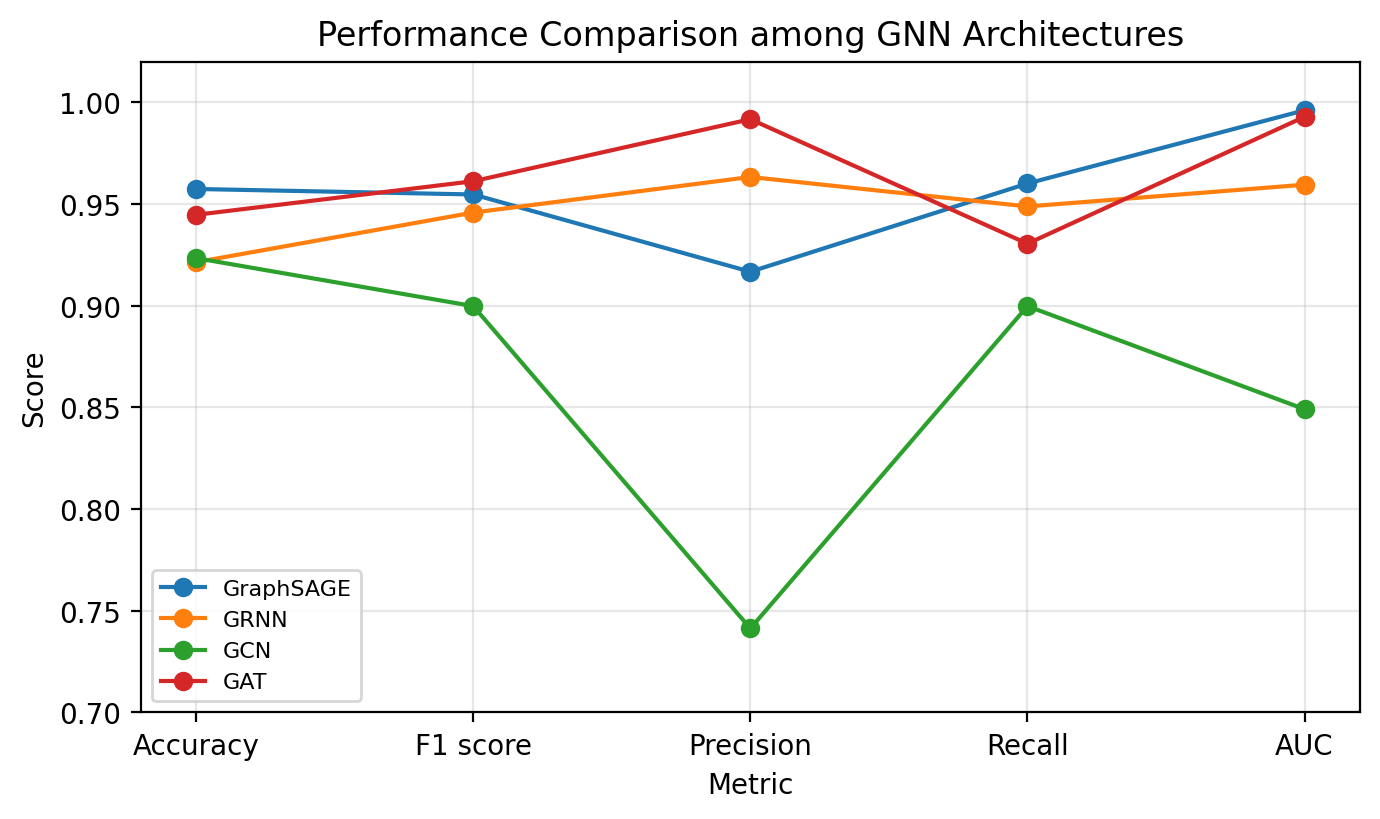
The growth of the digital payment ecosystem presents significant challenges to economic stability and consumer trust because of financial fraud. Traditional rule-based and machine-learning approaches often fail to capture the complex relational patterns present in fraudulent transaction networks. This study develops and evaluates a Graph Attention Network (GAT) model for detecting fraudulent card transactions in the Nigerian financial sector by using graph-based representations to capture relationships among entities. We constructed a heterogeneous graph representation of transaction data from a Nigerian bank, in which nodes represent cards, merchants, account holders, and transactions, while edges represent transaction relationships. A GAT architecture was implemented to learn node embeddings, and an ablation study was conducted to evaluate the contribution of graph structure by comparing the proposed GAT with a no-edge GAT and a randomized-edge GAT. The model was also benchmarked against GraphSAGE, a Gated Graph Recurrent Network (GRNN), a Graph Convolutional Network (GCN), and non-graph baselines including XGBoost, a feedforward neural network, and LightGBM. All models were evaluated on a real-world Nigerian banking dataset using stratified train--test splits, normalized numerical features, and median imputation for missing age values. The results show that graph structure substantially improves fraud detection: the proposed GAT achieved an F1-score of 0.9612, outperforming the no-edge GAT (0.2650) and the randomized-edge GAT (0.8769). Although the GAT achieved a higher F1-score than the GCN (0.9612 versus 0.8998), GraphSAGE achieved a higher AUC than the GAT (0.9961 versus 0.9929), indicating a trade-off between threshold-dependent performance and ranking performance.
References
[1] W. Hilal, S. A. Gadsden & J. Yawney, ``Financial fraud: a review of anomaly detection techniques and recent advances'', Expert Systems with Applications 193 (2022) 116429. https://doi.org/10.1016/j.eswa.2021.116429
[2] A. A. S. Alsuwailem & A. K. J. Saudagar, ``Anti-money laundering systems: a systematic literature review'', Journal of Money Laundering Control 23 (2020) 833. https://doi.org/10.1108/JMLC-02-2020-0018
[3] O. I. Odufisan, O. V. Abhulimen & E. O. Ogunti, ``Harnessing artificial intelligence and machine learning for fraud detection and prevention in Nigeria'', Journal of Economic Criminology 7 (2025) 100127. https://doi.org/10.1016/j.jeconc.2025.100127
[4] A. Kesharwani & P. Shukla, ``FFDM--GNN: A financial fraud detection model using graph neural network'', International Conference on Computing and Communication Security (ICCSC), 2024, pp. 1--6. https://doi.org/10.1109/ICCSC62048.2024.10830438
[5] C. Lou, Y. Wang, J. Li, Y. Qian & X. Li, ``Graph neural network for fraud detection via context encoding and adaptive aggregation'', Expert Systems with Applications 261 (2025) 125473. https://doi.org/10.1016/j.eswa.2024.125473
[6] D. Cheng, X. Wang, Y. Zhang & L. Zhang, ``Graph neural network for fraud detection via spatial-temporal attention'', IEEE Transactions on Knowledge and Data Engineering 34 (2022) 3800. https://doi.org/10.1109/TKDE.2020.3025588
[7] N. Jiang, F. Duan, H. Chen, W. Huang & X. Liu, ``MAFI: GNN-based multiple aggregators and feature interactions network for fraud detection over heterogeneous graph'', IEEE Transactions on Big Data 8 (2022) 905. https://doi.org/10.1109/TBDATA.2021.3132672
[8] O. Onyeama, ``Credit card fraud detection in the Nigerian financial sector: A comparison of unsupervised TensorFlow-based anomaly detection techniques, autoencoders and PCA algorithm'', arXiv (2024) arXiv:2407.08758. https://doi.org/10.48550/arXiv.2407.08758
[9] B. O. Malasowe, A. O. Adewumi & C. K. Ayo, ``Enhancing the random forest model via synthetic minority oversampling technique for credit-card fraud detection'', Journal of Computing Theories and Applications 2 (2024) 456. Available online: https://www.researchgate.net/publication/379324623_Enhancing_the_Random_Forest_Model_via_Synthetic_Minority_Oversampling_Technique_for_Credit-Card_Fraud_Detection
[10] M. Guang, Z. Li, C. Yan, Y. Xu, J. Wang, D. Cheng & C. Jiang, ``Multi-temporal partitioned graph attention networks for financial fraud detection'', IEEE Transactions on Information Forensics and Security 20 (2025) 9399. https://doi.org/10.1109/TIFS.2025.3607231
[11] L. Wei, Y. Li & J. Xu, ``Financial anti-fraud based on dual-channel graph attention network'', Journal of Theoretical and Applied Electronic Commerce Research 19 (2024) 297. https://doi.org/10.3390/jtaer19010016
[12] M. Lu, Z. Han, S. Rao, Z. Zhang, Y. Zhao, Y. Shan, R. Raghunathan, C. Zhang & J. Jiang, ``BRIGHT: Graph neural networks in real-time fraud detection'', Proceedings of the 31st ACM International Conference on Information and Knowledge Management (CIKM '22), 2022, pp. 3342--3351. https://doi.org/10.1145/3511808.3557136
[13] B. Wu, K. M. Chao & Y. Li, ``Heterogeneous graph neural networks for fraud detection and explanation in supply chain finance'', Information Systems 121 (2024) 102335. https://doi.org/10.1016/j.is.2023.102335
[14] B. Xu, H. Shen, B.-J. Sun, R. An, Q. Cao & X. Cheng, ``Towards consumer loan fraud detection: Graph neural networks with role-constrained conditional random field'', Proceedings of the AAAI Conference on Artificial Intelligence 35 (2021) 4537. https://doi.org/10.1609/aaai.v35i5.16582
[15] A. Singh, A. Gupta, H. Wadhwa, S. Asthana & A. Arora, ``Temporal debiasing using adversarial loss based GNN architecture for crypto fraud detection'', 2021 20th IEEE International Conference on Machine Learning and Applications (ICMLA), 2021, pp. 391--396. https://doi.org/10.1109/ICMLA52953.2021.00067
[16] J. Chen, T. Ma & C. Xiao, ``FastGCN: Fast learning with graph convolutional networks via importance sampling'', International Conference on Learning Representations (ICLR), Vancouver, BC, Canada, 2018, pp. 1--15. https://doi.org/10.48550/arXiv.1801.10247
[17] A. Asiri & K. Somasundaram, ``Graph convolution network for fraud detection in bitcoin transactions'', Scientific Reports 15 (2025) 11076. https://doi.org/10.1038/s41598-025-95672-w
[18] D. Wang, Y. Qi, J. Lin, P. Cui, Q. Jia, Z. Wang, Y. Fang, Q. Yu, J. Zhou & S. Yang, ``A semi-supervised graph attentive network for financial fraud detection'', Proceedings of the IEEE International Conference on Data Mining (ICDM), 2019, pp. 598--607. https://doi.org/10.1109/ICDM.2019.00070
[19] S. Li, J. Zhou, C. Mo, J. Li, G. K. F. Tso & Y. Tian, ``Motif-aware temporal GCN for fraud detection in signed cryptocurrency trust networks'', arXiv (2022) arXiv:2211.13123. https://doi.org/10.48550/arXiv.2211.13123
[20] A. Kumar & V. Kataria, ``GraphSAGE vs. fraudsters: The future of online transaction security'', International Journal of Innovative Research in Science, Engineering and Technology 13 (2024) 9422. https://doi.org.10.15680/IJIRSET.2024.1311213
[21] Z. Xiao, ``Research on financial fraud detection method based on graph neural network'', International Conference on Algorithms, Image Processing, and Deep Learning (AIPDL 2025), 2025, pp. 56--61. https://doi.org/10.1117/12.3078631
[22] Y. Wang & X. Wang, ``Real-time transaction flow analysis with graph neural networks for financial fraud detection'', Journal of Computational Methods in Sciences and Engineering (2025) 1. https://www.researchgate.net/publication/396605700_Real-time_transaction_flow_analysis_with_graph_neural_networks_for_financial_fraud_detection
[23] X. Wang, J. Guo, X. Luo & H. Yu, ``DyHDGE: Dynamic heterogeneous transaction graph embedding for safety-centric fraud detection in financial scenarios'', Journal of Safety Science and Resilience 5 (2024) 486. https://doi.org/10.1016/j.jnlssr.2024.05.005
[24] J. Zhu, Y. Yan, L. Zhao, M. Heimann, L. Akoglu & D. Koutra, ``Beyond homophily in graph neural networks: Current limitations and effective designs'', Proceedings of Advances in Neural Information Processing Systems (NeurIPS), vol. 33, 2020, pp. 7793--7804. https://doi.org/10.48550/arXiv.2006.11468
Published
How to Cite
Issue
Section
Copyright (c) 2026 Oladayo Tosin Akinwande, Sulaimon Adebayo Bashir, Opeyemi Aderiike Abisoye, Solomon Adelowo Adepoju (Author)

This work is licensed under a Creative Commons Attribution 4.0 International License.