Assessment of heavy metals and natural radionuclides in locally produced soaps used in Benue State, Nigeria: implications for human health risk
Keywords:
Exposure, Health risk, Heavy metals, Locally produced soap, Natural radioactivityAbstract
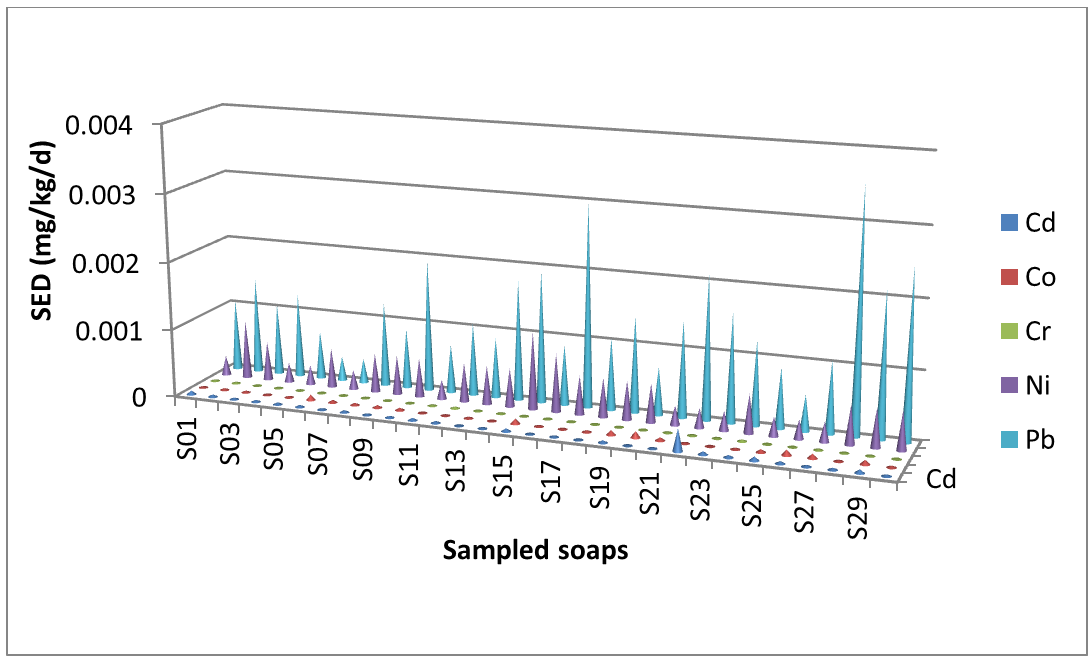
Human exposure to ionizing radiation and toxic metals remains a major concern for physicists, chemists, environmentalists, and the public. In this study, heavy metals (HMs: Ni, Pb, Co, Cr, and Cd) and natural radionuclides (NRs: 238U, 232Th, and 40K) were analyzed in thirty locally produced soaps used in Benue State, Nigeria. The HMs were determined using Atomic Absorption Spectrophotometry (AAS), while NRs were measured using a NaI(Tl) detector. The concentration ranges of Ni, Pb, Co, Cr, and Cd were 0.100--0.400, 0.124--1.235, 0.003--0.034, 0.001--0.010, and 0.0037--0.115 ppm, respectively. These values were below the recommended safe limits set by the WHO and the U.S. FDA, indicating no immediate health risk except under prolonged exposure that could lead to HM accumulation. The results further showed that only three of the thirty surveyed soaps posed a severe radiological health concern because of elevated NR concentrations. The margin of safety, systemic exposure dose, and carcinogenic-risk estimates at 50% and 100% bio-accessibility indicated a higher health risk for children than for adults. Overall, the findings support safer production and use of locally produced soaps in Benue State and may encourage the growth of micro, small, and medium enterprises (MSMEs).
References
[1] C. J. Mgbemere & C. P. Ononugbo, ``Assessment of Radionuclides in some fruits from Niger Delta and it Risks'', Asian Journal of Research and Reviews in Physics, 5 (2021) 2584-5992. https://doi.org/10.9734/ajr2p/2021/v5i330167.
[2] K. G. Sharma, J. Gadiya, & M. Dhanawat, ``Textbook on cosmetic formulation'', Kbuuk publications, Houston and Pothi.com, India, 2016, pp 59 -- 90.
[3] Z. Hani, S. Hashim, H. Hassan, N. N. Yusof & D. A. Bradley, ``Radioactive material in cosmetic and healthcare products: Regulatory controls. Radiation Physics and Chemistry 188 (2021) 109673. https://doi.org/10.1016/j.radphyschem.2021.109673.
[4] O. Idoko, S. Emmanuel, A. Salau & P. Obigwa, ``Quality assessment on some soaps sold in Nigeria''. Nigerian Journal of Technology 37 (2018) 1137 -- 1140. https://doi.org/10.4314/njt.v37i4.37
[5] A. Koray, G. Akkaya, A. Kahraman, G. Kaynak & R. Baldik, ``The Investigation of Radionuclide concentration in soil and Lifetime Cancer Risk Due to Gamma Radioactivity in Zonguldak, Turkey''. Acta Physica Polonica 2017 (2016) 3 - 11. https://doi.org/10.12693/APhysPolA.132.1122.
[6] N. N. Jibirili & C. B.Eke, ``Radionuclide Content in Yam Samples and Health Risks Assessment in Oguta Oil Producing Locality Imo State Nigeria". International Journal of Physics Research and Applications 4 (2021) 006 -- 014. https://doi.org/10.29328/journal.ijpra.1001034.
[7] J. A. Egwumah, I. S. Eneji, R. A. Wuana, & A. U. Itodo, ``Determination of heavy metals levels in Palm Oil obtained from Ankpa, Alamaboro and Dekina Local Government Areas of Kogi State, Nigeria''. FUAM Journal of Pure and Applied Science, 3 (2023) 55 -- 60. https://www.fuamjpas.org.ng/articledetail.php?id=aj0smfoa1fgu22ap
[8] M. O. Audu, T. Sombo, M. J. Ogabo, I. O. Agada & C. C. Akoso, ``Natural Radionuclide Distribution in Surface Soil and Water within Doma LGA, Nasarawa State-North Central Nigeria''. Asian Basic and Applied Research Journal 7 (2025) 337 - 349. https://doi.org/10.56557/abaarj/2025/v7i1178.
[9] O. E. Orisakwe & J. O. Otaraku, ``Metal concentrations in cosmetics commonly used in Nigeria'', The Scientific World Journal 2013 (2013) 95963. http://dx.doi.org/10.1155/2013/959637.
[10] P. Dinake, O. Motswetla, T. T. Kereeditse & R. Kelebemang, ``Assessment of level of heavy metals in Cosmetics'', Toxicology Research and Application 7 (2023) 1 -- 8. http://dx.doi.org/10.1177/23978473231156620.
[11] O. Gyamfi, J. Aboko, E. Ankapong, J. T. Marfo, N. Y. Awuah-Boateng, K. Sarpong, & E. Dartey, ``A systematic review of heavy metals contamination in cosmetics'', Cutaneous and Ocular Toxicology 43 (2024) 5--12. https://doi.org/10.1080/15569527.2023.2268197.
[12] M. F. Alam, M. Akhter, B. Mazumder, A. Ferdous, M. D. Hossain, N. C. Dafader, F. T. Ahmed, S. K. Kundu, T. Taheri & A. K. M. Atique Ullah, ``Assessment of some heavy metals in selected cosmetics commonly used in Bangladesh and human health risk''. Journal of Analytical Science & Technology 10 (2019) 1 -- 8. https://dx.doi.org/10.1186/s40543-018-0162-0.
[13] M. O. Audu, J. N. Tsaviv, I. O. Agada, A. P. Achu & I. S. Eneji, ``Health risk assessment of heavy metals and radiation exposure in locally produced cosmetic powders used in Benue State, Nigeria''. Communication in Physical Sciences 12 (2025) 1929 -1948. https://journalcps.com/index.php/volumes/article/view/680.
[14] F. O. Abulude, M. O. Ogunkoya, R. F. Ogunleye, O Emidun & A. I. Abulude, ``Assessment of the content of Pb, Cd, Ni and Cr in soaps and detergents from Akure, Nigeria''. Research Journal of Environmental Toxicology 1 (2007) 102 -- 104. https://dx.doi.org/10.3923/rjet.2007.102.104.
[15] S. R. N. Endah & S. I. Surantaatmadja, ``The Determination of Heavy Metals Level: Lead in Cosmetic Soap Preparation by Atomic Absorption Spectrophotometer (AAS)''. IOP Conference Series: Journal of Physics 1179 (2019) 012178. https://iopscience.iop.org/article/10.1088/1742-6596/1179/1/012178
[16] A. Sani, M. B. Gaya & F. A. Abubakar, Determination of some heavy metals in selected cosmetic products sold in Kano Metropolis, Nigeria. Toxicology Reports 3 (2016) 866 -- 869. https://doi.org/10.1016/j.toxrep.2016.11.001.
[17] C. M. A. Iwegbue, O. S. Emakunu, B. Lari, E. Francis, F. E. Egobueze, G. O. Tesi, G. E. Nwajei & B. S. Martincigh, ``Risk of human exposure to metals in some household hygienic products in Nigeria''. Toxicology Reports 6 (2019) 914 -- 923. https://doi.org/10.1016/j.toxrep.2019.08.014.
[18] A. H. Ojelabi, M. I. Lateef & B. H. Lawal, ``Determination and comparative analyses of radionuclide concentration levels of some imported and local bathing soaps used in Nigeria''. International Journal of Research 5 (2018) 1012 -- 1023. https://journals.pen2print.org/index.php/ijr/article/view/16857/0
[19] K. S. Almugren, S. F. Abdul Sani, M. K. M. Azim, N. N. Ismail, M. U. Khandaker, S. J. Alsufyani, F. H. Alkallas, H. F. Almajid, D. A. Bradley & K. A. Naseer, ``The presence of NORMs and toxic heavy metals in talcum baby powder''. Journal of Radiation Research and Applied Sciences, 16 (2023) 100660. https://doi.org/10.1016/j.jrras.2023.100660.
[20] H. Arshad, Z. M. Mehmooda, M. H. Shahb & A. M. Abbasi, ``Evaluation of heavy metals in cosmetic products and their health risk assessment''. Saudi Pharmaceutical Journal, 28 (2020) 779 --790. https://doi.org/10.1016/j.jsps.2020.05.006.
[21] G. O. Avwiri, C. P. Ononugbo & I. E. Nwokeoji, ``Radiation hazard indices and excess lifetime cancer risk in soil, sediment and water around Mini-Okoro/Oginigba Creek, Port Harcourt, Rivers State, Nigeria''. Comprehensive Journal of Environment and Earth Sciences 3 (2014) 38-50. https://journals.sagepub.com/doi/10.1177/11786302231224581
[22] S. A. Onjefu, A. N. I. Kauluma, M. Zivuku, E. Ejembi, R. H. Hamunyela & B. M. Tyobeka, ``Assessment of radioactivity levels in shore sediments along the coastline of the Orange River, Oranjemund, Namibia''. Heliyon, 8 (2022): e10579. https://doi.org/10.1016/j.heliyon.2022.e10579.
[23] E. O. Echeweozoa, C. I. Nworiea, A. O. Ojobeagua, P. B. Otaha & I. J. Okoro, ``Health risk assessment due to environmental radioactivity and heavy metal contamination at the central solid waste dumpsite in Ebonyi State, Nigeria''. Journal of the Nigerian Society of Physical Sciences 7 (2025) 2160. http://dx.doi.org/10.46481/jnsps.2025.2160.
[24] A. I. Olanrewaju & G. O. Avwiri, ``Quantification of Activity Concentrations and Radiation Hazard Indices in the Solid Minerals Exploration Fields of Benue State, Nigeria with Multivariate Statistical Approach''. Advances in Research 10 (2017) 1 - 13. http://dx.doi.org/10.9734/AIR/2017/33432.
[25] Scientific Committee on Consumer Safety (SCCS), (2012). The scientific Committee on Consumer Safety (SCCS), The SCCS's Notes of Guidance for Testing of Cosmetic Substances and Their Safety Evaluation (SCCS/1501/12), 8th Ed. (Scientific Committee on Consumer Safety, European Union, Belgium, 2012). The SCCS adopted this opinion at the 17th plenary meeting of 11 December, 2012. https://health.ec.europa.eu/publications/sccs-notes-guidance-testing-cosmetic- ingredients-and-their-safety-evaluation-12th-revision_en
[26] M. T. Bello-Hassan, T. A. Samuel & P. O. Emmanuel, ``Health Risk Assessment of Heavy and Trace Metals in Personal Care Products in Nigeria''. International Journal of Biochemistry Bioinformatics and Biotechnology Studies 9 (2024) 22 -- 32. https://doi.org/10.37745/ijbbbs.15/vol9n12232.
[27] N. M. Mgbemena, I. Ilechukwu, O. U. Akoh & A. C. Adinnu, ``Risk assessment of heavy metals in some commonly used cosmetics in Rivers State Nigeria. Journal of Chemical Society of Nigeria 49 (2024) 508 -- 510. https://doi.org/10.46602/jcsn.v49i3.986.
[28] J. A. O. Oyekunle, O. T. Ore, O. H. Ogunjumelo & M. S. Akanni, ``Comparative chemical analysis of indigenous Nigeria soaps with conventional ones''. Heliyon 7 (2021) e06689. https://doi.org/10.1016/j.heliyon.2021.e06689.
[29] M. E. Medhat, V. P. Singh & S. P. Shirmardi, ``Determination of Lead and radioactivity in cosmetic products: hazard assessment''. Nuclear Technology and Radiation Protection 30 (2015) 219 - 224. https://doi.org/10.2298/NTRP1503219M.
[30] J. M. Manu, S. Norah, F. Vincent & S. Francis, ``Levels of Cd, Cr, Cu, Ni, Zn, As and Pb in Some Cosmetic Products in Jimeta -- Yola Modern Market, Adamawa State, Nigeria''. Journal of Applied Sciences and Environmental Management 27 (2023) 1739 - 1743. https://dx.doi.org/10.4314/jasem.v27i8.18.
Published
How to Cite
Issue
Section
Copyright (c) 2026 Moses Owoicho Audu, Inikpi Ojochenemi Agada, Julius Nyiayem Tsaviv, Aondohemba Paschal Achu, Ishaq Shaibu Eneji (Author)

This work is licensed under a Creative Commons Attribution 4.0 International License.