Multisectoral data lakehouse for climate-resilient agriculture and sustainable food securityin Nigeria
Keywords:
Precision Agriculture (PA), Data lakehouse, Energy resource distribution, Ontology-driven data integration, Semantic machine learningAbstract
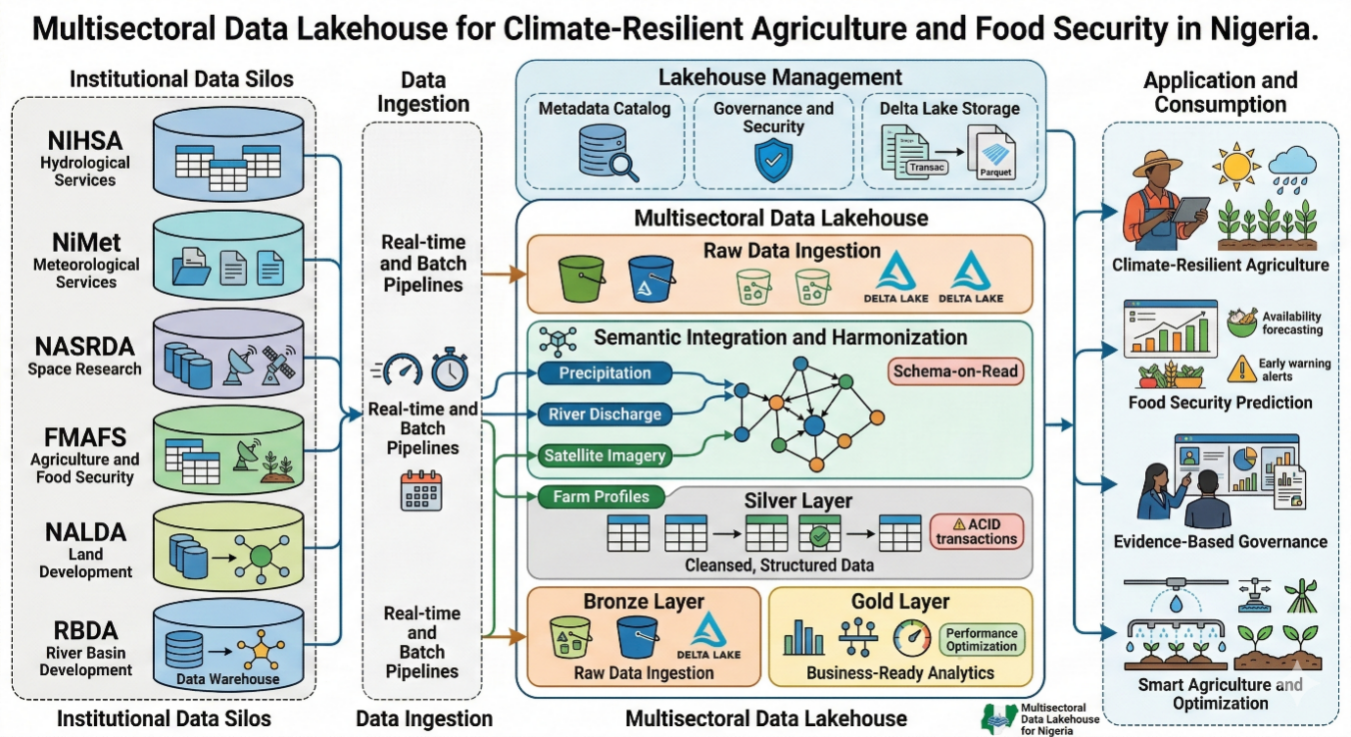
Nigeria, the most populous country in sub-Saharan Africa, faces multifaceted, overlapping problems of economic instability, security concerns, and an acute energy deficit, further aggravated by the ever-increasing impacts of climate change on its agricultural systems, a primary source of livelihood for millions. These hydra-headed challenges require a scientific, data-driven, informed response. The paper examines how principles from the physical sciences, particularly in data management, modelling, analytics, and systems integration, can be applied to promote efficient energy resource distribution for climate-resilient agriculture (CRA), thereby boosting the economy and ensuring long-term food security. A mixed-methods approach, combining literature reviews, AI tools, case studies of climate adaptation projects, ontology-driven data harmonisation, and stakeholder consultations, was used in the research. Findings revealed that an integrated National Climate–Water-Agriculture Data Lakehouse can significantly enhance climate-resilient agriculture and energy resource sharing, thereby improving the economy and food security. The hybrid Semantic Machine learning Framework provide accurate food security analytics and predictions. The initiative becomes a scientific laboratory and a decision-support ecosystem, transforming siloed databases into actionable insights that policymakers, researchers, and practitioners can use to enhance the economy. The paper concludes that a multisectoral ontology-driven National Climate-Water-Agriculture Data Lakehouse transforms physical science data into practical tools for climate-resilient agriculture by connecting laboratories to farmlands and datasets to decision-making, thereby enabling evidence-based agricultural governance and smart-agriculture to increase food production and boost the economies of the major and small-holding farmers in the face of emerging climatic chaos compounded by security concerns.
References
[1] Fao, “The state of food security and nutrition in the world 2022”, Food and Agriculture Organisation of the United Nations (2022). https://doi.org/10.4060/cc0639en.
[2] Nhsjs, “From data to action: using machine learning to combat food insecurity”, National High School Journal of Science (2025). https://nhsjs.com/2025/from-data-to-action-using-machine-learning-to-combat-food-insecurity/.
[3] F. O. Oderinde, O. I. Akano, F. A. Adesina & A. O. Omotayo, “Trends in climate, socioeconomic indices and food security in Nigeria”, Frontiers in Sustainable Food Systems 6 (2022). https://doi.org/10.3389/fsufs.2022.940858.
[4] J. Francis, “Why 85% of your AI models may fail”, Forbes.com (2024). https://www.forbes.com/councils/forbestechcouncil/2024/11/15/why-85-of-your-ai-models-may-fail/.
[5] Nigerian Meteorological Agency (NIMET), “2025 seasonal climate prediction (SCP)” (2025). https://nimet.gov.ng/publication_detail?id=42.
[6] Nasrda, “National space research and development agency”. https://central.nasrda.gov.ng/nasrda-set-to-revolutionize-agriculture-with-satellite-technology/.
[7] M. Armbrust, A. Ghodsi, R. Xin & M. Zaharia, “Lakehouse: a new generation of open platforms that unify data warehousing and advanced analytics”, Proceedings of CIDR 2021 (2021). https://www.cidrdb.org/cidr2021/papers/cidr2021_paper17.pdf.
[8] K. R. Arsenault et al., “The NASA hydrological forecast system for food and water security applications”, Bull. Am. Meteorol. Soc. 101 (2020) E1007. https://doi.org/10.1175/BAMS-D-18-0264.1.
[9] S. B. Dhal & D. Kar, “Transforming agricultural productivity with AI-driven forecasting: innovations in food security and supply chain optimization”, Forecasting 6 (2024) 925. https://doi.org/10.3390/forecast6040046.
[10] N. Naidoo, S. Lawton, M. Ramnanan, J. V. Fonou-Dombeu & R. Gowda, “Modelling climate-smart agriculture with ontology”, International Conference on Artificial Intelligence, Big Data, Computing and Data Communication Systems (icABCD) (2021). https://doi.org/10.1109/icABCD51485.2021.9519380.
[11] S. Jiang, R. Angarita, R. Chiky, S. Cormier & F. Rousseaux, “Towards the integration of agricultural data from heterogeneous sources: perspectives for the French agricultural context using semantic technologies”, Lect. Notes Bus. Inf. Process. 382 (2020) 89. https://doi.org/10.1007/978-3-030-49165-9_8.
[12] S. Schmid, C. Henson & T. Tran, “Using knowledge graphs to search an enterprise data lake” (2019) 262. https://link.springer.com/chapter/10.1007/978-3-030-32327-1_46.
[13] R. Pratap Deb Nath, T. Rani Das, T. Chandro Das & S. M. Shafkat Raihan, “Knowledge graph generation and enabling multidimensional analytics on bangladesh agricultural data”, IEEE Access 12 (2024) 87512. https://doi.org/10.1109/ACCESS.2024.3416388.
[14] R. A. Neves & P. E. Cruvinel, “Ontology for structuring a digital databases for decision making in grain production”, in 2021 IEEE 15th International Conference on Semantic Computing (ICSC), IEEE (2021) 386. https://doi.org/10.1109/ICSC50631.2021.00071.
[15] Y. Pan et al., “Transforming agriculture with intelligent data management and insights”, in 2023 IEEE International Conference on Big Data (BigData), IEEE (2023) 3489. https://doi.org/10.1109/BigData59044.2023.10386589.
[16] M. San Emeterio de la Parte, J.-F. Martı́nez-Ortega, P. Castillejo & N. Lucas-Martı́nez, “Spatio-temporal semantic data management systems for IoT in agriculture 5.0: challenges and future directions”, Internet of Things 25 (2024) 101030. https://doi.org/10.1016/j.iot.2023.101030.
[17] N. N. Ubachukwu, T. N. Nzelibe, I. U. Nzelibe & O. O. John, “Climate change adaptive strategies for enhancing food security in Biu-Nigeria”, 8 (2025) 2657. https://doi.org/10.48346/IMIST.PRSM/ajlp-gs.v8i10.59550.
[18] C. O. Egbunu, M. T. Ogedengbe, T. S. Yange, M. A. Rufai & H. I. Muhammed, “Towards food security: the prediction of climatic factors in Nigeria using random forest approach”, Journal of Computer Science and Information Technology 7 (2021) 70. https://doi.org/10.35134/jcsitech.v7i4.15.
[19] M. Guillen-Aguinaga, E. Aguinaga-Ontoso, L. Guillen-Aguinaga, F. Guillen-Grima & I. Aguinaga-Ontoso, “Data quality in the age of AI: a review of governance, ethics, and the FAIR principles”, Group 2882 (2025) 930X. https://doi.org/10.3390/data10120201.
[20] N. Davidson, “The cost of poor data quality on business operations” (2026). https://lakefs.io/blog/poor-data-quality-business-costs.
[21] A. O. Kehinde, M. A. Onafowokan & O. O. Onalaja, “Leveraging machine learning techniques for the prediction and enhancement of food safety standards in Nigeria”, FUDMA Journal of Sciences 9 (2025) 130. https://doi.org/10.33003/fjs-2025-0904-3562.
[22] M. F. E. Anupam & S. A. Mustafa, “Integrated data governance and predictive analytics for enhancing public service management in bangladesh: a framework for evidence-based decision-making”, Bangladesh Journal of Administration and Management 38 (2025) 1. https://doi.org/10.56379/bjam.V38i1.100.
[23] A. A. Harby & F. Zulkernine, “From data warehouse to lakehouse: a comparative study”, 2022 IEEE International Conference on Big Data (Big Data) (2022) 389. https://doi.org/10.1109/BigData55660.2022.10020719.
[24] A. A. Effiong, B. E. Okon & I. J. Udo, “Smart irrigation in Nigeria: a panacea for curbing hunger and food insecurity”, Asian Journal of Advanced Research and Reports 19 (2025) 53. https://doi.org/10.9734/ajarr/2025/v19i61041.
[25] M. Horvat, A. Krtali?, A. Akagi? & I. Mekterovi?, “Ontology-based data observatory for formal knowledge representation of UXO using advanced semantic web technologies”, Electronics 13 (2024) 814. https://doi.org/10.3390/electronics13050814.
Published
How to Cite
Issue
Section
Copyright (c) 2026 Adam Omeiza Yusuf, Taiwo Kolajo, Emeka Ogbuju, Francisca Oladipo (Author)

This work is licensed under a Creative Commons Attribution 4.0 International License.