Assessment of solar radiation variability and its impact on estimated photovoltaic electricity output over Kano, Nigeria
Keywords:
Solar radiation, Variability, Photovoltaic energy, Kano, Empirical modelsAbstract
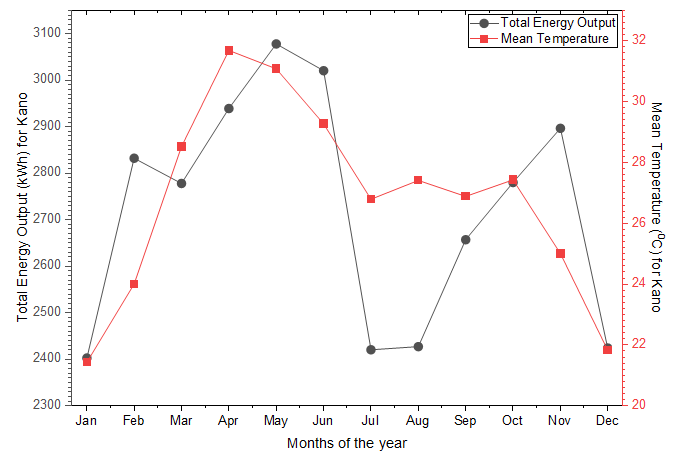
This study assessed the variability of solar radiation and its impact on photovoltaic (PV) energy generation in Kano, a Sahelian city in Nigeria located at latitude 12.05oN and longitude 8.20oE. Thirty-one years (1990-2020) of meteorological data obtained from the Nigerian Meteorological Agency (NiMet) were used. Monthly, seasonal, and annual variations in global solar radiation (GSR), sunshine duration, and mean temperature were analysed to evaluate their influence on solar-energy output. The average annual GSR was 17.86 MJ m-2 day-1, the mean sunshine duration was 7.55 h day-1, and the mean annual temperature was 26.78oC. Using a 21.9%-efficient monocrystalline panel with an area of 2.58 m2, the estimated mean monthly energy output was 2721.44 kWh, with peak generation occurring during the rainy season. Correlation analysis showed a strong positive relationship between GSR and energy output. Among the empirical models tested, Garcia's temperature-based model performed best, with R2 = 92.2%. The findings confirm that solar-radiation variability significantly influences PV generation and that temperature-based models provide superior estimation accuracy in Sahelian climates, supporting large-scale solar deployment in northern Nigeria.
References
[1] K. S. Reddy, T. K. Mallick & D. Chemisana, ``Solar power generation'', International Journal of Photoenergy 2013 (2013) 950564. https://doi.org/10.1155/2013/950564.
[2] S. Mehdizadeh, J. Behmanesh & K. Khalili, ``Comparison of artificial intelligence methods and empirical equations to estimate daily solar radiation'', Journal of Atmospheric and Solar-Terrestrial Physics 146 (2016) 215. https://doi.org/10.1016/j.jastp.2016.06.006.
[3] O. V. Oluchi, D. L. Kelechi, E. V. Chukwuemeka, O. C. Auselm & E. K. Opara, ``Exploring the ideal photovoltaic PV tilt angle across the six geo-political zones in Nigeria'', Journal of Electrical and Electronic Engineering 2 (2024) 25. https://doi.org/10.48001/joeeed.2024.2225-.
[4] A. Mamman, J. Abdullahi & A. A. Abdulhamid, ``Assessment of solar radiation models and measurement techniques for Nasarawa State'', International Journal of African Development and Sustainable Research 6 (2024) 255. https://nightingalepublications.com/index.php/nijadsr/article/view/214/226.
[5] M. Bashahu & G. Ndacayisaba, ``Estimation of daily global solar radiation with different sunshine-based models for some Burundian station'', Energy and Power Engineering 16 (2024) 161001. https://doi.org/10.4236/epe.2024.161001.
[6] D. B. Ampratwum & A. S. S. Dorvlo, ``Estimation of solar radiation from the number of sunshine hour'', Applied Energy 63 (1999) 161. https://doi.org/10.1016/S0306-2619(99)00025-2.
[7] D. O. Akpootu, B. I. Tijjani & U. M. Gana, ``Sunshine and temperature dependent models for estimating global solar radiation across the Guinea Savannah climate zone of Nigeria'', American Journal of Physics and Applications 7 (2019) 125. https://doi.org/10.11648/j.ajpa.20190705.15.
[8] R. Chen, K. Ersi, J. Yang, S. Lu & W. Zhao, ``Validation of five global solar radiation models with measured daily data in China'', Energy Conversion and Management 45 (2004) 1759. https://doi.org/10.1016/j.enconman.2003.09.019.
[9] C. Maduabuchi & M. Eke, ``Solar electricity generation using a photovoltaic thermoelectric system operating in Nigeria climate'', IOP Conference Series: Earth and Environmental Science 730 (2021) 012029. https://doi.org/10.1088/1755-1315/730/1/012029.
[10] A. A. Garba, R. O. Amusat & Y. H. Ngadda, ``Estimation of global solar radiation using sunshine-based model in Maiduguri, North East, Nigeria'', Applied Research Journal 2 (2016).
[11] A. Gagne, D. Turcotte, N. Goswamy & Y. Poissant, ``High resolution characterization of solar variability for two sites in Eastern Canada'', Solar Energy 137 (2016) 46. https://doi.org/10.1016/j.solener.2016.07.042.
[12] D. Palmer, E. Koubli, I. Cole, T. Betts & R. Gottschalg, ``Comparison of solar radiation and PV generation variability: system dispersion in the UK'', IET Renewable Power Generation 11 (2017) 550. https://doi.org/10.1049/iet-rpg.2016.0768.
Published
How to Cite
Issue
Section
Copyright (c) 2026 Abba Babagana, Davidson Odafe Akpootu, Muhammad Bello Abdullahi, Ahmad Isa Tambuwal (Author)

This work is licensed under a Creative Commons Attribution 4.0 International License.