Healthcare delivery in Bayelsa State through health systems modeling
Keywords:
Health systems modeling, Healthcare delivery, Outpatient satisfaction, Multiple linear regressionAbstract
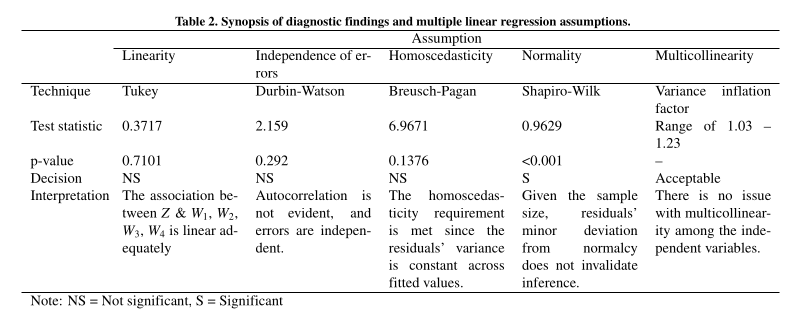
In Nigeria, improving healthcare delivery of course is still exceedingly difficult, in areas with resource-constrained settings like Bayelsa State especially. Indeed, in order to ascertain the factors affecting satisfaction of outpatients as a stand-in for healthcare delivery effectiveness, this research employed a health systems modeling technique. A structured questionnaire was used to gather data from 200 outpatients at Federal Medical Centre, Yenagoa. Multiple regression analysis was then used to evaluate the impact of waiting times, travel times, education levels, and healthcare system capacity and access on patient satisfaction. The statistical techniques: Tukey, Durbin-Watson, Breusch-Pagan, Shapiro-Wilk and Variance Inflation Factors were respectively employed to assess linearity, independence of errors, homoscedasticity, normality and multicollinearity. The robustness of the model was achieved by the diagnostic results, which reveal that the main assumptions were mostly achieved, justifying the reliability of the model. The results from the regression model explain about 42.3% of the variation in outpatient satisfaction and are significant statistically. The biggest positive predictor variable of satisfaction was capacity and access, emphasizing the significance of sufficient staffing, infrastructure, drug availability, and pricing. Service delays were determined as a major constraint in the delivery of healthcare, and waiting times were found to have a considerable negative impact on satisfaction. Travel time revealed a weaker negative influence, whereas level of education significantly did not affect satisfaction once factors of system-level were considered. To maximize healthcare delivery and raise patient satisfaction in Bayelsa State, waiting times must be decreased and the healthcare system's capacity must be strengthened.
References
[1] B. S. Aregbeshola & S. M. Khan, “Fifty years of primary health care in the rainforest: temporal trends in morbidity and mortality in indigenous amerindian populations of suriname”, Journal of Global Health 8 (2018) 020403. https://doi.org/10.7189/jogh.08.020403.
[2] S. Ilinca, L. Di Giorgio, P. Salari & J. Chuma, “Socio-economic inequality and inequity in use of health care services in kenya: evidence from the fourth kenya household health expenditure and utilization survey”, International Journal for Equity in Health 18 (2019) 12939. https://doi.org/10.1186/s12939-019-1106-z.
[3] D. Ogoina, C. Kaduru, J. Stow, E. Okoyen & P. N. Igwele, “The bayelsa health summit: strategizing for health at a subnational level in nigeria”, Transactions of the Royal Society of Tropical Medicine and Hygiene 116 (2022) 1093. https://doi.org/10.1093/trstmh/trac042.
[4] M. A. Morid, O. R. L. Sheng & J. Dunbar, “Time series prediction using deep learning methods in healthcare”, ACM Transactions on Management Information Systems 14 (2023) 3531326. https://doi.org/10.1145/3531326.
[5] Z. Zhang, Y. Zhao, A. Canes, D. Steinberg & O. Lyashevska, “Predictive analytics with gradient boosting in clinical medicine”, Annals of Translational Medicine 7 (2019) 21037. https://doi.org/10.21037/atm.2019.03.29.
[6] A. B. Bamana, M. S. Kamalabad & D. L. Oberski, “A systematic literature review of time series methods applied to epidemic prediction”, Informatics in Medicine Unlocked 50 (2024) 101571. https://doi.org/10.1016/j.imu.2024.101571.
[7] T. M. Abuhay, “Applications and challenges of simulation for healthcare operations management in africa: a systematic review”, Simulation & Gaming 76 (2025) 2406243. https://doi.org/10.1080/01605682.2024.2406243.
[8] A. E. Ladele, J. O. Ogunkoya, O. A. Opadotun, S. C. Ezeugo, O. O. Olaseinde & V. T. Olubusuyi, “Assessment of patients’ satisfaction of care and associated factors among outpatients at a private tertiary clinic in ogun state, nigeria”, Journal of Medical Science and Clinical Research 10 (2022) 18535. https://dx.doi.org/10.18535/jmscr/v10i9.09.
[9] S. Xesfingi & A. Vozikis, “Patient satisfaction with the healthcare system: assessing the impact of socio-economic and healthcare provision factors”, BMC Health Services Research 16 (2016) 1186. https://doi.org/10.1186/s12913-016-1327-4.
[10] N. M. Radwan, A. N. Alkattan, A. M. Haji & K. I. Alabdulkareem, “Evaluation of levels and determinants of patient satisfaction with primary health care services in saudi arabia: a systematic review and meta-analysis”, Sulaiman Al Habib Medical Journal 5 (2023) 1007. https://doi.org/10.1007/s44229-023-00039-w.
[11] T. Sukmawati, Ramadania & W. Pebrianti, “Enhancing patient satisfaction by healthcare service providers: a systematic literature review”, Asian Journal of Economics, Business and Accounting 24 (2024) 121613. https://doi.org/10.9734/ajeba/2024/v24i121613.
Published
How to Cite
Issue
Section
Copyright (c) 2026 Jude Opara, Uche Celestine Agwi, Chidimma Udo Osuagwu (Author)

This work is licensed under a Creative Commons Attribution 4.0 International License.