Tetrahydrofuran-based recycling of furan–lignin foams: comparative characterization of regenerated and virgin foams
Keywords:
Foam recyclability, Furan–lignin foam, Recycled polyol, Solvent-assisted dissolutionAbstract
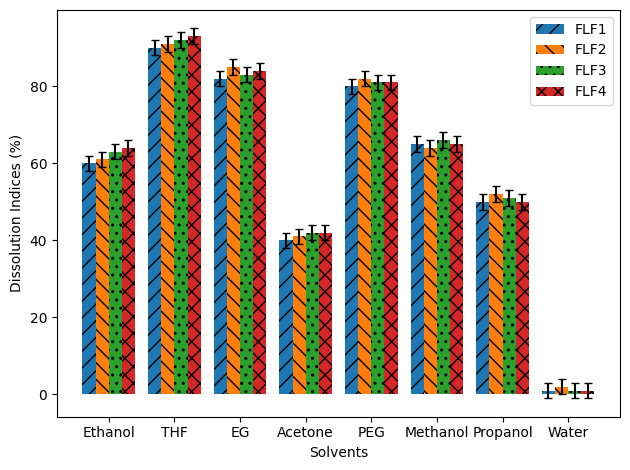
Foams are used widely in furniture, construction, automotive, and related industries because of their mechanical performance and durability. However, the poor recyclability of conventional polyurethane (PU) foams has raised environmental concerns because of their persistence and contribution to solid-waste accumulation. Bio-based furan-lignin foams (FLFs) offer a promising alternative because they are derived from renewable feedstocks and may provide improved end-of-life options. This study investigated the recycling of rigid FLFs through solvent-assisted dissolution. Virgin foams were prepared from furfuryl alcohol, used as a cross-linker, and lignin-based polyol obtained from corn husks and palm fruit shells, respectively. Glyoxal was used as a hardener and diethyl ether as a blowing agent. Eight solvents were evaluated for their dissolution indices and recyclability potential. Tetrahydrofuran (THF) gave the highest dissolution index (93.24%), followed by ethylene glycol and polyethylene glycol-400, whereas water gave the lowest value (1.10%). Four recycled furan-lignin foams (RFLFs) were then produced from the THF-derived dissolution product, which was used as recycled polyol. Comparative characterization showed that RFLF2 produced the highest char residue (24.45%), whereas RFLF4 showed the highest degradation temperature (556.80 oC), compressive stress, and density (0.876 g cm-3). The regenerated foams retained, and in some cases improved, the mechanical and thermal performance of the virgin FLFs.
References
[1] R. Godinho, N. Gama, A. Barros-Timmons & A. Ferreira, ``Recycling of different types of polyurethane foam wastes via acidolysis to produce polyurethane coatings'', Sustainable Materials and Technologies 29 (2021) e00330. https://doi.org/10.1016/j.susmat.2021.e00330.
[2] A. J. Adebayo, J. K. Ogunjobi, O. O. Oluwasina & L. Lajide, ``Comparative production and optimization of furfural and furfuryl alcohol from agricultural wastes'', Chemistry Africa 6 (2023) 2401. https://doi.org/10.1007/s42250-023-00594-7.
[3] A. J. Adebayo, J. K. Ogunjobi, O. O. Oluwasina & L. Lajide, ``Effects of additives concentrations on synthesis and characterization of furan-lignin foams'', Current Research in Green and Sustainable Chemistry 6 (2023) 100362. https://doi.org/10.1016/j.crgsc.2023.100362.
[4] G. Liberati, F. Biagi, A. Nanni, M. F. Parisi, L. Barbaresi, L. Querci, S. Ceccarelli, M. Regazzi, A. Bonoli & M. Colonna, ``Mechanical recycling of foam from end-of-life mattresses by AIR-LAY process for the production of new mattresses with a fully circular approach'', Cleaner Materials 12 (2024) 100249. https://doi.org/10.1016/j.clema.2024.100249.
[5] M. Pawlak, K. Pobłocki, J. Drzeżdżon, B. Gawdzik & D. Jacewicz, ``Isocyanates and isocyanides---life-threatening toxins or essential compounds?'', Science of the Total Environment 934 (2024) 173250. https://doi.org/10.1016/j.scitotenv.2024.173250.
[6] Y. Ge & Z. Li, ``Application of lignin and its derivatives in adsorption of heavy metal ions in water: a review'', ACS Sustainable Chemistry & Engineering 6 (2018) 7181. https://doi.org/10.1021/acssuschemeng.8b01345.
[7] W. Li & J. Shi, ``Lignin-derived carbon material for electrochemical energy storage applications: insight into the process-structure-properties-performance correlations'', Frontiers in Bioengineering and Biotechnology 11 (2023) 1121027. https://doi.org/10.3389/fbioe.2023.1121027.
[8] A. J. Adebayo, J. K. Ogunjobi, O. O. Oluwasina & L. Lajide, ``Development and characterization of lignin-furan rigid foams by varying precursors and catalyst concentration'', International Journal of Environmental Science and Technology 21 (2024) 3087. https://doi.org/10.1007/s13762-023-05164-5.
[9] D. Simón, A. M. Borreguero, A. de Lucas & J. F. Rodríguez, ``Glycolysis of viscoelastic flexible polyurethane foam wastes'', Polymer Degradation and Stability 116 (2015) 23. https://doi.org/10.1016/j.polymdegradstab.2015.03.008.
[10] N. Kraitape & C. Thongpin, ``Influence of recycled polyurethane polyol on the properties of flexible polyurethane foams'', Energy Procedia 89 (2016) 186. https://doi.org/10.1016/j.egypro.2016.05.025.
[11] G. Gaidukova, A. Ivdre, A. Fridrihsone, A. Verovkins, U. Cabulis & S. Gaidukovs, ``Polyurethane rigid foams obtained from polyols containing bio-based and recycled components and functional additives'', Industrial Crops and Products 102 (2017) 133. https://doi.org/10.1016/j.indcrop.2017.03.024.
[12] A. J. Adebayo, J. K. Ogunjobi, O. O. Oluwasina & L. Lajide, ``Isolation, optimization, liquefaction, and characterization of lignin from agricultural wastes'', Applied Journal of Environmental Engineering Science 8 (2022) 307. https://doi.org/10.48422/IMIST.PRSM/ajees-v8i4.34570.
[13] I. Izarra, A. M. Borreguero, I. Garrido, J. F. Rodríguez & M. Carmona, ``Comparison of flexible polyurethane foams properties from different polymer polyether polyols'', Polymer Testing 100 (2021) 107268. https://doi.org/10.1016/j.polymertesting.2021.107268.
[14] A. J. Adebayo & A. Olanrewaju, ``A complete review of lignin's extraction, analysis, applications, and future outlook'', Chemistry Africa 8 (2025) 1711. https://doi.org/10.1007/s42250-025-01323-y.
[15] Q. M. Li, R. A. W. Mines & R. S. Birch, ``The crush behaviour of Rohacell-51WF structural foam'', International Journal of Solids and Structures 37 (2000) 6321. https://doi.org/10.1016/S0020-7683(99)00277-2.
[16] N. Gama, B. Godinho, G. Marques, R. Silva, A. Barros-Timmons & A. Ferreira, ``Recycling of polyurethane by acidolysis: the effect of reaction conditions on the properties of the recovered polyol'', Polymer 219 (2021) 123561. https://doi.org/10.1016/j.polymer.2021.123561.
[17] C. S. Carriço, T. V. Fraga & M. D. Pasa, ``Production and characterization of polyurethane foams from a simple mixture of castor oil, crude glycerol, and untreated lignin as bio-based polyols'', European Polymer Journal 85 (2016) 53. https://doi.org/10.1016/j.eurpolymj.2016.10.012.
[18] J. Zhu, R. Balieu & H. Wang, ``The use of solubility parameters and free energy theory for phase behaviour of polymer-modified bitumen: a review'', Road Materials and Pavement Design 22 (2021) 757. https://doi.org/10.1080/14680629.2019.1645725.
[19] J. Manjkow, J. S. Papanu, D. W. Hess, D. S. Soane & A. T. Bell, ``Influence of processing and molecular parameters on the dissolution rate of poly(methyl methacrylate) thin films'', Journal of the Electrochemical Society 134 (1987) 2003. https://doi.org/10.1149/1.2100807.
[20] A. C. Ouano & F. A. Carothers, ``Dissolution dynamics of some polymers: solvent--polymer boundaries'', Polymer Engineering & Science 20 (1980) 160. https://doi.org/10.1002/pen.760200208.
[21] W. J. Cooper, P. D. Krasicky & F. Rodriguez, ``Effects of molecular weight and plasticization on dissolution rates of thin polymer films'', Polymer 26 (1985) 1069. https://doi.org/10.1016/0032-3861(85)90230-7.
[22] B. A. Miller-Chou & J. L. Koenig, ``A review of polymer dissolution'', Progress in Polymer Science 28 (2003) 1223. https://doi.org/10.1016/S0079-6700(03)00045-5.
[23] N. Gama, A. Ferreira & A. Barros-Timmons, ``Polyurethane foams: past, present, and future'', Materials 11 (2018) 1841. https://doi.org/10.3390/ma11101841.
[24] A. Delavarde, G. Savin, P. Derkenne, M. Boursier, R. Morales-Cerrada, B. Nottelet, J. Pinaud & S. Caillol, ``Sustainable polyurethanes: toward new cutting-edge opportunities'', Progress in Polymer Science 151 (2024) 101805. https://doi.org/10.1016/j.progpolymsci.2024.101805.
[25] V. Toni, R. Henrik, T. Tero, H. Tuomo & L. Ulla, ``Characterization of lignin reinforced tannin/furanic foams'', Heliyon 6 (2020) e03228. https://doi.org/10.1016/j.heliyon.2020.e03228.
[26] Z. Wu, W. Huang, X. Shan & Z. Li, ``Preparation of a porous graphene oxide/alkali lignin aerogel composite and its adsorption properties for methylene blue'', International Journal of Biological Macromolecules 143 (2020) 325. https://doi.org/10.1016/j.ijbiomac.2019.12.017.
[27] Q. Wu, F. Ran, L. Dai, C. Li, R. Li & C. Si, ``A functional lignin-based nanofiller for flame-retardant blend'', International Journal of Biological Macromolecules 190 (2021) 390. https://doi.org/10.1016/j.ijbiomac.2021.08.233.
[28] N. N. Solihat, A. F. Hidayat, M. N. Taib, A. M. Hussin, M. H. Lee, S. H. Ghani, M. A. A. Edrus, S. S. O. A. Vahabi & H. Fatriasari, ``Recent developments in flame-retardant lignin-based biocomposite: manufacturing and characterization'', Journal of Polymers and the Environment 30 (2022) 4517. https://doi.org/10.1007/s10924-022-02494-2.
[29] V. Mimini, V. Kabrelian, K. Fackler, H. Hettegger, A. Potthast & T. Rosenau, ``Lignin-based foams as insulation materials: a review'', Holzforschung 73 (2019) 117. https://doi.org/10.1515/hf-2018-0111.
[30] Q. Yan, R. Arango, J. Li & Z. Cai, ``Fabrication and characterization of carbon foams using 100% kraft lignin'', Materials & Design 201 (2021) 109460. https://doi.org/10.1016/j.matdes.2021.109460.
[31] H. Duarte, J. Brás, E. M. S. Hassani, M. J. Aliaño-Gonzalez, S. Magalhães, L. Alves, A. J. M. Valente, A. Eivazi, M. Norgren & A. Romano, ``Lignin-furanic rigid foams: enhanced methylene blue removal capacity, recyclability, and flame retardancy'', Polymers 16 (2024) 3315. https://doi.org/10.3390/polym16233315.
[32] A. Pizzi, ``Tannin-based bio-foams---a review'', Journal of Renewable Materials 7 (2019) 477. https://doi.org/10.32604/jrm.2019.06511.
[33] X. Xi, A. Pizzi & C. Gerardin, ``Glucose-biobased non-isocyanate polyurethane rigid foams'', Journal of Renewable Materials 7 (2019) 301. https://doi.org/10.32604/jrm.2019.04174.
[34] X. Xi, Z. Wu & A. Pizzi, ``Furfuryl alcohol-aldehyde plywood adhesive resins'', Journal of Adhesion 96 (2020) 814. https://doi.org/10.1080/00218464.2018.1519435.
[35] G. Wang, X. Liu, J. Zhang, W. Sui, J. Jang & C. Si, ``One-pot lignin depolymerization and activation by solid acid catalytic phenolation for lightweight phenolic foam preparation'', Industrial Crops and Products 124 (2018) 216. https://doi.org/10.1016/j.indcrop.2018.07.080.
[36] X. Xuedong, A. Pizzi, L. Hong, D. Guanben & Z. Xiaojian, ``Characterization and preparation of furanic-glyoxal foams'', Polymers 12 (2020) 692. https://doi.org/10.3390/polym12030692.
[37] C. Xinyi, X. Xuedong, A. Pizzi, E. Fredon, Z. Xiaojian, L. Jinxing, G. Christine & D. Guanben, ``Preparation and characterization of condensed tannin non-isocyanate polyurethane (NIPU) rigid foams by ambient temperature blowing'', Polymers 12 (2020) 750. https://doi.org/10.3390/polym12040750.
[38] A. Pizzi, ``Tannins: prospectives and actual industrial applications'', Biomolecules 9 (2019) 344. https://doi.org/10.3390/biom9080344.
[39] C. Lacoste, A. Pizzi, M. C. Basso, M. P. Laborie & A. Celzard, ``Pinus pinaster tannin/furanic foams: part 2: physical properties'', Industrial Crops and Products 61 (2014) 531. https://doi.org/10.1016/j.indcrop.2014.04.034.
[40] G. C. D'Souza, F. Dodangeh, G. B. Venkata, M. B. Ray, A. Prakash & C. Xu, ``A comprehensive review of biobased polyurethane and phenol formaldehyde hydrophilic foams for environmental remediation, floral, and hydroponics applications'', Biomass and Bioenergy 192 (2025) 107493. https://doi.org/10.1016/j.biombioe.2024.107493.
[41] L. Gao, G. Zheng, Y. Zhou, L. Hu & G. Feng, ``Improved mechanical property, thermal performance, flame retardancy and fire behavior of lignin-based rigid polyurethane foam nanocomposite'', Journal of Thermal Analysis and Calorimetry 120 (2015) 1311. https://doi.org/10.1007/s10973-015-4434-2.
[42] W. Lu, Q. Li, Y. Zhang, H. Yu, S. Hirose, H. Hatakeyama, Y. Matsumoto & Z. Jin, ``Lignosulfonate/APP IFR and its flame retardancy in lignosulfonate-based rigid polyurethane foams'', Journal of Wood Science 64 (2018) 287. https://doi.org/10.1007/s10086-018-1701-4.
[43] L. Chang, M. Sain & M. Kortschot, ``Improvement in compressive behavior of alkali-treated wood polyurethane foams'', Cellular Polymers 33 (2014) 139. https://doi.org/10.1177/026248931403300302.
[44] T. K. Fagbemigun & C. Mai, ``Production and characterisation of self-blowing lignin-based foams'', European Journal of Wood and Wood Products 81 (2023) 579. https://doi.org/10.1007/s00107-022-01908-1.
Published
How to Cite
Issue
Section
Copyright (c) 2026 Alaba Joseph Adebayo, Olugbenga O. Oluwasina, Joseph Kolawole Ogunjobi, Labunmi Lajide (Author)

This work is licensed under a Creative Commons Attribution 4.0 International License.