Synthesis, optimization, and evaluation of polyurethane from underutilized vegetable oils
Keywords:
Polyurethane biopolyol, Pet-polyol, Sunflower, Waste cooking oilAbstract
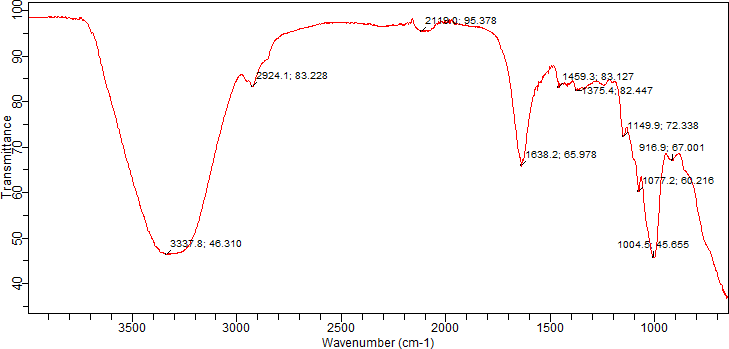
Biodegradable polyurethane can be produced from sustainable feedstocks such as waste sunflower cooking oil, which is often used for biodiesel production. This work describes the synthesis, characterization, and optimization of sustainable, mixed petroleum-sunflower polyol alongside their optimization. Polyol production was studied at a fixed sodium hydroxide catalyst concentration (1.0% w/w), reaction times of 40, 60, and 80 min, and oil-to-glycerol molar ratios of 3:1 and 4:1. Fourier transform infrared (FTIR) spectroscopy was used for polyol characterization. Polyurethane synthesis used a fixed amount of toluene diisocyanate (TDI), variable mixed-polyol ratios, and stannous octoate catalyst (2.0% w/w). The polyurethanes were evaluated for physical properties, mechanical and structural performance, chemical resistance, and stress--strain behavior. The highest polyol yield was 60.1% at an oil-to-glycerol molar ratio of 4:1, a reaction time of 80 min, a fixed sodium hydroxide catalyst concentration of 1.0% w/w, and 250 oC. SuPU-30:20 showed the best overall balance, with a tensile strength of 14 kPa, elevation of 52 mm, porosity of 16, weight of 14.9 g, 40% compression of 36.5, and good resistance to chemical attack. These results suggest that waste sunflower cooking oil is a promising sustainable feedstock for polyurethane, with SuPU-30:20 approaching the performance range of commercial flexible foams in tensile strength and density, although porosity and elevation remain below typical values.
References
[1] C. S. Sipaut, S. Murni, S. Saalah, T. C. Hoon, M. N. Mohamad Ibrahim, I. A. Rahman & A. A. Abdullah, ``Synthesis and characterization of polyols from refined cooking oil for polyurethane foam formation'', Cellular Polymers 31 (2012) 19. https://doi.org/10.1177/026248931203100102.
[2] Y. Chen, L. Yang, J. Wu, L. Ma, D. E. Finlow, S. Lin & K. Song, ``Thermal and mechanical properties of epoxy resin toughened with epoxidized soybean oil'', Journal of Thermal Analysis and Calorimetry 113 (2013) 939. https://doi.org/10.1007/s10973-012-2859-4.
[3] A. Cornille, R. Auvergne, O. Figovsky, B. Boutevin & S. Caillol, ``A perspective approach to sustainable routes for non-isocyanate polyurethanes'', European Polymer Journal 87 (2017) 535. https://doi.org/10.1016/j.eurpolymj.2016.11.027.
[4] I. Dominguez-Candela, A. Lerma-Canto, S. C. Cardona, J. Lora & V. Fombuena, ``Physicochemical characterization of novel epoxidized vegetable oil from chia seed oil'', Materials 15 (2022) 3250. https://doi.org/10.3390/ma15093250.
[5] M. Alam, D. Akram, E. Sharmin, F. Zafar & S. Ahmad, ``Vegetable oil-based eco-friendly coating materials: a review article'', Arabian Journal of Chemistry 7 (2013) 469. https://doi.org/10.1016/j.arabjc.2013.12.023.
[6] M. Desroches, M. Escouvois, R. Auvergne, S. Caillol & B. Boutevin, ``From vegetable oils to polyurethanes: synthetic routes to polyols and main industrial products'', Polymer Reviews 52 (2012) 38. https://doi.org/10.1080/15583724.2011.640443.
[7] X. Kong, G. Liu, H. Qi & J. M. Curtis, ``Preparation and characterization of high-solid polyurethane coating systems based on vegetable oil derived polyols'', Progress in Organic Coatings 76 (2013) 1151. https://doi.org/10.1016/j.porgcoat.2013.03.019.
[8] E. Sharmin, F. Zafar, D. Akram, M. Alam & S. Ahmad, ``Recent advances in vegetable oils-based environment friendly coatings: a review'', Industrial Crops and Products 76 (2015) 215. https://doi.org/10.1016/j.indcrop.2015.06.022.
[9] M. Zhang, H. Pan, L. Zhang, L. Hu & Y. Zhou, ``Study of the mechanical, thermal properties and flame retardancy of rigid polyurethane foams prepared from modified castor-oil-based polyols'', Industrial Crops and Products 59 (2014) 135. https://doi.org/10.1016/j.indcrop.2014.05.016.
[10] D. A. Echeverri, L. A. Rios & B. L. Rivas, ``Synthesis and copolymerization of thermosetting resins obtained from vegetable oils and biodiesel-derived crude glycerol'', European Polymer Journal 67 (2015) 428. https://doi.org/10.1016/j.eurpolymj.2014.11.046.
[11] P. Felizardo, M. J. N. Correia, I. Raposo, J. F. Mendes, R. Berkemeier & J. M. Bordado, ``Production of biodiesel from waste frying oils'', Waste Management 26 (2006) 487. https://doi.org/10.1016/j.wasman.2005.02.025.
[12] E. de C. Vasques, C. R. G. Tavares, C. I. Yamamoto, M. R. Mafra & L. Igarashi-Mafra, ``Adsorption of glycerol, monoglycerides and diglycerides present in biodiesel produced from soybean oil'', Environmental Technology 34 (2013) 2361. https://doi.org/10.1080/21622515.2013.770558.
[13] ASTM D4052-22, Standard Test Method for Density, Relative Density, and API Gravity of Liquids by Digital Density Meter. https://store.astm.org/d4052-22.html.
[14] ASTM D5554-15 (2021). Standard Test Method for Determination of the Iodine Value of Fats and Oils. https://store.astm.org/d5554-15r21.html.
[15] ASTM D664-24. Standard Test Method for Acid Number of Petroleum Products by Potentiometric Titration. https://store.astm.org/d0664-24.html.
[16] ASTM D5558-95 (2017). Standard Test Method for Determination of the Saponification Value of Fats and Oils. https://store.astm.org/d5558-95r17.html.
[17] D. C. Moreno, M. A. Velasco & D. H. Malagon-Romero, ``Production of polyurethanes from used vegetable oil-based polyols'', Chemical Engineering Transactions 79 (2020) 337. https://doi.org/10.3303/CET2079057.
[18] V. V. Goud, A. V. Patwardhan & N. C. Pradhan, ``Studies on the epoxidation of mahua oil (Madhumica indica) by hydrogen peroxide'', Bioresource Technology 97 (2006) 1365. https://doi.org/10.1016/j.biortech.2005.07.004.
[19] ASTM International, ``Standard practices for evaluating the resistance of plastics to chemical reagents'', ASTM D543-21, West Conshohocken, PA, USA, 2021. Available online: https://store.astm.org/d0543-21.html.
[20] M. F. Valero, J. E. Pulido, A. Ramírez & Z. Cheng, ``Determinación de la densidad de entrecruzamiento de poliuretanos obtenidos a partir de aceite de ricino modificado por transesterificación'', Polímeros 19 (2009) 14. https://doi.org/10.1590/S0104-14282009000100008.
[21] P. Alagi, Y. J. Choi & S. C. Hong, ``Preparation of vegetable oil-based polyols with controlled hydroxyl functionalities for thermoplastic polyurethane'', Euro. Polym J. 78 (2016) 46. https://doi.org/10.1016/j.eurpolymj.2016.03.003.
[22] A. Hejna, M. Kirpluks, P. Kosmela, U. Cabulis, J. Haponiuk & L. Piszczyk, ``The influence of crude glycerol and castor oil-based polyol on the structure and performance of rigid polyurethane-polyisocyanurate foams'', Industrial Crops and Products 95 (2017) 113. https://doi.org/10.1016/j.indcrop.2016.10.023.
[23] A. Badan & T. Majka, ``The influence of vegetable-oil based polyols on physico-mechanical and thermal properties of polyurethane foams'', Proceedings of the 21st International Electronic Conference on Synthetic Organic Chemistry, online, 2017, paper 4763. https://doi.org/10.3390/ecsoc-21-04763.
[24] H. Trujillo, T. A. Lerma, M. Palencia, N. G. Chate-Galvis, E. J. Medellín-Fernández & L. R. Anaya-Tatis, ``Functional polyurethanes: fundamentals, synthesis, characterization and their applications'', Journal of Science with Technological Applications 20 (2024) 118. https://doi.org/10.34294/j.jsta.26.20.118.
[25] A. Campanella, L. M. Bonnaillie & R. P. Wool, ``Polyurethane foams from soyoil-based polyols'', Journal of Applied Polymer Science 112 (2009) 2567. https://doi.org/10.1002/app.29898.
[26] A. Cifarelli, L. Boggioni, A. Vignali, I. Tritto, F. Bertini & S. Losio, ``Flexible polyurethane foams from epoxidised vegetable oils and a bio-based diisocyanate'', Polymers 13 (2021) 612. https://doi.org/10.3390/polym13040612.
[27] M. Ghasemlou, F. Daver, E. P. Ivanova & B. Adhikari, ``Polyurethanes from seed oil-based polyols: a review of synthesis, mechanical and thermal properties'', Ind. Crops and Products 142 (2019) 111841. https://doi.org/10.1016/j.indcrop.2019.111841.
[28] LSPM, Standard Test Methods for Flexible Cellular Materials—Slab, Bonded, and Molded Polyurethane Foams, ASTM D3574-25. Available online. https://doi.org/10.1520/D3574-25.
Published
How to Cite
Issue
Section
Copyright (c) 2026 Aliru Olajide Mustapha, Maryam Adamu, Khadijat Kemi Ajidagba, John Osheizah Abedoh, Musa AlfaNla Kamaldeen, Abdulfatai Temitope Ajiboye, Lukman Bola Abdulra'uf (Author)

This work is licensed under a Creative Commons Attribution 4.0 International License.