Geochemical modelling and ecological risk of heavy metals in industrial agricultural soils: a Python-driven approach from southwestern Nigeria
Keywords:
Agricultural soil contamination, Ecological risk index, Contamination factor, Human health risk assessment, Python geochemistryAbstract
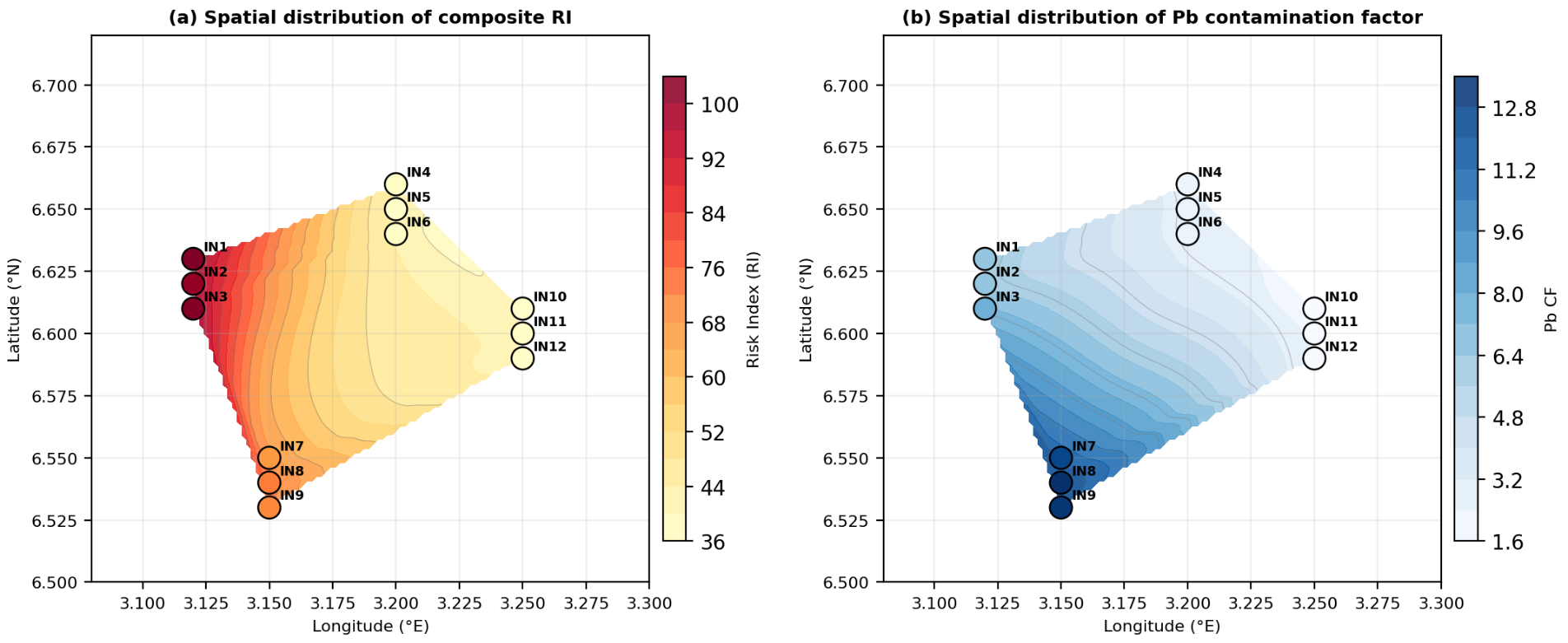
Heavy metal contamination of agricultural soils near the Ota Industrial Estate, southwestern Nigeria, was assessed using a six-module Python pipeline that integrates geochemical indexing, ecological-risk modelling, and human-health risk assessment. Cu, Pb, Zn, and Cd were analysed at 12 sites. Cu, Pb, and Zn were within WHO/FAO permissible limits. Cd concentrations exceeded the WHO/FAO guideline of 0.80 mg/kg at half of the locations (IN1--IN6, up to 3.09 mg/kg), and two locations exceeded the upper limit of 3.0 mg/kg. Contamination-factor analysis classified Pb at the vehicle-workshop zones (IN7--IN9) as considerable to very high, with CF up to 12.61, and classified Cu/Zn as moderate to very high at fabrication and galvanisation zones. The mean ecological risk index (RI) for the estate was 64.5 ± 24.1, indicating low overall risk, although Cd and Pb fell within moderate Er bands in some sub-zones. Independent recomputation showed that none of five originally proposed metal-pair correlations was significant; however, a strong Pb--Cd correlation was Bonferroni-significant (r = 0.946, p = 0.0012), indicating a shared anthropogenic source. US EPA RAGS non-carcinogenic hazard indices were below unity for adults (HI = 0.014) and children (HI = 0.126). Carcinogenic risk was not quantified because validated oral slope factors for Cd or Pb are unavailable in IRIS. The principal regulatory basis for clean-up is the Cd exceedance. The open-source pipeline provides a reproducible framework for soil-contamination assessment in West African regulatory contexts.
References
[1] M. N. Kumwimba, X. Li, J. Huang, D. K. Muyembe, M. Dzakpasu & E. Sanganyado, ``Performance of various fillers in ecological floating beds planted with Myriophyllum aquaticum treating municipal wastewater'', Science of the Total Environment 842 (2022) 156827. https://doi.org/10.1016/j.scitotenv.2022.156827.
[2] D. Hou, D. O'Connor, A. D. Igalavithana, D. S. Alessi, J. Luo, D. C. W. Tsang, D. L. Sparks, Y. Yamauchi, J. Rinklebe & Y. S. Ok, ``Metal contamination and bioremediation of agricultural soils for food safety and sustainability'', Nature Reviews Earth & Environment 1 (2020) 366. https://doi.org/10.1038/s43017-020-0061-y.
[3] B. J. Alloway (Ed.), Heavy Metals in Soils: Trace Metals and Metalloids in Soils and their Bioavailability, 3rd ed., Springer, Dordrecht, Netherlands, 2013, pp. 1--614. https://doi.org/10.1007/978-94-007-4470-7.
[4] S. Khan, M. Naushad, E. C. Lima, S. Zhang, S. M. Shaheen & J. Rinklebe, ``Global soil pollution by toxic elements: current status and future perspectives on risk assessment and remediation strategies'', Journal of Hazardous Materials 417 (2021) 126039. https://doi.org/10.1016/j.jhazmat.2021.126039.
[5] L. J"arup, ``Hazards of heavy metal contamination'', British Medical Bulletin 68 (2003) 167. https://doi.org/10.1093/bmb/ldg032.
[6] V. Kumar, A. Sharma, P. Kaur, G. P. S. Sidhu, A. S. Bali, R. Bhardwaj, A. K. Thukral & A. Cerd`a, ``Pollution assessment of heavy metals in soils of India and ecological risk assessment'', Chemosphere 216 (2019) 449. https://doi.org/10.1016/j.chemosphere.2018.10.066.
[7] K. D. Oyeyemi, C. O. Ajanaku, A. A. Akinyemi, O. A. Akintokun, O. F. Ojo, F. O. Chukwusa, G. C. George & O. J. Rotimi, ``Assessment of groundwater contamination from industrial and municipal waste materials at a dumpsite in Ota, Southwestern Nigeria'', in Global Forum for Sustainable Built Environment Conference, Springer Nature Switzerland, Cham, Switzerland, 2026, pp. 651--660. https://doi.org/10.1007/978-3-032-08992-2_54.
[8] O. O. Adeyemi & Z. O. Ojekunle, ``Concentrations and health risk assessment of industrial heavy metals pollution in groundwater of Ogun State, Nigeria'', Scientific African 11 (2021) e00666. https://doi.org/10.1016/j.sciaf.2020.e00666.
[9] K. M. Onuoha, ``Perspectives on the origin and evolution of the Benue Trough and Anambra Basin'', in Geology of Nigeria, C. A. Kogbe (Ed.), Rock View (Nigeria) Ltd, Jos, Nigeria, 1999, pp. 311--338.
[10] L. Hakanson, ``An ecological risk index for aquatic pollution control: a sedimentological approach'', Water Research 14 (1980) 975. https://doi.org/10.1016/0043-1354(80)90143-8.
[11] F. Li, X. Y. Zeng, C. H. Wu, Z. P. Duan, Y. M. Wen, G. R. Huang, X. L. Long, M. J. Li, M. J. Li & J. Y. Xu, ``Ecological risks assessment and pollution source identification of trace elements in contaminated sediments from the Pearl River Delta, China'', Biological Trace Element Research 155 (2013) 301. https://doi.org/10.1007/s12011-013-9789-2.
[12] G. Tepanosyan, L. Sahakyan, A. Gevorgyan & M. Frontasyeva, ``Factors conditioning the content of chemical elements in soil and mosses in Armenia'', Journal of Trace Elements and Minerals 2 (2022) 100029. https://doi.org/10.1016/j.jtemin.2022.100029.
[13] J. Rinklebe, V. Antoniadis, S. M. Shaheen, O. Rosche & M. Altermann, ``Health risk assessment of potentially toxic elements in soils along the central Elbe River, Germany'', Environment International 126 (2019) 76. https://doi.org/10.1016/j.envint.2019.02.011.
[14] C. R. Harris, K. J. Millman, S. J. van der Walt et al., ``Array programming with NumPy'', Nature 585 (2020) 357. https://doi.org/10.1038/s41586-020-2649-2.
[15] K. N. J. Hussain, B. R., Jagadeesh, V. R. Channavar, V. S. Radder, T. Y. Mankikar, L. Hublikar, C. B. Ashwini, ``Python-driven multivariate analysis: a comprehensive approach to sustainable groundwater quality assessment for irrigation purposes'', CLEAN--Soil, Air, Water 53 (2025) e70085. https://doi.org/10.1002/clen.70085.
[16] P. Affaton, J. Sougy & R. Trompette, ``The tectono-stratigraphic relationships between the upper Precambrian and lower Paleozoic Volta Basin and the Pan-African Dahomeyide orogenic belt (West Africa)'', American Journal of Science 280 (1980) 224. https://doi.org/10.2475/ajs.280.3.224.
[17] A. Kabata-Pendias & H. Pendias, Trace Elements in Soils and Plants, 3rd ed., CRC Press, Boca Raton, USA, 2001, pp. 1--413. https://dl.icdst.org/pdfs/files3/284d873749e377558208bca765468ffd.pdf
[18] F. Ustaou{g}lu, S. K"ukrer, B. Tac{s} & H. Topaldemir, ``Evaluation of metal accumulation in Terme River sediments using ecological indices and a bioindicator species'', Environmental Science and Pollution Research 29 (2022) 47399. https://doi.org/10.1007/s11356-021-17975-5.
[19] United States Environmental Protection Agency (US EPA), Exposure Factors Handbook: 2011 Edition, EPA/600/R-09/052F, National Center for Environmental Assessment, Washington, DC, USA, 2011. Available online: https://www.epa.gov/expobox/exposure-factors-handbook-2011-edition.
[20] H. Zhao, B. Xia, C. Fan, P. Zhao & S. Shen, ``Human health risk from soil heavy metal contamination under different land uses near Dabaoshan mine, southern China'', Science of the Total Environment 417 (2012) 45. https://doi.org/10.1016/j.scitotenv.2011.12.047.
[21] United States Environmental Protection Agency (US EPA), Integrated Risk Information System (IRIS), National Center for Environmental Assessment, Washington, DC, USA, 2023. Available online: https://www.epa.gov/iris.
[22] P. Virtanen, R. Gommers, T. E. Oliphant et al., ``SciPy 1.0: fundamental algorithms for scientific computing in Python'', Nature Methods 17 (2020) 261. https://doi.org/10.1038/s41592-019-0686-2.
[23] P. Goovaerts, Geostatistics for Natural Resources Evaluation, Oxford University Press, New York, USA, 1997, pp. 1--483. https://www.researchgate.net/publication/224839861_Geostatistics_for_Natural_Resource_Evaluation
[24] M. Molina-Roco, M. Escudey, M. Antil'en, N. Arancibia-Miranda & K. Manqui'an-Cerda, ``Distribution of contaminant trace metals inadvertently provided by phosphorus fertilisers: movement, chemical fractions and mass balances in contrasting acidic soils'', Environmental Geochemistry and Health 40 (2018) 2491. https://doi.org/10.1007/s10653-018-0115-y.
[25] G. Y. Hadzi, D. K. Essumang & G. A. Ayoko, ``Assessment of contamination and potential ecological risks of heavy metals in riverine sediments from gold mining and pristine areas in Ghana'', Journal of Trace Elements and Minerals 7 (2024) 100109. https://doi.org/10.1016/j.jtemin.2023.100109.
[26] A. A. Adesuyi, K. L. Njoku & M. O. Akinola, ``Assessment of heavy metals pollution in soils and vegetation around selected industries in Lagos State, Nigeria'', Journal of Geoscience and Environment Protection 3 (2015) 11. https://doi.org/10.4236/gep.2015.37002.
[27] V. Antoniadis, S. M. Shaheen, J. Boersch, T. Frohne, G. Du Laing & J. Rinklebe, ``Bioavailability and risk assessment of potentially toxic elements in garden edible vegetables and soils around a highly contaminated former mining area in Germany'', Journal of Environmental Management 186 (2017) 192. https://doi.org/10.1016/j.jenvman.2016.09.052.
[28] A. Facchinelli, E. Sacchi & L. Mallen, ``Multivariate statistical and GIS-based approach to identify heavy metal sources in soils'', Environmental Pollution 114 (2001) 313. https://doi.org/10.1016/S0269-7491(00)00243-8.
Published
How to Cite
Issue
Section
Copyright (c) 2026 Charles Olubunmi Ogunkoya, Gideon Oluyinka Layade (Author)

This work is licensed under a Creative Commons Attribution-NonCommercial-NoDerivatives 4.0 International License.