Integrated geoelectrical and geotechnical characterization of subsurface conditions responsible for foundation failures at the former Shagari housing estate, Numan, Adamawa State, Nigeria
Keywords:
Foundation failure, Electrical resistivity tomography, Geotechnical characterization, Differential settlementAbstract
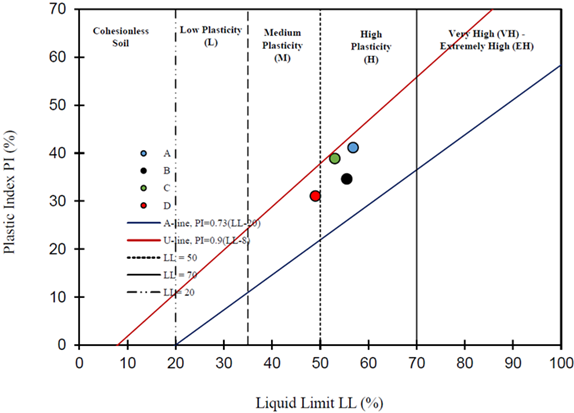
Foundation failures remain a persistent challenge within heterogeneous basement-complex terrains of northeastern Nigeria. This study presents an integrated geoelectrical--geotechnical investigation of foundation failures at the former Shagari Housing Estate, Numan, Adamawa State, Nigeria, aimed at delineating subsurface conditions responsible for structural distress and differential settlement. Two-dimensional electrical resistivity tomography (ERT), acquired with the Wenner configuration and interpreted using RES2DINV inversion software, was combined with laboratory geotechnical analyses to develop a robust subsurface failure model. Geoelectrical results reveal very low resistivity values (2.67--24.7 Ω m), indicating water-saturated, weak clayey subsoils, with corrosivity conditions ranging from very strongly to moderately corrosive. Particle-size distribution shows high fines content (79.48%), exceeding the recommended 35% threshold. Atterberg limits confirm expansive behavior, with liquid limits of 49.00--56.80% and plasticity indices of 31.07--41.15%, while natural moisture contents (18.99--23.08%) exceed acceptable ranges. Undrained triaxial tests show low shear strength (cohesion: 7--22 kN/m2; friction angle: 1.50--50) and low bearing capacity (maximum 55.16 kN/m2). Consolidation results indicate medium to high compressibility and low permeability. The strong spatial correlation between low-resistivity zones and poor geotechnical properties confirms that the observed failures are associated with highly plastic, compressible, and moisture-sensitive soil layers. The findings demonstrate that integrating ERT with laboratory analyses provides a reliable predictive framework for identifying geotechnically vulnerable zones before construction.
References
[1] K. N. Eze, O. Igwe, D. N. Okereke, C. S. Uwom & K. P. Ukor, ``Foundation integrity assessment of failed buildings in Ehamufu and Aguamede, South East Nigeria'', Scientific Reports 13 (2023) 719. https://doi.org/10.1038/s41598-023-28043-y.
[2] K. Sudha, M. Israil, S. Mittal & J. Rai, ``Soil characterization using electrical resistivity tomography and geotechnical investigations'', Journal of Applied Geophysics 67 (2009) 74. https://doi.org/10.1016/j.jappgeo.2008.09.012.
[3] A. Devi, M. Israil, R. Anbalagan & P. K. Gupta, ``Subsurface soil characterization using geoelectrical and geotechnical investigations at a bridge site in Uttarakhand Himalayan region'', Journal of Applied Geophysics 144 (2017) 78. https://doi.org/10.1016/j.jappgeo.2017.07.005.
[4] J. Audu, E. Ike, J. B. Yerima & A. S. Oniku, ``Geophysical investigation of road pavement failure along the Mubi Bypass Road, Jambutu, Jimeta, Yola, Adamawa State'', Nigerian Journal of Physics 34 (2025) 28. https://njp.nipngr.org/index.php/njp/article/view/369.
[5] A. O. Atilade, J. O. Coker & N. O. Adebisi, ``Integrated geophysical and geotechnical methods for pre-foundation investigations at Lagos State University of Science and Technology, Ikorodu, Southwestern Nigeria'', Nigerian Journal of Physics 33 (2024) 134. https://doi.org/10.62292/njp.v33(s).2024.261.
[6] N. Aguirre-Macias, M. Fuentes-Arreazola, S. Pedroza-Ruciles, H. Rendon-Contreras & J. Chavoya-Gama, ``Subsurface geotechnical-characterization near some buildings at the Centro Universitario de la Costa UDG (Puerto Vallarta, Jalisco, Mexico) using electrical resistivity tomography'', Open Journal of Civil Engineering 14 (2024) 520. https://doi.org/10.4236/ojce.2024.144029.
[7] F. Oppong & O. Kolawole, ``Reassessment of natural expansive materials and their impact on freeze--thaw cycles in geotechnical engineering: a review'', Frontiers in Built Environment 10 (2024) 1396542. https://doi.org/10.3389/fbuil.2024.1396542.
[8] P. M. Soupios, P. Georgakopoulos, N. Papadopoulos, V. Saltas, A. Andreadakis, F. Vallianatos & J. P. Makris, ``Use of engineering geophysics to investigate a site for a building foundation'', Journal of Geophysics and Engineering 4 (2007) 94. https://doi.org/10.1088/1742-2132/4/1/011.
[9] A. Sharma, M. Samanta & D. P. Kanungo, ``Site-specific correlation between geotechnical and geoelectrical properties of soil deposits in India'', Journal of Applied Geophysics 221 (2024) 105288. https://doi.org/10.1016/j.jappgeo.2024.105288.
[10] M. S. Erick, K. S. Parfait & B. Dieudonne, ``Geophysical investigations of heterogeneity foundation soils using electrical resistivity tomography technique'', Soil Mechanics and Foundation Engineering 61 (2025) 592. https://doi.org/10.1007/s11204-025-10016-0.
[11] M. H. Loke & R. D. Barker, ``Practical techniques for 3D resistivity surveys and data inversion'', Geophysical Prospecting 44 (1996) 499. https://doi.org/10.1111/j.1365-2478.1996.tb00162.x.
[12] M. H. Loke, J. E. Chambers, D. F. Rucker, O. Kuras & P. B. Wilkinson, ``Recent developments in the direct-current geoelectrical imaging method'', Journal of Applied Geophysics 95 (2013) 135. https://doi.org/10.1016/j.jappgeo.2013.02.017.
[13] A. Samouelian, I. Cousin, A. Tabbagh, A. Bruand & G. Richard, ``Electrical resistivity survey in soil science: a review'', Soil and Tillage Research 83 (2005) 173. https://doi.org/10.1016/j.still.2004.10.004.
[14] A. I. Obasi, O. P. Aghamelu, C. N. Chukwu & P. N. Nnabo, ``Engineering geophysical study of the Ebonyi State University permanent site, Abakaliki, South-Eastern Nigeria'', Current Journal of Applied Science and Technology 7 (2015) 168. https://doi.org/10.9734/BJAST/2015/15195.
[15] O. A. Odundun, V. I. Fagorite & E. O. Rogbitan, ``Geoelectrical and geotechnical investigation of foundation failure in and around Oroke High School, Akungba-Akoko, southwestern Nigeria'', International Journal of Advanced Geosciences 8 (2020) 237. https://doi.org/10.14419/ijag.v8i2.31121.
[16] F. Bellmunt, A. Gabas, A. Macau, B. Benjumea, M. Vila & S. Figueras, ``Sediment characterization in deltas using electrical resistivity tomography: the Ebro delta case'', Journal of Applied Geophysics 196 (2022) 104520. https://doi.org/10.1016/j.jappgeo.2021.104520.
[17] O. Adewoyin, E. O. Joshua, I. I. Akinwumi, M. Omeje & E. S. Joel, ``Evaluation of geotechnical parameters using geophysical data'', Journal of Engineering and Technological Sciences 49 (2017) 95. https://doi.org/10.5614/j.eng.technol.sci.2017.49.1.6.
[18] W. Lowrie, Fundamentals of Geophysics, 2nd ed. Cambridge University Press, Cambridge, UK, 2007, pp. 66--70. https://doi.org/10.1017/CBO9780511807107.
[19] W. M. Telford, L. P. Geldart & R. E. Sheriff, Applied Geophysics, 2nd ed., Cambridge University Press, Cambridge, UK, 1990, pp. 353--358. https://doi.org/10.1017/CBO9781139167932.
[20] J. Benkhelil, ``The origin and evolution of the Cretaceous Benue Trough (Nigeria)'', Journal of African Earth Sciences (and the Middle East) 8 (1989) 251. https://doi.org/10.1016/S0899-5362(89)80028-4.
[21] N. G. Obaje, Geology and Mineral Resources of Nigeria, Springer, Berlin, Germany, 2009. https://doi.org/10.1007/978-3-540-92685-6.
[22] M. A. Olade, ``Evolution of Nigeria's Benue Trough (aulacogen): a tectonic model'', Geological Magazine 112 (1975) 575. https://doi.org/10.1017/S001675680003898X.
[23] Adamawa State Government, The 2012 Flood Report, Ministry of Environment, Adamawa State, Nigeria, 2012.
[24] M. A. Olade, ``Early Cretaceous basalt volcanism and initial continental rifting in Benue Trough, Nigeria'', Nature 273 (1978) 458. https://doi.org/10.1038/273458a0.
[25] H. S. Ward, ``Resistivity and induced polarization methods'', in Geotechnical and Environmental Geophysics, S. H. Ward (Ed.), Society of Exploration Geophysicists, Houston, USA, 1990, pp. 147--189. https://doi.org/10.1190/1.9781560802785.
[26] I. A. Akinlabi & C. O. Adegboyega, ``Engineering geophysical investigation of road failure in a basement complex terrain, Southwestern Nigeria'', Journal of Geography, Environment and Earth Science International 25 (2021) 40. https://doi.org/10.9734/JGEESI/2021/v25i230270.
[27] M. A. Abed, A. A. A. Othman, S. Shebl, M. Zayed & M. H. Farag, ``A comprehensive geotechnical and geophysical assessment of the foundation sublayers in Egypt's New Administrative Capital'', Scientific Reports 15 (2025) 43229. https://doi.org/10.1038/s41598-025-29246-1.
[28] H.-Y. Fang & J. L. Daniels, Introductory Geotechnical Engineering: An Environmental Perspective, CRC Press, Boca Raton, USA, 2006. https://doi.org/10.1201/9781315274959.
[29] J.-L. Briaud, ``Introduction in geotechnical engineering'', in Geotechnical Engineering: Unsaturated and Saturated Soils, J.-L. Briaud (Ed.), Wiley, Hoboken, USA, 2023. https://doi.org/10.1002/9781119788720.ch1.
[30] S. A. Bisong, A. A. Abong & A. O. Egor, ``Geophysical investigation of pavement failure along Jonathan By-Pass--Akansoko and Atimbo--Parliamentary roads in Calabar metropolis, Cross River State, Nigeria'', Science World Journal 18 (2023) 375. https://doi.org/10.4314/swj.v18i3.8.
[31] A. I. Idornigie & M. O. Olorunfemi, ``Electrical resistivity determination of subsurface layers, subsoil competence and soil corrosivity at an engineering site location in Akungba Akoko, South Western Nigeria'', Ife Journal of Science 8 (2006) 159. https://doi.org/10.4314/ijs.v8i2.32216.
[32] I. A. Akinlabi & M. L. Olaiya, ``Geoelectrical and physicochemical evaluation of soil corrosivity on metallic pipelines: a case study'', Journal of Geography, Environment and Earth Science International 25 (2021) 46. https://doi.org/10.9734/JGEESI/2021/v25i530287.
[33] A. H. Amadi, J. A. Ajienka, O. Akaranta, P. R. Moses, N. U. Achara, V. D. Ola & R. D. Udo, ``A review of soil resistivity testing for enhanced corrosion control: overcoming limitations through integrated geophysical approaches and alternative methodologies'', Measurement 242 (2025) 116214. https://doi.org/10.1016/j.measurement.2024.116214.
[34] J. O. Irokwe, I. L. Nwaogazie & S. Sule, ``Development of empirical models for the estimation of CBR value of soil from their index properties: a case study of the Ogbia-Nembe Road in Niger Delta Region of Nigeria'', Open Journal of Civil Engineering 12 (2022) 648. https://doi.org/10.4236/ojce.2022.124036.
[35] R. Glossop & A. W. Skempton, ``Particle-size in silts and sands'', Journal of the Institution of Civil Engineers 25 (1945) 81. https://doi.org/10.1680/ijoti.1945.13927.
[36] K. H. Head & R. J. Epps, Manual of soil laboratory testing, Volume II, Permeability, Shear Strength and Compressibility Tests, 3rd ed. Caithness, Scotland: Whittles Publishing. https://archive.org/details/manualofsoillabo0000head_p8s3.
[37] E. Ike, J. Park, R. Ewusi-Wilson & C. Lee, ``Chemo-mechanical controls on clay fabric: generalized maps for predicting soil behavior in variable chemical environments'', Next Sustainability 7 (2026) 100296. https://doi.org/10.1016/j.nxsust.2026.100296.
Published
How to Cite
Issue
Section
Copyright (c) 2026 Beatrice Bomki Humphrey, Jamu Benson Yerima, Emmanuel Ike, Adetola Sunday Oniku (Author)

This work is licensed under a Creative Commons Attribution-NonCommercial-NoDerivatives 4.0 International License.