Isolation and characterization of a dihydrostilbene from the aerial parts of Indigofera conferta
Keywords:
Indigofera conferta, Isolation, Characterization, DihydrostilbeneAbstract
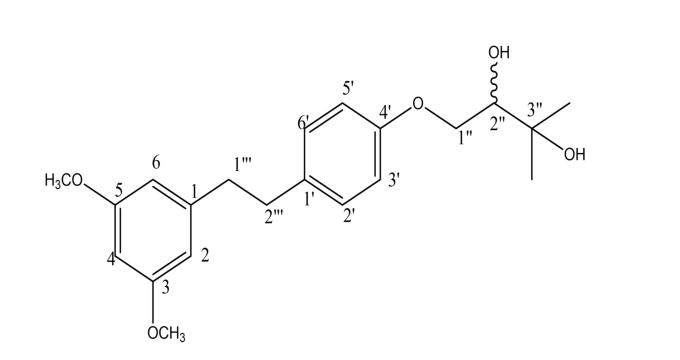
Indigofera conferta, an annual herb widely distributed in northeastern and western Nigeria, is used ethnomedicinally to treat inflammation, pain, sore feet, and snakebite. Despite these uses, the phytochemical constituents of this species remain underexplored. The chloroform fraction of the methanol extract of the aerial parts of I. conferta was separated by silica gel column chromatography to afford a compound. The structure of the compound was elucidated using UV, FT-IR, one-dimensional and two-dimensional NMR (1H, 13C, HSQC, and HMBC) spectroscopy and comparison with previously reported literature data. The compound was assigned as 3,5-dimethoxy-4'-O-(2,3-dihydroxy-3-methylbutyl)-dihydrostilbene. This report documents the first isolation of this compound from I. conferta and contributes to the phytochemical and chemotaxonomic knowledge of the genus Indigofera.
References
[1] J. B. Gillet, R. M. Polhill & B. Verdcourt, Flora of Tropical East Africa: Leguminosae (Papilionoideae), Part 4, Crown Agents for Oversea Governments and Administrations, London, UK, 1971.
[2] A. M. Musa, G. Abbas, A. B. Aliyu, M. S. Abdullahi & I. N. Akpulu, ``Phytochemical and antimicrobial screening of Indigofera conferta Gillet (Papilionaceae)'', Research Journal of Medicinal Plant 2 (2008) 74. https://doi.org/10.3923/rjmp.2008.74.78.
[3] S. Abdulkadir, A. K. Adamu, D. B. Dangora, S. O. Alonge, A. H. Yaro, G. Ibrahim & K. Y. Musa, ``Phytochemical screening and effects of Indigofera conferta Gillet (Papilionaceae) methanol extract (whole plant) on rabbit jejunum and pregnant rat uterus'', Nigerian Journal of Pharmaceutical Sciences 6 (2007) 105.
[4] H. Lou, H. Liu, H. Wang, Y. Zhao, L. Huang, J. Fu, X. Hao & W. Pan, ``Diverse flavonoids from the roots of Indigofera stachyodes", Chemistry & Biodiversity 19 (2022) e202200676, https://doi.org/10.1002/cbdv.202200676.
[5] D. Thangadurai, N. Ramesh, M. B. Viswanathan & D. X. Prasad, ``A novel xanthene from Indigofera longeracemosa stem'', Fitoterapia 72 (2001) 92. https://doi.org/10.1016/S0367-326X(00)00236-7.
[6] T. U. Rahman, M. A. Zeb, W. Liaqat, M. Sajid, S. Hussain & M. I. Choudhary, ``Phytochemistry and pharmacology of genus Indigofera: A review", Records of Natural Products 12 (2018) 1. https://doi.org/10.25135/RNP.13.16.12.585.
[7] E. Gerometta, I. Grondin, J. Smadja, M. Frederich & A. Gauvin-Bialecki, ``A review of traditional uses, phytochemistry and pharmacology of the genus Indigofera", Journal of Ethnopharmacology 253 (2020) 112608. https://doi.org/10.1016/j.jep.2020.112608.
[8] M. Isah, S. Murtala, S. M. Abdullahi, A. N. Hamza, N. Tajuddeen, M. L. Dauda, V. Mzozoyana & A. M. Musa, ``A bioactive chalcone from the aerial parts of Indigofera conferta Gillet'', Natural Product Research 37 (2023) 3631. https://doi.org/10.1080/14786419.2022.2098493.
[9] A. Musa, A. K. Haruna, M. Ilyas, A. Ahmadu, S. Gibbons & M. M. Rahman, ``Dihydrostilbenes from Indigofera pulchra'', Natural Product Communications 3 (2008) 805. https://doi.org/10.1177/1934578X0800300524.
[10] S. D. Sarker & L. Nahar (Eds.), Natural Products Isolation, 3rd ed., Humana Press, New York, NY, USA, 2012. https://doi.org/10.1007/978-1-61779-624-1.
[11] G. L. Silva, I.-S. Lee & A. D. Kinghorn, ``Special problems with the extraction of plants'', in Natural Products Isolation, J. P. R. Cannell (Ed.), Humana Press, New Jersey, USA, 1998, pp. 343--363. https://doi.org/10.1007/978-1-59259-256-2_12.
[12] Q. M. Andersen & K. R. Markham (Eds.), Flavonoids: Chemistry, Biochemistry and Applications, Taylor & Francis Group, Boca Raton, FL, USA, 2006, pp. 127--208.
[13] W. Zhao, G. Qin, Y. Ye, R. Xu & X. Le, ``Bibenzyls from Stemona tuberosa'', Phytochemistry 38 (1995) 711. https://doi.org/10.1016/0031-9422(94)00655-D.
[14] H. Fortin, S. Tomasi, P. Jaccard, V. Robin & J. Boustie, ``A prenyloxycoumarin from Psiadia dentata'', Chemical and Pharmaceutical Bulletin 49 (2001) 619. https://doi.org/10.1248/cpb.49.619.
Published
How to Cite
Issue
Section
Copyright (c) 2026 Maryam Isah, Asmau N. Hamza, Nkiruka Theresa Nnadozie, Edward Ayakeme Bebe, Nasir Tajuddeen, Aliyu M. Musa

This work is licensed under a Creative Commons Attribution 4.0 International License.