Evaluation of antioxidant capacity and nutritional components of Five locally consumed fruits in Eastern Nigeria
Keywords:
Nutraceutical, Oxidative stress, Total antioxidants, Total flavonoidsAbstract
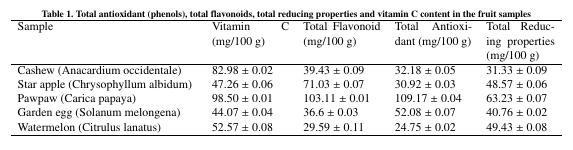
The nutraceutical richness of locally cultivated fruits in Eastern Nigeria remains poorly documented, limiting guidance for dietary management of oxidative stress-related disorders. This study quantified the vitamin C content, total flavonoids, total antioxidants, and reducing properties of five commonly consumed fruits: cashew (Anacardium occidentale), star apple (Chrysophyllum albidum), pawpaw (Carica papaya), garden egg (Solanum melongena), and watermelon (Citrullus lanatus). Spectroscopic methods were employed to assay total antioxidants, flavonoids, and reducing properties using gallic acid, rutin, and trichloroacetic acid as standards, respectively, while vitamin C was determined by titrimetric analysis using 2,6-dichlorophenol indophenol. Results (mean ± SD, mg/100 g) showed that pawpaw had the highest vitamin C (98.50 ± 0.01), total flavonoids (103.11 ± 0.01), total antioxidants (109.17 ± 0.04), and reducing properties (63.23 ± 0.07), followed by star apple, watermelon, garden egg, and cashew. A strong positive correlation (r = 0.87) was observed between total flavonoid content and reducing power, indicating that flavonoids significantly contribute to antioxidant activity. These findings provide evidence supporting increased consumption of pawpaw, star apple, and watermelon to mitigate oxidative stress, compensate for nutrient deficiencies, and promote public health in Eastern Nigeria.
References
[1] V. Lobo, A. Patil, A. Phatak & N. Chandra, ‘‘Free radicals, antioxidants and functional foods: Impact on human health’’, Pharmacognosy Reviews 4 (2010) 118. https://doi.org/10.4103/0973-7847.70902.
[2] G. Pizzino, N. Irrera, M. Cucinotta, G. Pallio, F. Mannino, V. Arcoraci, F. Squadrito, D. Altavilla & A. Bitto, ‘‘Oxidative Stress: Harms and Benefits for Human Health’’, Oxidative Medicine and Cellular Longevity 2017 (2017) 8416763. https://doi.org/10.1155/2017/8416763.
[3] A. Phaniendra, D. B. Jestadi & L. Periyasamy, ‘‘Free Radicals: Properties, Sources, Targets, and Their Implication in Various Diseases’’, Indian Journal of Clinical Biochemistry 30 (2014) 11. https://doi.org/10.1007/s12291-014-0446-0.
[4] N. Francenia Santos-Sánchez, R. Salas-Coronado, C. Villanueva-Cañongo & B. Hernández-Carlos, ‘‘Antioxidant compounds and their antioxidant mechanism’’, IntechOpen 15 (2019) 254. https://doi.org/10.5772/intechopen.85270.
[5] M. Taghvaei & S. M. Jafari, ‘‘Application and stability of natural antioxidants in edible oils in order to substitute synthetic additives’’, Journal of Food Science and Technology 52 (2015) 1272. https://doi.org/10.1007/s13197-013-1080-1.
[6] K. S. Heavener & E. M. Bradshaw, ‘‘The aging immune system in Alzheimer’s and Parkinson’s diseases’’, Seminars in Immunopathology 44 (2022) 649. https://doi.org/10.1007/s00281-022-00944-6.
[7] C. Chen, Y. Zhao, B. Su, Y. Wu, P. Zhong & X. Zheng, ‘‘Association between multimorbidity and memory-related diseases among middle-aged and older adults: Evidence from the China Health and Retirement Longitudinal Study’’, Frontiers in Public Health 11 (2013) 1115207. https://doi.org/10.3389/fpubh.2023.1115207.
[8] R. Jia, Q. Wang, H. Huang, Y. Yang, Y. F. Chung & T. Liang, ‘‘ Cardiovascular disease risk models and dementia or cognitive decline: A systematic review’’, Frontiers in Aging Neuroscience 15 (2023) 1257367. https://doi.org/10.3389/fnagi.2023.1257367.
[9] D. M. Kasote, S. S. Katyare, M. V. Hegde and H. Bae, ‘‘Significance of Antioxidant Potential of Plants and its Relevance to Therapeutic Applications’’, International Journal of Biological Sciences 11 (2015) 982. https://doi.org/10.7150/ijbs.1209.
[10] E. Agboeze, C. Chime, P. I. Udeozo, V. A. Ofordile, P. O. Nsude, C. G. Eze, L. C. Okwesili, H. O. Agboeze & E. C. Ezike, ‘‘Heavy metal contamination and health risks from dumpsite effluents in Enugu State Southeastern Nigeria’’, Environmental Analysis Health and Toxicology 40 (2025) 456. https://doi.org/10.5620/eaht.2025023.
[11] M. Calderón-Oliver & E. Ponce-Alquicira, ‘‘Fruits: A Source of Polyphenols and Health Benefits’’, Natural and Artificial Flavoring Agents and Food Dyes, Metropolitan Autonomous University, México City, México, 2017, pp.189-228.https://doi.org/10.1016/B978-0-12-811518-3.00007-7.
[12] E. N. Ponnampalam, A. Kiani, S. Santhiravel, B. W. Holman, C. Lauridsen & F. R. Dunshea, ‘‘The Importance of Dietary Antioxidants on Oxidative Stress, Meat and Milk Production, and Their Preservative Aspects in Farm Animals: Antioxidant Action, Animal Health, and Product Quality—Invited Review’’, Animals 12 (2021) 3279. https://doi.org/10.3390/ani12233279.
[13] D. Nowak, M. Gośliński, E. Wojtowicz & K. Przygoński, ‘‘Antioxidant Properties and Phenolic Compounds of Vitamin C-Rich Juices’’, Journal of food science 83 (2018) 2237. https://doi.org/10.1111/1750-3841.14284.
[14] P. C. Chijindu, O. B. Onyeukwu & U. Ogheneoruese, ‘‘Evaluation of Nutritional, Phytochemicals and Antioxidant Capacity of Telfairia Occidentalis F. and Vernonia Amygdalina Delile Leaves’’, Nigerian Journal of Biochemistry and Molecular Biology 39 (2024) 170. https://doi.org/10.4314/njbmb.v39i3.8.
[15] H. Phiri, A. Lumai, K. Zombe & J. Nyirenda, ‘‘Evaluation of antioxidant activity of selected wild fruits and vegetables from Zambia’’, Food and Humanity 3 (2024) 100390. https://doi.org/10.1016/j.foohum.2024.100390.
[16] AOAC, Official Methods of Analysis, 21st Edition, Washington, D.C.: Association of Official Analytical Chemists, 2019. [Online]. https://www.aoac.org/wp-content/uploads/2019/08/Front-Matter-List-of-Changes-2.pdf.
[17] O. S. Nwozo, E. M. Effiong, P. M. Aja & C. G. Awuchi, ‘‘Antioxidant, phytochemical, and therapeutic properties of medicinal plants: A review’’, International Journal of Food Properties 26 (2023) 359. https://doi.org/10.1080/10942912.2022.2157425.
[18] I. L. Lawag et al., “A modified Folin–Ciocalteu assay for the determination of total phenolics content in honey,” Applied Sciences, 13 (2022) 2135. https://doi.org/10.3390/app13042135.
[19] R.N.Lamptey, B.Chaulagain, R.Trivedi, A.Gothwal, B.Layek&J.Singh, ‘‘A Review of the Common Neurodegenerative Disorders: Current Therapeutic Approaches and the Potential Role of Nanotherapeutics’’, International Journal of Molecular Sciences 23 (2022) 2135. https://doi.org/10.3390/app13042135.
[20] H. Bilal, A. Sharif, M. Malik & H. Zubair, ‘‘Aqueous Ethanolic Extract of Adiantum incisum Forssk. Protects against Type 2 Diabetes Mellitus via Attenuation of α-Amylase and Oxidative Stress’’, ACS Omega 42 (2022) 37724. https://doi.org/10.3390/ijms23031851.
[21] N. A. Asuama, ‘‘Nutritional and medicinal values of some edible vegetables in Enugu State Nigeria’’, International Scholars Journals 3 (2015) 294. https://www.internationalscholarsjournals.com/articles/nutritional.
[22] C. Ogbuanu, C. Amujiogu, P. Obi & P. Nsude, ‘‘Nutraceutical and health benefits of some vegetables eaten in Enugu State Nigeria’’, African Journal of Food Science 8 (2014) 471. https://doi.org/10.1021/acsomega.2c05625.
[23] J. Gopalraaj & K. Velayudhannair, ‘‘A comparative study of nutrient composition, proteolytic activity, phytochemical profiles, vitamin C content, and antioxidant properties in the peels of selected perennial fruits’’, Agricultural Research 14 (2025) 742. https://doi.org/10.1007/s40003-024-00798-4.
[24] O. A. Michael, O. M. Banji, A. B. Olufunso, O. O. Abiodun, O. Gbenga, J. B. Adebola & A. S. Damilola, ‘‘Determination of Nutrients, Antinutrients and Antioxidants Concentrations in some edible Forest Vegetables in Ondo and Oyo State, South Western Nigeria’’, Nigerian Journal of Nutritional Sciences 44 (2023) 212. https://dx.doi.org/10.4314/njns.v44i2.21.
[25] D. Pem & R. Jeewon, ‘‘Fruit and Vegetable Intake: Benefits and Progress of Nutrition Education Interventions- Narrative Review Article’’, Iranian Journal of Public Health 44 (2015) 1309. https://doi.org/10.5304/jafscd.2025.143.014.
[26] M. A. Ikram, ‘‘Cardiovascular risk factors and future risk of Alzheimer’s disease’’, BMC Medicine 12 (2014) 130. https://doi.org/10.1186/s12916-014-0130-5.
[27] S. Losada-Barreiro, Z. Sezgin-Bayindir, F. Paiva-Martins & C. BravoDíaz, ‘‘Biochemistry of Antioxidants: Mechanisms and Pharmaceutical Applications’’, Biomedicines 10 (2022) 3051. https://doi.org/10.3390/biomedicines10123051.
[28] C. Zhang, Y. Zhao, H. Tao, L. Li, Y. He, X. Zhang, Y. Zhu & G. Hong, ‘‘Analysis of the Flavonoidome Reveals the Different Health-Promoting Flavonoid Characteristics in Fruit’’, Antioxidants 12 (2023) 1165. https://doi.org/10.3390/antiox12091665.
[29] P. Esquivel et al., ‘‘Effect of processing on biofunctionality of selected tropical fruit juices’’, ACS Food Science & Technology 2 (2023) 455. https://doi.org/10.1021/acsfoodscitech.1c00414.
[30] S. Pan, Z. Lin, T. Yao, X. Guo, T. Xu, X. Sheng, X. Song, Z. Chen, W. Wei, Y. Yan & Y. Hu, ‘‘Global burden of non-communicable chronic diseases associated with a diet low in fruits from 1990 to 2019’’, Front. Nutr. 10 (2023) 1202763. https://doi.org/10.3389/fnut.2023.1202763.
[31] A.N.Panche, A.D.DiwanandS.R.Chandra, ‘‘Flavonoids: Anoverview’’, Journal of Nutritional Science 5 (2016) e47. https://doi.org/10.1017/jns. 2016.41.
[32] S. S. Kumar, T. V. Gayathri, K. Krishnakumar & M. John, ‘‘Antioxidant potential and mineral elemental profiling of young and mature fruit and leaf of Carica papaya L. cultivar’Red Lady’’, Journal of Trace Elements and Minerals 9 (2024) 100166. https://doi.org/10.1017/jns.2016.41.
[33] F. M. Makinde, P. Ayeni, A. Lemboye & F. O. Adeyemo, ‘‘Effects of African Star Apple (Chrysophyllum Albidum) Components on Neuroprotective and Carbohydrate Metabolizing Enzymes’’, Chrysophyllum Albidum 23 (2025) 5399122. https://dx.doi.org/10.2139/ssrn.5399122.
[34] M. N. Nwafor, E. B. Amadi, A. J. Whyte, N. F. Godwin, U. O. Abosede, C. S. Ogunwa & A. Babandi, ‘‘Comprehensive phytochemical and antioxidant profiling of Tetrapleura tetraptera fruit: a nutritional and bioactive potential assessment from Rivers State, Nigeria’’, Asian Journal of Biochemistry, Genetics and Molecular Biology 16 (2024) 88. https://10.9734/ajbgmb/2024/v16i12425.
[35] M. M. Rahaman, R. Hossain, J. Herrera-Bravo, M. T. Islam, O. Atolani, O. S. Adeyemi, O. A. Owolodun, L. Kambizi, S. D. Daştan, D. Calina & J. Sharifi-Rad, ‘‘Natural antioxidants from some fruits, seeds, foods, natural products, and associated health benefits: An update’’, Food Science & Nutrition 11 (2023) 1657. https://doi.org/10.1002/fsn3.3217.
[36] L. Smith, G. López Sánchez, N. Veronese, P. Soysal, H. Oh, Y. Barnett, H. Keyes, L. Butler, P. Allen, K. Kostev, L. Jacob, J. Shin & A. Koyanagi, ‘‘Fruit and Vegetable Intake and Non-Communicable Diseases among Adults Aged ≥50 Years in Low- and Middle-Income Countries’’, J Nutr Health Aging 26 (2022) 1003. https://doi.org/10.1007/s12603-022-1855-z.
[37] L. L. Pruteanu, D. S. Bailey, A. C. Grădinaru & L. J`‘antschi, ‘‘The Biochemistry and Effectiveness of Antioxidants in Food, Fruits, and Marine Algae’’, Antioxidants 12 (2023) 860. https://doi.org/10.3390/antiox12040860.
[38] A. N. Olise and I. B. Enweani-nwokelo, ‘‘Evaluation of nutritional values, phytochemical constituents and in vitro antioxidant studies of six indigenous nigerian plantS’’, Journal of Biomedical Investigation 11 (2023) 97. https://journals.unizik.edu.ng/jbi/article/view/2537
[39] F. Shahidi & P. Ambigaipalan, ‘‘Phenolics and polyphenolics in foods, beverages and spices: Antioxidant activity and health effects – A review’’, Journal of Functional Foods 18 (2015) 820. https://doi.org/10.1016/j.jff.2015.06.018.
[40] J. Bié, B. Sepodes, P. C. Fernandes & M. H. Ribeiro, ‘‘Polyphenols in Health and Disease: Gut Microbiota, Bioaccessibility, and Bioavailability’’, Compounds 3 (2023) 40. https://doi.org/10.3390/compounds3010005.
[41] B. O. Ekute, M. E. Khan, A. A. Pam & J. E. Emurotu, ‘‘ Assessment of the nutritional and phytochemical composition of selected mushroom species grown in Southern Nigeria’’, Journal of the Nigerian Society of Physical Sciences 7 (2025) 2978. https://doi.org/10.46481/jnsps.2025.2978.
[42] J. Kubola & M. N. Siriamornpun, ‘‘Phytochemicals, vitamin C and sugar content of Thai wild fruits’’, Food chemistry 26 (2011) 972. https://doi.org/10.1016/j.foodchem.2010.11.104.
[43] R. Dhalaria, R. Verma, D. Kumar, S. Puri, A. Tapwal, V. Kumar, E. Nepovimova & K. Kuca, ‘‘Bioactive compounds of edible fruits with their anti-aging properties: a comprehensive review to prolong human life’’, Antioxidants 9 (2020) 1123. https://doi.org/10.3390/antiox9111123.
Published
How to Cite
Issue
Section
Copyright (c) 2026 C. C. Ogbuanu, O. C. Ike, C. N. Eze, C. C. Ugwoke, E. Agboeze, C. I. Diara

This work is licensed under a Creative Commons Attribution 4.0 International License.