Diffusion-absorption modeling of drug transport in the gastrointestinal tract: an initial-boundary value problem approach
Keywords:
Drug diffusion, Absorption kinetics, Initial-boundary value problem, Gastrointestinal transport, Mathematical modelingAbstract
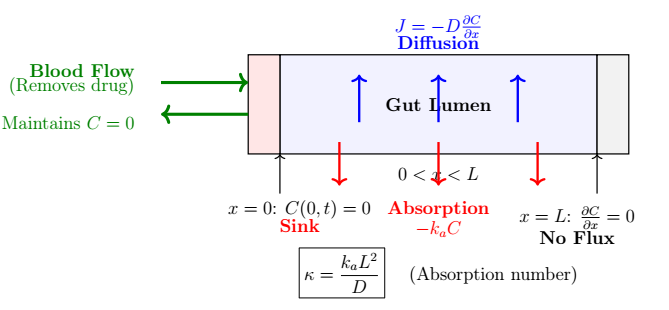
The absorption of drugs in the gastrointestinal tract is a fundamental process in oral drug delivery involving the complex interplay of diffusion and permeation. This paper develops a mathematical model for drug transport in the gastrointestinal lumen, incorporating Fickian diffusion and a first-order volumetric sink term to represent uptake into the systemic circulation. The model is formulated as an initial-boundary value problem with no-flux boundary conditions at both the gut wall and the luminal center, representing a closed system where drug removal occurs solely through the distributed absorption term. Separation of variables is employed to derive an analytical solution, revealing that the concentration remains spatially uniform throughout the domain and decays exponentially with time as C(x,t) = C0e-kat. The dimensionless absorption number κ = kaL2/D emerges as the key parameter governing the rate of drug elimination, with κ ≫ 1 indicating absorption-dominated transport and κ ≪ 1 indicating diffusion-dominated transport. The analytical solution is verified numerically using a Crank--Nicolson finite difference scheme, demonstrating excellent agreement with errors on the order of machine precision (∼ 10−15). The model provides a rigorous framework for understanding the biophysical interplay between diffusion and absorption in oral drug delivery and has potential applications in the design of controlled release formulations and absorption enhancement strategies.
References
[1] K. D. Tripathi, Essentials of Medical Pharmacology, 7th ed., Jaypee Brothers Medical Publishers, New Delhi, India, 2013. Available online: https://search.worldcat.org/title/868299888.
[2] A. A. Alagga, M. V. Pellegrini & V. Gupta, ``Drug absorption'', in StatPearls [Internet], StatPearls Publishing, Treasure Island, FL, USA, updated 27 February 2024. Available online: https://www.ncbi.nlm.nih.gov/books/NBK557405/.
[3] J. Crank, The Mathematics of Diffusion, 2nd ed., Clarendon Press, Oxford, UK, 1975. Available online: https://search.worldcat.org/title/1320797.
[4] M. Grassi & G. Grassi, ``Mathematical modelling and controlled drug delivery: Matrix systems'', Current Drug Delivery 2 (2005) 97. https://pubmed.ncbi.nlm.nih.gov/16305412/. DOI: https://doi.org/10.2174/1567201052772906
[5] H. S. Carslaw & J. C. Jaeger, Conduction of Heat in Solids, 2nd ed., Clarendon Press, Oxford, UK, 1959. Available online: https://search.worldcat.org/title/535528.
[6] I. O. Oji, E. Nwaeze, S. N. Aloke, L. O. Omenyi & E. U. Michael, ``Fractional-order pharmacokinetic model for oral drug absorption: A two-compartment analysis using Caputo derivative'', Global Journal of Mathematical Analysis 12(1) 48. https://doi.org/10.14419/yw1pt752. DOI: https://doi.org/10.14419/yw1pt752
[7] P. Macheras & A. Iliadis, Modeling in Biopharmaceutics, Pharmacokinetics and Pharmacodynamics: Homogeneous and Heterogeneous Approaches, Springer, New York, USA, 2006. https://doi.org/10.1007/0-387-31910-7. DOI: https://doi.org/10.1007/0-387-31910-7
[8] Z. Vinarov, M. Abdallah, J. A. G. Agundez, K. Allegaert, A. W. Basit, M. Braeckmans, J. Ceulemans, M. Corsetti, B. T. Griffin, M. Grimm, D. Keszthelyi, M. Koziolek, C. M. Madla, C. Matthys, L. E. McCoubrey, A. Mitra, C. Reppas, J. Stappaerts, N. Steenackers, N. L. Trevaskis, T. Vanuytsel, M. Vertzoni, W. Weitschies, C. Wilson & P. Augustijns, ``Impact of gastrointestinal tract variability on oral drug absorption and pharmacokinetics: An UNGAP review'', European Journal of Pharmaceutical Sciences 162 (2021) 105812. https://doi.org/10.1016/j.ejps.2021.105812. DOI: https://doi.org/10.1016/j.ejps.2021.105812
[9] J. E. Hall & M. E. Hall, Guyton and Hall Textbook of Medical Physiology, 14th ed., Elsevier, Philadelphia, PA, USA, 2021. Available online: https://shop.elsevier.com/books/guyton-and-hall-textbook-of-medical-physiology/hall/978-0-323-59712-8.
[10] L. Shargel & A. B. C. Yu, Applied Biopharmaceutics & Pharmacokinetics, 7th ed., McGraw-Hill Education, New York, USA, 2016. Available online: https://www.mheducation.com/highered/mhp/product/applied-biopharmaceutics-pharmacokinetics-seventh-edition.html.
[11] J. Siepmann, R. A. Siegel & M. J. Rathbone (Eds.), Fundamentals and Applications of Controlled Release Drug Delivery, Springer, New York, USA, 2012. https://doi.org/10.1007/978-1-4614-0881-9. DOI: https://doi.org/10.1007/978-1-4614-0881-9
Published
How to Cite
Issue
Section
Copyright (c) 2026 Sunday N. Aloke, Ifeanyichukwu O. Oji, Nelson N. Ezieke, Theophilus S. Igwe, Aloysius N. Ezaka, Nicodemus I. Ede

This work is licensed under a Creative Commons Attribution 4.0 International License.