Coupled optical and electrical modeling of TiO2 anti-reflective coatings for enhanced performance in GaAs thin-film solar cells
Keywords:
TiO2 anti-reflective coating, GaAs thin-film solar cell, Optical–electrical modeling, Photovoltaic efficiencyAbstract
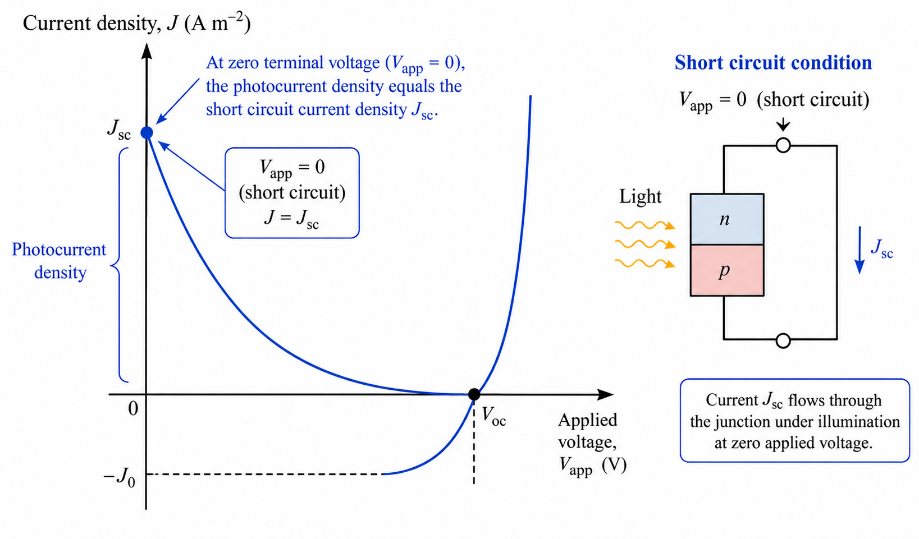
Optical reflection losses at the air--semiconductor interface limit the performance of gallium arsenide (GaAs) thin-film solar cells, whereas optical and electrical optimization are often considered separately. This study develops a coupled MATLAB-based optical--electrical simulation framework to evaluate the effect of titanium dioxide (TiO2) anti-reflective coating (ARC) thickness on GaAs thin-film solar cells. The optical response was assessed from wavelength-dependent reflectance, transmittance, absorptance, and quantum efficiency, and electrical performance was evaluated from current density--voltage characteristics, short-circuit current density ( Jsc), open-circuit voltage (Voc), fill factor (FF), and power conversion efficiency (PCE). TiO2 ARC thicknesses of 50, 75, and 100 nm were simulated under AM 1.5G illumination at 300 K. The 50 nm coating produced the lowest reflectance, highest absorptance, highest current density, and highest quantum efficiency across 300--900 nm. It also provided the best overall photovoltaic performance, with Jsc ≈ 34.7 mA cm-2, Voc approx 0.839 V, FF ≈ 0.842, and a maximum PCE of approximately 24.2%. Increasing the coating thickness to 75 and 100~nm reduced the PCE to approximately 22.95% and 21.85%, respectively. The results show that optimum photovoltaic efficiency requires a balanced combination of optical absorption, current generation, voltage, and FF. The coupled framework provides a computationally efficient tool for designing and optimizing ARCs for high-efficiency III--V photovoltaic devices.
References
[1] M. Noman, S. Tu, S. Ahmad, F. U. Zafar, H. A. Khan, S. U. Rehman, M. Waqas, A. D. Khan & O. U. Rehman, ``Assessing the reliability and degradation of 10--35 years field-aged PV modules'', PLOS ONE 17 (2022) e0261066. https://doi.org/10.1371/journal.pone.0261066.
[2] B. P. Singh, S. K. Goyal & P. Kumar, ``Solar PV cell materials and technologies: Analyzing the recent developments'', Materials Today: Proceedings 43 (2021) 2843. https://doi.org/10.1016/j.matpr.2021.01.003.
[3] J. Pastuszak & P. Węgierek, ``Photovoltaic cell generations and current research directions for their development'', Materials 15 (2022) 5542. https://doi.org/10.3390/ma15165542.
[4] C. Ji, W. Liu, Y. Bao, X. Chen, G. Yang, B. Wei, F. Yang & X. Wang, ``Recent applications of antireflection coatings in solar cells'', Photonics 9 (2022) 906. https://doi.org/10.3390/photonics9120906.
[5] E. Mirabi, F. Akrami Abarghuie & R. Arazi, ``Integration of buildings with third-generation photovoltaic solar cells: a review'', Clean Energy 5 (2021) 505. https://doi.org/10.1093/ce/zkab031.
[6] J. Li, A. Aierken, Y. Liu, Y. Zhuang, X. Yang, J. H. Mo, R. K. Fan, Q. Y. Chen, S. Y. Zhang, Y. M. Huang & Q. Zhang, ``A brief review of high efficiency III-V solar cells for space application'', Front. Phys. 8 (2020) 631925. https://doi.org/10.3389/fphy.2020.631925.
[7] B. Lorenzi, M. Acciarri & D. Narducci, ``Experimental determination of power losses and heat generation in solar cells for photovoltaic-thermal applications'', Journal of Materials Engineering and Performance 27 (2018) 6291. https://doi.org/10.1007/s11665-018-3604-3.
[8] A. M. Mandong & A. Uzum, ``Fresnel calculations of double/multi-layer antireflection coatings on silicon substrates'', Research on Engineering Structures and Materials 7 (2021) 539. https://doi.org/10.17515/resm2020.241en1217.
[9] D. Parajuli, G. S. Gaudel, D. Kc, K. B. Khattri & W.-Y. Rho, ``Simulation study of TiO$_2$ single layer anti-reflection coating for GaAs solar cell'', AIP Advances 13 (2023) 085002. https://doi.org/10.1063/5.0153197.
[10] S. Zandi, P. Saxena, M. Razaghi & N. E. Gorji, ``Simulation of CZTSSe thin-film solar cells in COMSOL: Three-dimensional optical, electrical, and thermal models'', IEEE Journal of Photovoltaics 10 (2020) 1503. https://doi.org/10.1109/JPHOTOV.2020.2999881.
[11] J. W. Leem, J. S. Yu, D.-H. Jun, J. Heo & W.-K. Park, ``Efficiency improvement of III--V GaAs solar cells using biomimetic TiO$_2$ subwavelength structures with wide-angle and broadband antireflection properties'', Solar Energy Materials and Solar Cells 127 (2014) 43. https://doi.org/10.1016/j.solmat.2014.03.041.
[12] B. Hammad, M. Al-Abed, A. Al-Ghandoor, A. Al-Sardeah & A. Al-Bashir, ``Modeling and analysis of dust and temperature effects on photovoltaic systems' performance and optimal cleaning frequency'', Renewable and Sustainable Energy Reviews 82 (2018) 2218. https://doi.org/10.1016/j.rser.2017.08.070.
[13] L. Tian, L. Li & M. Wu, ``Fabrication and characterisation of TiO$_2$ anti-reflection coatings with gradient index'', Micro & Nano Letters 12 (2017) 849. https://doi.org/10.1049/mnl.2017.0408.
[14] A. S. Sarkin, N. Ekren & S. Saglam, ``A review of anti-reflection and self-cleaning coatings on photovoltaic panels'', Solar Energy 199 (2020) 63. https://doi.org/10.1016/j.solener.2020.01.084.
[15] S. D. Muhammad & M. H. Ali, ``Evaluation of the effectiveness of TiO$_2$ antireflection coating for solar cell'', Dutse Journal of Pure and Applied Sciences 10 (2024) 349. https://doi.org/10.4314/dujopas.v10i4a.32.
[16] A. K. Tenwar, S. Singh, I. Mal & D. P. Samajdar, ``Anti-reflective nanostructures for efficiency improvement of GaAs-based solar cells'', Materials Today: Proceedings 58 (2022) 682. https://doi.org/10.1016/j.matpr.2022.02.163.
[17] N. I. I. Mohd Jamaluddin, M. Z. Mohd Yusoff, M. F. Malek, R. G. Artes Jr. & J. S. Sala, ``Simulation of a silicon solar cell using triple-layer anti-reflection coatings (ARC)'', Key Engineering Materials 994 (2024) 61. https://doi.org/10.4028/p-6Rxxkp.
[18] H. Liu, J. Peng, W. Liu, Y. Wang, J. Wu, G. Zhang, X. Wang & Y. Yan, ``Strong interference-based ultrathin conductive anti-reflection coating on metal substrates for optoelectronics'', NPG Asia Materials 10 (2018) 309. https://doi.org/10.1038/s41427-018-0011-z.
[19] A. Abu-Shamleh, H. Alzubi & A. Alajlouni, ``Optimization of antireflective coatings with nanostructured TiO$_2$ for GaAs solar cells'', Photonics and Nanostructures--Fundamentals and Applications 43 (2021) 100862. https://doi.org/10.1016/j.photonics.2020.100862.
[20] Y. He, Y. Tao, Z. Liu & Q. Huang, ``Design and optimization of nanostructure antireflection film for thin GaAs solar cells based on the photoelectrical coupling model'', Applied Energy 364 (2024) 123184. https://doi.org/10.1016/j.apenergy.2024.123184.
[21] S. Kim, V. Q. Hoang & C. W. Bark, ``Silicon-based technologies for flexible photovoltaic devices: From basic mechanism to manufacturing technologies'', Nanomaterials 11 (2021) 2944. https://doi.org/10.3390/nano11112944.
[22] Y. Zeng, A. Gentle, R. Webster, Z. Yang, Z. Zhou, N. Song, M. Keevers, M. Green & J. Y. Jiang, ``Revisiting photovoltaic module antireflection coatings: A novel, dense sol--gel design to address long-standing durability limitations'', Progress in Photovoltaics: Research and Applications 33 (2025) 1400. https://doi.org/10.1002/pip.3877.
[23] N. Gomidze, L. Kalandadze, O. Nakashide, I. Jabnidze, M. Khajishvili & J. Shainidze, ``Toward sustainable solar energy: analyzing key parameters in photovoltaic systems'', AIP Adv. 14 (2024) 110701. https://doi.org/10.1063/5.0243711.
[24] A. Martí, E. Antolín, C. R. Stanley, C. D. Farmer, N. López, P. Díaz, E. Cánovas, P. G. Linares & A. Luque, ``Production of photocurrent due to intermediate-to-conduction-band transitions: A demonstration of a key operating principle of the intermediate-band solar cell'', Physical Review Letters 97 (2006) 247701. https://doi.org/10.1103/PhysRevLett.97.247701.
[25] F. Aungwa, K. Ogunmoye, D. S. Igba, P. R. Jubu, A. A. Oche, E. Danladi, N. F. Gesa, A. T. Adepoju, E. J. Adoyi & M. B. Ochang, ``Optical thickness of dielectric layer in solar cell design for improved efficiency: A theoretical insight'', Physics Access 5 (2025) 67. https://doi.org/10.47514/phyaccess.2025.5.1.007.
[26] M. A. Green, ``Accurate expressions for solar cell fill factors including series and shunt resistances'', Applied Physics Letters 108 (2016) 081111. https://doi.org/10.1063/1.4942660.
[27] M. A. Green, E. D. Dunlop, D. H. Levi, J. Hohl-Ebinger, M. Yoshita & A. W. Y. Ho-Baillie, ``Solar cell efficiency tables (version 54)'', Progress in Photovoltaics: Research and Applications 27 (2019) 565. https://doi.org/10.1002/pip.3171.
[28] S. J. Yaqoob, A. L. Saleh, S. Motahhir, E. B. Agyekum, A. Nayyar & B. Qureshi, ``Comparative study with practical validation of photovoltaic monocrystalline module for single and double diode models'', Scientific Reports 11 (2021) 19153. https://doi.org/10.1038/s41598-021-98593-6.
[29] A. S. M. Mohsin, S. Mondal, M. Mobashera, A. Malik, M. Islam & M. Rubaiat, ``Efficiency improvement of thin film solar cell using silver pyramids array and antireflective layer'', Heliyon 9 (2023) e16749. https://doi.org/10.1016/j.heliyon.2023.e16749.
[30] A. Bahrami, S. Mohammadnejad, N. J. Abkenar & S. Soleimaninezhad, ``Optimized single- and double-layer antireflection coatings for GaAs solar cells'', International Journal of Renewable Energy Research 3 (2013) 79. Available online: https://dergipark.org.tr/en/pub/ijrer/issue/16080/168273.
Published
How to Cite
Issue
Section
Copyright (c) 2026 F. Aungwa, D. S. Igba, A. A. McAsule, M. B. Ochang, W. V. Zhiya, A. I. Tyom

This work is licensed under a Creative Commons Attribution 4.0 International License.