Green synthesis of Cu, Fe, and Cu/Fe nanomaterials using Khaya senegalensis and investigation of their photocatalytic reduction of 4-nitrophenol and antibacterial properties
Keywords:
Green synthesis, Catalytic properties, Antibacterial activity, Bimetallic nanoparticles, Khaya senegalensisAbstract
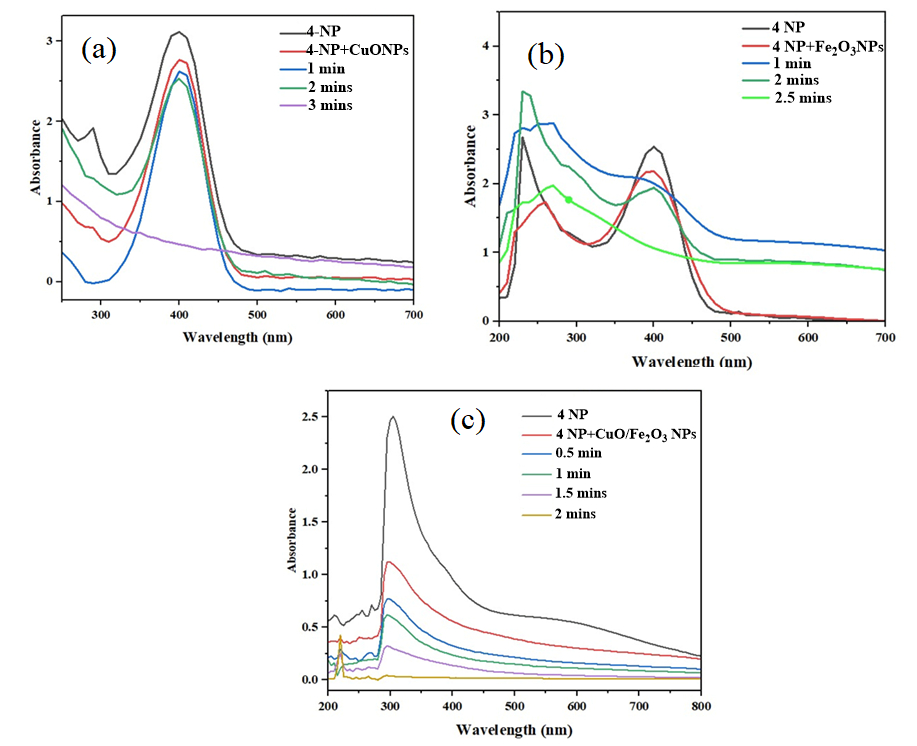
The persistent environmental and health threats posed by nitroaromatic pollutants particularly 4-nitrophenol (4-NP), and the rise of multidrug-resistant bacterial pathogens demand sustainable, efficient, and eco-friendly remediation strategies. To address these challenges, this study aimed to develop monometallic (CuO and Fe₂O₃) and bimetallic (CuO/Fe₂O₃) nanoparticles via a green, one-pot synthesis using Khaya senegalensis leaf extract, leveraging its rich phytochemical content (notably flavonoids and tannins) as natural reducing and capping agents. The synthesized nanoparticles were characterized using UV–Vis spectroscopy, XRD, FTIR, and HAADF STEM, confirming the formation of spherical, monodispersed particles (20–50 nm) with distinct surface plasmon resonance peaks at 224 nm (CuO), 290 nm (Fe₂O₃), and a redshifted peak at 295 nm (CuO/Fe₂O₃). The XRD analysis revealed the crystallite sizes of CuO, Fe2O3 and CuO/Fe₂O₃ NPs to be 26, 22 and 28 nm, respectively. Bimetallic CuO/Fe₂O₃ nanocomposite demonstrated exceptional photocatalytic efficiency, achieving complete reduction of 4-NP to 4-aminophenol in just 2 minutes, over 50% faster than monometallic counterparts. Furthermore, it exhibited potent antibacterial activity, with minimum inhibitory concentrations (MIC) of 8 µg/mL against Escherichia coli and Bacillus subtilis, and 40 µg/mL against Pseudomonas aeruginosa, alongside minimum bactericidal concentrations (MBC) of 16 µg/mL and 80 µg/mL, respectively. These results underscore the multifunctional potential of K. senegalensis-derived CuO/Fe₂O₃ nanocomposites as green, high-performance agents for simultaneous environmental detoxification and antimicrobial applications. We recommend their further development for scalable water treatment and as alternatives to conventional antibiotics, particularly against resilient Gram-negative pathogens.
References
[1] A. Baruwa, O. J. Gbadeyan & K. Permaul, “Revolutionizing biotechnology: the impact of nanocatalysts and nanomaterials—a comprehensive review”, Discov. Mater. 5 (2025) 89. https://doi.org/10.1007/s43939-025-00269-9. DOI: https://doi.org/10.1007/s43939-025-00269-9
[2] G. N. Bosio, F. S. Garcı́a Einschlag, L. Carlos & D. O. Mártire, “Recent advances in the development of novel iron–copper bimetallic photo Fenton catalysts”, Catalysts 13 (2023) 159. https://doi.org/10.3390/catal13010159. DOI: https://doi.org/10.3390/catal13010159
[3] Z. ?wi?tkowska-Warkocka, “Bimetal CuFe nanoparticles—synthesis, properties, and applications”, Appl. Sci. 11 (2021) 1978. https://doi.org/10.3390/app11051978. DOI: https://doi.org/10.3390/app11051978
[4] S. Devi, G. S. Sabesan & S. A. Ismail (Eds.), Opportunities for biotechnology research and entrepreneurship, Bentham Science Publishers, 2024. https://doi.org/10.2174/97898151961151240101. DOI: https://doi.org/10.2174/97898151961151240101
[5] J. Singh, T. Dutta, K.-H. Kim, M. Rawat, P. Samddar & P. Kumar, “?Green? synthesis of metals and their oxide nanoparticles: applications for environmental remediation”, J. Nanobiotechnol. 16 (2018) 84. https://doi.org/10.1186/s12951-018-0408-4. DOI: https://doi.org/10.1186/s12951-018-0408-4
[6] D. B. Tripathy & A. Gupta, “Nanocomposites as sustainable smart materials: a review”, J. Reinf. Plast. Compos. (2024). https://doi.org/10.1177/07316844241233162. DOI: https://doi.org/10.1177/07316844241233162
[7] A. M. E. Shafey, “Green synthesis of metal and metal oxide nanoparticles from plant leaf extracts and their applications: a review”, Green Process. Synth. 9 (2020) 304. https://doi.org/10.1515/gps-2020-0031. DOI: https://doi.org/10.1515/gps-2020-0031
[8] Z. Vaseghi, A. Nematollahzadeh & O. Tavakoli, “Green methods for the synthesis of metal nanoparticles using biogenic reducing agents: a review”, Rev. Chem. Eng. 34 (2018) 529. https://doi.org/10.1515/revce-2017-0005. DOI: https://doi.org/10.1515/revce-2017-0005
[9] Z. Vaseghi, O. Tavakoli & A. Nematollahzadeh, “Rapid biosynthesis of novel Cu/Cr/Ni trimetallic oxide nanoparticles with antimicrobial activity”, J. Environ. Chem. Eng. 6 (2018) 1898. https://doi.org/10.1016/j.jece.2018.02.038. DOI: https://doi.org/10.1016/j.jece.2018.02.038
[10] S. Shahzadi, S. Fatima, Q. Ul Ain, Z. Shafiq & M. R. S. A. Janjua, “A review on green synthesis of silver nanoparticles (SNPs) using plant extracts: a multifaceted approach in photocatalysis, environmental remediation, and biomedicine”, RSC Adv. 15 (2025) 3858. https://doi.org/10.1039/D4RA07519F. DOI: https://doi.org/10.1039/D4RA07519F
[11] J. A. Aboyewa, N. R. S. Sibuyi, M. Meyer & O. O. Oguntibeju, “Green synthesis of metallic nanoparticles using some selected medicinal plants from Southern Africa and their biological applications”, Plants 10 (2021) 1929. https://doi.org/10.3390/plants10091929. DOI: https://doi.org/10.3390/plants10091929
[12] C. Rabadeaux, L. Vallette, J. Sirdaarta, C. Davis & I. E. Cock, “An examination of the antimicrobial and anticancer properties of Khaya senegalensis (Desr.) A. Juss. bark extracts”, Pharmacogn. J. 9 (2017) 504. https://doi.org/10.5530/pj.2017.4.82. DOI: https://doi.org/10.5530/pj.2017.4.82
[13] X. Xiong, C. Wu, J. J. Elser, Z. Mei & Y. Hao, “Occurrence and fate of microplastic debris in middle and lower reaches of the Yangtze River ? from inland to the sea”, Sci. Total Environ. 659 (2019) 66. https://doi.org/10.1016/j.scitotenv.2018.12.313. DOI: https://doi.org/10.1016/j.scitotenv.2018.12.313
[14] A. Haleem, A. Shafiq, S.-Q. Chen & M. Nazar, “A comprehensive review on adsorption, photocatalytic and chemical degradation of dyes and nitro-compounds over different kinds of porous and composite materials”, Molecules 28 (2023) 1081. https://doi.org/10.3390/molecules28031081. DOI: https://doi.org/10.3390/molecules28031081
[15] R. Franco-Duarte et al., “Advances in chemical and biological methods to identify microorganisms—from past to present”, Microorganisms 7 (2019) 130. https://doi.org/10.3390/microorganisms7050130. DOI: https://doi.org/10.3390/microorganisms7050130
[16] G. Yadav, N. Yadav & M. Ahmaruzzaman, “Photoreduction of nitrophenol using metal oxide-based nanocomposites: a green and efficient approach for aqueous environmental remediation”, Int. J. Environ. Anal. Chem. 105 (2025) 1779. https://doi.org/10.1080/03067319.2023.2298722. DOI: https://doi.org/10.1080/03067319.2023.2298722
[17] K. Loza, M. Heggen & M. Epple, “Synthesis, structure, properties, and applications of bimetallic nanoparticles of noble metals”, Adv. Funct. Mater. 30 (2020) 1909260. https://doi.org/10.1002/adfm.201909260. DOI: https://doi.org/10.1002/adfm.201909260
[18] I. Mustieles Marı́n, J. M. Asensio & B. Chaudret, “Bimetallic nanoparticles associating noble metals and first-row transition metals in catalysis”, ACS Nano 15 (2021) 3550. https://doi.org/10.1021/acsnano.0c09744. DOI: https://doi.org/10.1021/acsnano.0c09744
[19] O. Elmutasim, L. M. Maghrabi, D. S. Dhawale & K. Polychronopoulou, “Engaging the concepts of bimetallicity and mechanical strain for N2 activation: a computational exploration”, ACS Appl. Mater. Interfaces 16 (2024) 56254. https://doi.org/10.1021/acsami.4c09691. DOI: https://doi.org/10.1021/acsami.4c09691
[20] D. S. Idris & A. Roy, “Synthesis of bimetallic nanoparticles and applications—an updated review”, Crystals 13 (2023) 637. https://doi.org/10.3390/cryst13040637. DOI: https://doi.org/10.3390/cryst13040637
[21] A. Babajide, T. Adebolu, M. Oladunmoye & B. Oladejo, “Evaluation of antibacterial activity of Citrus aurantium L. leaf extracts on bacteria isolated from blood of Hepatitis B positive individuals in Ondo State, Nigeria”, Microbes Infect. Dis. 4 (2023) 304. https://doi.org/10.21608/mid.2021.103642.1206. DOI: https://doi.org/10.21608/mid.2021.103642.1206
[22] Y. Bibi, S. Nisa, A. Waheed, M. Zia, S. Sarwar, S. Ahmed & M. F. Chaudhary, “Evaluation of Viburnum foetens for anticancer and antibacterial potential and phytochemical analysis”, Afr. J. Biotechnol. 9 (2010) 5611. https://doi.org/10.5555/20103289930.
[23] A. Wadood, M. Ghufran, S. B. Jamal, M. Naeem, A. Khan et al., “Phytochemical analysis of medicinal plants occurring in local area of Mardan”, Biochem. Anal. Biochem. 2 (2013) 144. https://doi.org/10.4172/2161-1009.1000144. DOI: https://doi.org/10.4172/2161-1009.1000144
[24] D. Kumar, R. Ghosh & B. C. Pal, “α-Glucosidase inhibitory terpenoids from Potentilla fulgens and their quantitative estimation by validated HPLC method”, J. Funct. Foods 5 (2013) 1135. https://doi.org/10.1016/j.jff.2013.03.010. DOI: https://doi.org/10.1016/j.jff.2013.03.010
[25] R. Gul, S. U. Jan, S. Faridullah, S. Sherani & N. Jahan, “Preliminary phytochemical screening, quantitative analysis of alkaloids, and antioxidant activity of crude plant extracts from Ephedra intermedia indigenous to Balochistan”, Sci. World J. 2017 (2017) 1. https://doi.org/10.1155/2017/5873648. DOI: https://doi.org/10.1155/2017/5873648
[26] S. Kanagasubbulakshmi & K. Kadirvelu, “Green synthesis of iron oxide nanoparticles using Lagenaria siceraria and evaluation of its antimicrobial activity”, Def. Life Sci. J. 2 (2017) 422. https://doi.org/10.14429/dlsj.2.12277. DOI: https://doi.org/10.14429/dlsj.2.12277
[27] Z. Alhalili, “Green synthesis of copper oxide nanoparticles CuO NPs from Eucalyptus Globoulus leaf extract: adsorption and design of experiments”, Arab. J. Chem. 15 (2022) 103739. https://doi.org/10.1016/j.arabjc.2022.103739. DOI: https://doi.org/10.1016/j.arabjc.2022.103739
[28] M. ?ernı́k & V. V. Thekkae Padil, “Green synthesis of copper oxide nanoparticles using gum karaya as a biotemplate and their antibacterial application”, Int. J. Nanomedicine 2013 (2013) 889. https://doi.org/10.2147/IJN.S40599. DOI: https://doi.org/10.2147/IJN.S40599
[29] O. A. Fabiyi, A. H. Labulo, A. V. Ogundele, T. A. Adesalu, H. S. Mella, O. B. Akinsipo & A. O. Claudius-Cole, “Assessment and nematicidal activity of Cu/Fe and Zn/Fe bimetallic nanoparticles against root-knot nematode in beetroot and cabbage”, Sci. Rep. 15 (2025) 29165. https://doi.org/10.1038/s41598-025-14384-3. DOI: https://doi.org/10.1038/s41598-025-14384-3
[30] M. Yoro, J. D. Samson, J. Joshua, J. W. K. Jonah, P. D. Bello, D. G. Ajima & N. Umar, “Biosynthesis, optimization of process parameters and antimicrobial activity of silver nanoparticles from Moringa oleifera leaf extract”, Compr. Res. Rev. Chem. Pharm. 1 (2022) 001. https://doi.org/10.57219/crrcp.2022.1.1.0001. DOI: https://doi.org/10.57219/crrcp.2022.1.1.0001
[31] B. I. Iotsor, F. Iseghohi, O. E. Oladoja, O. R. Raji, Z. Yusuf & O. A. Oyewole, “Antimicrobial activities of garlic and ginger extracts on some clinical isolates”, Int. J. Biotechnol. 8 (2019) 59. https://doi.org/10.18488/journal.57.2019.81.59.65. DOI: https://doi.org/10.18488/journal.57.2019.81.59.65
[32] A. M. Bobenchik, J. A. Hindler, C. L. Giltner, S. Saeki & R. M. Humphries, “Performance of Vitek 2 for antimicrobial susceptibility testing of Staphylococcus spp. and Enterococcus spp”, J. Clin. Microbiol. 52 (2014) 392. https://doi.org/10.1128/JCM.02432-13. DOI: https://doi.org/10.1128/JCM.02432-13
[33] U. Kosikowska et al., “Prevalence of susceptibility patterns of opportunistic bacteria in line with CLSI or EUCAST among Haemophilus parainfluenzae isolated from respiratory microbiota”, Sci. Rep. 10 (2020) 11512. https://doi.org/10.1038/s41598-020-68161-5. DOI: https://doi.org/10.1038/s41598-020-68161-5
[34] A. U. Khan et al., “A facile fabrication of silver/copper oxide nanocomposite: an innovative entry in photocatalytic and biomedical materials”, Photodiagn. Photodyn. Ther. 31 (2020) 101814. https://doi.org/10.1016/j.pdpdt.2020.101814. DOI: https://doi.org/10.1016/j.pdpdt.2020.101814
[35] S. K. Maji, N. Mukherjee, A. Mondal & B. Adhikary, “Synthesis, characterization and photocatalytic activity of α-Fe2 O3 nanoparticles”, Polyhedron 33 (2012) 145. https://doi.org/10.1016/j.poly.2011.11.017. DOI: https://doi.org/10.1016/j.poly.2011.11.017
[36] B. Y. Yu & S.-Y. Kwak, “Carbon quantum dots embedded with mesoporous hematite nanospheres as efficient visible light-active photocatalysts”, J. Mater. Chem. 22 (2012) 8345. https://doi.org/10.1039/c2jm16931b. DOI: https://doi.org/10.1039/c2jm16931b
[37] M. Fazlzadeh, K. Rahmani, A. Zarei, H. Abdoallahzadeh, F. Nasiri & R. Khosravi, “A novel green synthesis of zero valent iron nanoparticles (NZVI) using three plant extracts and their efficient application for removal of Cr(VI) from aqueous solutions”, Adv. Powder Technol. 28 (2017) 122. https://doi.org/10.1016/j.apt.2016.09.003. DOI: https://doi.org/10.1016/j.apt.2016.09.003
[38] L. Qian & B. Chen, “Interactions of aluminum with biochars and oxidized biochars: implications for the biochar aging process”, J. Agric. Food Chem. 62 (2014) 373. https://doi.org/10.1021/jf404624h. DOI: https://doi.org/10.1021/jf404624h
[39] J. Liu, Q. Zhang, F. Ma, S. Zhang, Q. Zhou & A. Huang, “Three-step identification of infrared spectra of similar tree species to Pterocarpus santalinus covered with beeswax”, J. Mol. Struct. 1218 (2020) 128484. https://doi.org/10.1016/j.molstruc.2020.128484. DOI: https://doi.org/10.1016/j.molstruc.2020.128484
[40] S. Pasieczna-Patkowska, M. Cichy & J. Flieger, “Application of Fourier transform infrared (FTIR) spectroscopy in characterization of green synthesized nanoparticles”, Molecules 30 (2025) 684. https://doi.org/10.3390/molecules30030684. DOI: https://doi.org/10.3390/molecules30030684
[41] R. D. Neal, Y. Inoue, R. A. Hughes & S. Neretina, “Catalytic reduction of 4-nitrophenol by gold catalysts: the influence of borohydride concentration on the induction time”, J. Phys. Chem. C 123 (2019) 12894. https://doi.org/10.1021/acs.jpcc.9b02396. DOI: https://doi.org/10.1021/acs.jpcc.9b02396
[42] S. Guo, M. B. Isah, R. Hu, Z. Guo, X. Wei, Z. Liu & X. Zhang, “A metal-based heterojunction for controlled release of multiple cations and reactive oxygen species inhibiting multidrug-resistant bacteria in vitro and in vivo”, ACS Appl. Mater. Interfaces 17 (2025) 38859. https://doi.org/10.1021/acsami.5c05798. DOI: https://doi.org/10.1021/acsami.5c05798
[43] A. B. Lorusso, J. A. Carrara, C. D. N. Barroso, F. F. Tuon & H. Faoro, “Role of efflux pumps on antimicrobial resistance in Pseudomonas aeruginosa”, Int. J. Mol. Sci. 23 (2022) 15779. https://doi.org/10.3390/ijms232415779. DOI: https://doi.org/10.3390/ijms232415779
[44] O. Antonoglou, K. Lafazanis, S. Mourdikoudis, G. Vourlias, T. Lialiaris, A. Pantazaki & C. Dendrinou-Samara, “Biological relevance of CuFeO2 nanoparticles: antibacterial and anti-inflammatory activity, genotoxicity, DNA and protein interactions”, Mater. Sci. Eng. C 99 (2019) 264. https://doi.org/10.1016/j.msec.2019.01.112. DOI: https://doi.org/10.1016/j.msec.2019.01.112
[45] E. Arulkumar, R. K. Manivannan, G. Dhamodaran & R. Krishnan, “CuO@α-Fe2 O3 nanocomposite via one-pot synthesis for multifunctional photocatalytic, optoelectronic and antimicrobial applications”, J. Sol-Gel Sci. Technol. 116 (2025) 2505. https://doi.org/10.1007/s10971-025-06851-0. DOI: https://doi.org/10.1007/s10971-025-06851-0
[46] O. Ciofu & T. Tolker-Nielsen, “Tolerance and resistance of Pseudomonas aeruginosa biofilms to an-timicrobial agents—how P. aeruginosa can escape antibiotics”, Front. Microbiol. 10 (2019) 913. https://doi.org/10.3389/fmicb.2019.00913. DOI: https://doi.org/10.3389/fmicb.2019.00913
[47] A. Anurag Anand, A. Amod, S. Anwar, A. K. Sahoo, G. Sethi & S. K. Samanta, “A comprehensive guide on screening and selection of a suitable AMP against biofilm-forming bacteria”, Crit. Rev. Microbiol. 50 (2024) 859. https://doi.org/10.1080/1040841X.2023.2293019. DOI: https://doi.org/10.1080/1040841X.2023.2293019
[48] S. O. Ogunyemi, Y. Abdallah, E. Ibrahim, Y. Zhang, J. A. Bi, F. Wang & L. Xu, “Bacteriophage-mediated biosynthesis of MnO2 NPs and MgONPs and their role in the protection of plants from bacterial pathogens”, Front. Microbiol. 14 (2023) 1193206. https://doi.org/10.3389/fmicb.2023.1193206. DOI: https://doi.org/10.3389/fmicb.2023.1193206
Published
How to Cite
Issue
Section
Copyright (c) 2025 J. I. Kuv, J. A. Attah, I Hassan, O. G. Uyi, A. D. Terna, M. E. Binin, A. H. Labulo, A. A. Idzi, M. Isah, S. M. Idris, M. A. Alabi, K. A. Ojedoja, A. Y. Danas, F. O. Ogungbemiro, F. H. Omotehinwa, J. O. Anebi

This work is licensed under a Creative Commons Attribution 4.0 International License.