
Time series modelling of inflation and consumer price index trends in Nigeria
Keywords:
Inflation, ARIMA models, GARCH models, Cointegration, Monetary policy transmissionAbstract
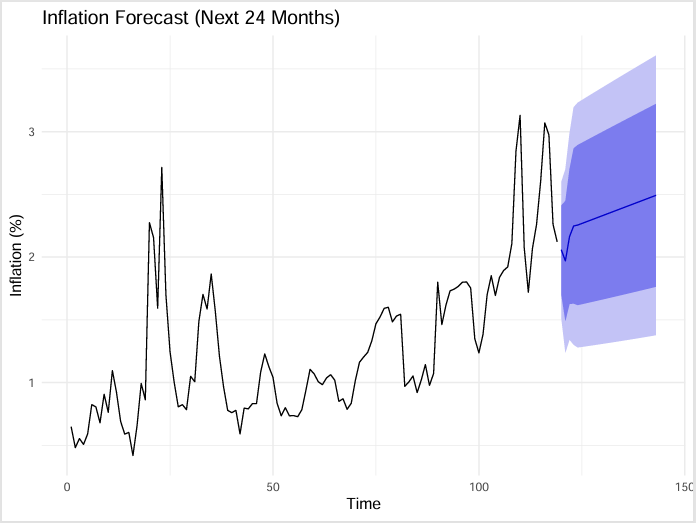
Inflation is a long-term, steady rise in the average price of goods and services. Its volatility weakens purchasing power, distorts income distribution, discourages investment and savings, and threatens macroeconomic stability. This study examined the relationship between the Consumer Price Index (CPI) and Financial Institutions’ Credit Deposit (FICD) ratio using regression, ARIMA, and GARCH models to forecast inflation. Data from the National Bureau of Statistics (2015-2024) and Central Bank of Nigeria were analyzed. Descriptive results showed high variability in inflation (mean = 1.29%, SD = 0.59, skewness = 1.05) and moderate variability in FICD (mean = 8.69, SD = 2.62, skewness = 0.36). Regression results indicated a negative but insignificant effect of FICD on inflation (β = −0.0177, p = 0.3977). The Augmented Dickey-Fuller test confirmed stationarity (p = 0.01). ARIMA(2,2,1) captured inflation persistence, while GARCH(2,3) identified mild volatility. Johansen cointegration tests revealed no long-run equilibrium among CPI, inflation, and FICD. Findings suggest that structural and cost-push factors drive inflation, requiring stronger monetary transmission and efficient credit allocation for price stability.
References
[1] P. A. Samuelson & W. D. Nordhaus, Economics, 19th ed., McGraw-Hill Education, New York, USA (2010). https://books.google.com.ng/books/about/EBOOK_Economics.html?id=rMovEAAAQBAJ&redir_esc=y.
[2] National Bureau of Statistics (NBS), Consumer price index report, March 2021, 2021. https://nigerianstat.gov.ng/elibrary (Accessed July 20, 2025).
[3] Bureau of Economic Analysis (BEA), Gross domestic product: implicit price deflator, 2019. https://www.bea.gov/data/gdp/gross-domestic-product (Accessed July 21, 2025).
[4] National Bureau of Statistics (NBS), Consumer Price Index Report, December 2016, 2016. https://nigerianstat.gov.ng/elibrary (Accessed July 20, 2025).
[5] World Bank, Nigeria development update: rising to the challenge, 2020. https://www.worldbank.org/en/country/nigeria/publication/nigeria-development-update-ndu (Accessed July 20, 2025).
[6] O. P. Idisi, P. Ojokojo & E. S. Fidelis, ‘‘Causes and drivers of inflation in Nigeria: a comprehensive review,’’ World Journal of Advanced Research and Reviews, 19 (2023) 779. https://doi.org/10.30574/wjarr.2023.19.1.1376.
[7] N. Adeleye, A. A. Ogundipe, O. Ogundipe, I. Ogunrinola & O. Adediran, ‘‘Internal and external drivers of inflation in Nigeria,’’ Banks and Bank Systems 14 (2019) 206. http://dx.doi.org/10.21511/bbs.14(4).2019.19. DOI: https://doi.org/10.21511/bbs.14(4).2019.19
[8] A. A. Nadani & A. Isah, ‘‘The effectiveness of monetary policy transmission in Nigeria: evidence from the monetary policy rate and the cash reserve ratio,’’ CBN Journal of Applied Statistics 15 (2024) 117. https://doi.org/10.33429/Cjas.15124.5/8. DOI: https://doi.org/10.33429/Cjas.15124.5/8
[9] S. F. Mohammed, N. Gambo & O. J. Oketta, ‘‘Inflation dynamics and monetary policy effectiveness in Nigeria,’’ European Journal of Accounting, Auditing and Finance Research 13 (2025) 1. https://doi.org/10.37745/ejaafr.2013/vol13n9119. DOI: https://doi.org/10.37745/ejaafr.2013/vol13n9119
[10] N. D. Nwaonuma & U. Ebubechima, ‘‘Unemployment, Inflation and Economic Growth: Evidence from Nigeria’’, African Journal of Politics and Administrative Studies 16 (2023) 762. https://dx.doi.org/10.4314/ajpas.v16i2.40. DOI: https://doi.org/10.4314/ajpas.v16i2.40
[11] G. A. Anidiobu, P. I. P. Okolie & D. C. Oleka, ‘‘Analysis of inflation and its effect on economic growth in Nigeria’’, IOSR Journal of Economics and Finance 9 (2018) 28. https://www.iosrjournals.org/iosr-jef/papers/Vol9-Issue1/Version-4/E0901042836.pdf.
[12] F. A. Anyanwu, A. C. Ananwude & N. T. Okoye, Exchange rate policy and Nigeria’s economic growth: a Granger causality impact assessment'', International Journal of Applied Economics, Finance and Accounting 1(1) (2017) 1. https://doi.org/10.33094/8.2017.11.1.13. DOI: https://doi.org/10.33094/8.2017.11.1.13
[13] U. N. Anyanwu, C. U. Kalu, O. O. Mgbemena & K. Madubuike, ‘‘Exchange rate dynamics and inflation targeting monetary policy in Nigeria: evidence from normalized co-integration analysis’’, Social Science and Law Journal of Policy Review and Development Strategies 11 (2025) 179. https://internationalpolicybrief.org/wp-content/uploads/2025/04/ARTICLE-14-3.pdf DOI: https://doi.org/10.48028/iiprds/ssljprds.v11.i1.14
[14] C. I. Ezeanyeji, C. O. Obi, C. P. Imoagwu, & U. F. Ejefobihi, ‘‘Monetary policy and inflation control: the case of Nigeria,’’ European Journal of Economic and Financial Research, 6 (2021) 1. https://www.oapub.org/soc/index.php/EJEFR/article/view/1172. DOI: https://doi.org/10.46827/ejmms.v6i2.1017
[15] National Bureau of Statistics (NBS), Annual Abstract of Statistics: Conin Nigeria: a comprehensive review,’’ World Journal of Advanced Research and Reviews 19 (2023) 779. https://doi.org/10.30574/wjarr.2023.19.1.1376. DOI: https://doi.org/10.30574/wjarr.2023.19.1.1376
[16] Central Bank of Nigeria (CBN), Statistical bulletin: key macroeconomic indicators, 2024. https://www.cbn.gov.ng/documents/Statbulletin.html (Accessed July 21, 2025).
[17] D. R. Anderson, D. J. Sweeney & T. A. Williams, Statistics for business and economics, Cengage Learning, Boston, USA (2012). https://books.google.com.ng/books/about/Statistics_for_Business_Economics.html?id=6r0aCgAAQBAJ&redir_esc=y.
[18] D.P. Brockwell & R. A. Davis, Introduction to time series and forecasting, Springer, New York, USA (2002). https://link.springer.com/book/10.1007/978-3-319-29854-2. DOI: https://doi.org/10.1007/b97391
[19] R.J. Hyndman & G. Athanasopoulos, Forecasting: Principles and Practice, OTexts, Melbourne, Australia (2008). https://otexts.com/fpp3/.
[20] G.E.P. Box, G.M. Jenkins, G.C. Reinsel & G.M. Ljung, Time series analysis: forecasting and control, John Wiley & Sons, Hoboken, USA (2015). https://doi.org/10.1002%2F9781118619193.fmatter.
[21] J. M. Wooldridge, Econometric analysis of cross section and panel data, MIT Press, Cambridge, USA (2010). https://ipcid.org/evaluation/apoio/Wooldridge%20-%20Cross-section%20and%20Panel%20Data.pdf.
[22] T. Bollerslev, ‘‘Generalized Autoregressive Conditional Heteroskedasticity’’, Journal of Econometrics, 31 (1986) 307. https://doi.org/10.1016/0304-4076(86)90063-1. DOI: https://doi.org/10.1016/0304-4076(86)90063-1
[23] S. Johansen, ‘‘Estimation and hypothesis testing of cointegration vectors in Gaussian vector autoregressive models’’, Econometrica: Journal of the Econometric Society 59 (1991) 1551. https://www.jstor.org/stable/2938278. DOI: https://doi.org/10.2307/2938278
[24] R. F. Engle & C. W. J. Granger, ‘‘Co-integration and error correction: representation, estimation, and testing’’, Econometrica: Journal of the Econometric Society 55 (1987) 251. http://www.jstor.org/stable/1913236?origin=JSTOR-pdf. DOI: https://doi.org/10.2307/1913236
[25] R. G. Brown, Smoothing, forecasting and prediction of discrete time series, Prentice-Hall, Englewood Cliffs, USA (1959). https://doi.org/10.2307/2344012. DOI: https://doi.org/10.2307/2344012
[26] W. H. Greene, Econometric analysis, 7th ed., Pearson Education Limited, Harlow, England (2012). https://elibrary.pearson.de/book/99.150005/9781292231150.
Published
How to Cite
Issue
Section
Copyright (c) 2025 Benson Ade Eniola Afere, Yahaya Baba Usman, Ekele Alih, Ekele Vincent Aguda, Latifat Enesi

This work is licensed under a Creative Commons Attribution 4.0 International License.