
Diurnal solar energy and temperature changes over Nigeria using satellite data
Keywords:
Global horizontal irradiance, Temperature, Diurnal variability, Nigeria’s climatic zonesAbstract
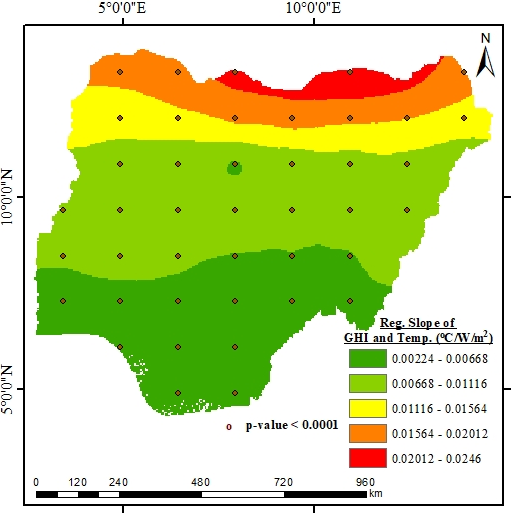
This study investigated the diurnal variability of global horizontal irradiance (GHI) and surface temperature across Nigeria’s major climatic zones. Daily all-sky surface shortwave downward irradiance and 2-m air temperature data spanning 2001–2023 were obtained from the Modern-Era Retrospective Analysis for Research and Applications, Version 2 (MERRA-2). The daily datasets were aggregated into monthly means and analyzed across four climatological seasons. Daily variability was quantified using standard deviation, while long-term trends were assessed using simple linear regression, with statistical significance evaluated at p < 0.05. The relationship between GHI and surface temperature was examined using Pearson’s correlation coefficient. Results show that daily GHI variability was highest in the southern tropical monsoon and tropical rainforest zones, whereas daily temperature variability was greatest in the northern warm desert and warm semi-arid regions. Monthly analysis revealed that GHI peaked in April over northern zones but reached maximum values in February across other regions. Surface temperature was highest between March and May, but lowest in August for the tropical monsoon, tropical rainforest, and Mediterranean climates; January for the warm semi-arid and warm desert climates; and December for the tropical savanna climate. Correlation analysis indicated very weak to moderate relationships between GHI and surface temperature. Regression results revealed a very weak to weak positive relationship, with significant differences across all locations examined ($p < 0.0001$). Long-term trends showed a slight increase in GHI across all climatic zones, while surface temperature increased marginally in most regions except the northern warm semi-arid and warm desert zones.
References
[1] R. Geiger, R. H. Aron & P. Todhunter, The climate near the ground, fifth ed. Friedr. Vieweg & Sohn Verlagsgesellschaft mbH, Braunschweig/Wiesbaden, 1995, pp 5–50. https://link.springer.com/chapter/10.1007/978-3-322-86582-3_2.
[2] O. O. Soneye, M. A. Ayoola, I. A. Ajao & O. O. Jegede, “Diurnal and seasonal variations of the incoming solar radiation flux at a tropical station, Ile-Ife, Nigeria”, Heliyon 5 (2019) 1. https://doi.org/10.1016/j.heliyon.2019.e01673. DOI: https://doi.org/10.1016/j.heliyon.2019.e01673
[3] M. A. Ayoola, L. A. Sunmonu, M. I. Bashiru & O. O. Jegede, “Measurements of net all wave radiation at a tropical location, Ile-Ife, Nigeria”, Atmosfera 27 (2014) 305. https://doi.org/10.1016/S0187-6236(14)71118-X. DOI: https://doi.org/10.1016/S0187-6236(14)71118-X
[4] O. O. Jegede, “Diurnal variations of net radiation at a tropical station - Osu; Nigeria”, Theor. Appl. Climatol. 58 (1997) 161. https://doi.org/10.1007/BF00865016. DOI: https://doi.org/10.1007/BF00865016
[5] O. O. Jegede, E. O. Ogolo & T. O. Aregbesola, “Estimating net radiation using routine meteorological data at a tropical location in Nigeria”, Int’l Journal of Sustainable Energy 25 (2006) 107. https://doi.org/10.1080/14786450600593261. DOI: https://doi.org/10.1080/14786450600593261
[6] S. E. Falodun & E. O. Ogolo, “Diurnal and seasonal variations of global solar radiation at Akure, South-Western Nigeria”, J. Eng. Appl. Sci. 2 (2007) 125. https://makhillpublications.co/files/published-files/mak-jeas/2007/1-125-128.pdf.
[7] E. O. Ogolo, S. E. Falodun, S. S. Oluyamo & E. F. Nymphas, “Analysis of data on net longwave, shortwave and global radiation during transition period in a tropical station in Southwestern Nigeria”, Indian Journal of Radio Space Phys. 38 (2009) 347. https://nopr.niscpr.res.in/bitstream/123456789/6902/1/IJRSP%2038%286%29%20347-352.pdf.
[8] M. O. Adeniyi, E. F. Nymphas & E. O. Oladiran, “Characteristics of total solar radiation in an urban tropical environment”, International Journal of Physical Sciences 7 (2012) 5154. https://doi.org/10.5897/IJPS09.253. DOI: https://doi.org/10.5897/IJPS09.253
[9] O. R. Oladosu, A. T. Adediji, J. S. Ojo & A. Adegbite, “Daily averages of solar radiation measured at Iju, Nigeria in 2008” International Journal of Physical Sci. 7 (2012) 5026. https://doi.org/10.5897/IJPS11.377. DOI: https://doi.org/10.5897/IJPS11.377
[10] D. O. Akpootu & S. Aruna, “Diurnal and seasonal variations of global solar radiation in Akure, Ondo state, South Western Nigeria”, The Int’l Journal of Engineering and Sc. 2 (2013) 80. https://theijes.com/papers/v2-i12/Version-3/Version-3/L021203080089.pdf.
[11] O. S. Adedoja, B. G. Ayantunji, U. A. Saleh & S. S. Jatto, “Diurnal and seasonal variation of global solar radiation at Anyigba, North-Central Nigeria”, International Journal of Engineering Science and Innovative Technology 4 (2015) 140. https://www.ijesit.com/Volume%204/Issue%204/IJESIT201504_19.pdf.
[12] I. U. Chiemeka, “Estimation of solar radiation at Uturu, Nigeria”, Int. J. Phys. Sci. 3 (2008) 126. https://doi.org/10.5897/IJPS.9000238.
[13] T. Igbawua, A. A. Tyovenda, T. Sombo & I. M. Echi, “Spatio-temporal assessment of aerosol-induced atmospheric heating rates in Nigeria”, J. Nig. Soc. Phys. Sci. 7 (2025) 1918. https://doi.org/10.46481/jnsps.2025.1918. DOI: https://doi.org/10.46481/jnsps.2025.1918
[14] H. E. Beck, T. R. McVicar, N. Vergopolan, A. Berg, N. J. Lutsko, A. Dufour, Z. Zeng, X. Jiang, A. I. J. M van Dijk & D. G. Miralles, “High-resolution (1 km) Köppen-Geiger maps for 1901–2099 based on constrained CMIP6 projections”, Scientific Data 10 (2023) 724. https://doi.org/10.1038/s41597-023-02549-6. DOI: https://doi.org/10.1038/s41597-023-02549-6
[15] A. A. Prasad, R. A. Taylor & M. Kay, “Assessment of direct normal irradiance and cloud connections using satellite data over Australia”, Applied Energy 143 (2015) 301. http://dx.doi.org/10.1016/j.apenergy.2015.01.050. DOI: https://doi.org/10.1016/j.apenergy.2015.01.050
[16] B. F. Murphy & B. Timbal, “A review of recent climate variability and climate change in southeastern Australia”, International Journal of Climatology 28 (2008) 859. https://doi.org/10.1002/joc.1627. DOI: https://doi.org/10.1002/joc.1627
[17] M. Journée, R. Müller & C. Bertrand, “Solar resource assessment in the Benelux by merging Meteosat-derived climate data and ground measurements”, Solar Energy 86 (2012) 3561. http://dx.doi.org/10.1016/j.solener.2012.06.023. DOI: https://doi.org/10.1016/j.solener.2012.06.023
Published
How to Cite
Issue
Section
Copyright (c) 2025 Louis Tersoo Abiem, David Inalegwu

This work is licensed under a Creative Commons Attribution 4.0 International License.