Environmental and health impacts of coal occurrence and exploitation in Akunza mighili, North central Nigeria
Keywords:
Akunza mighili, Coal, Tmax, Heavy metal pollution index, X-ray fluorescenceAbstract
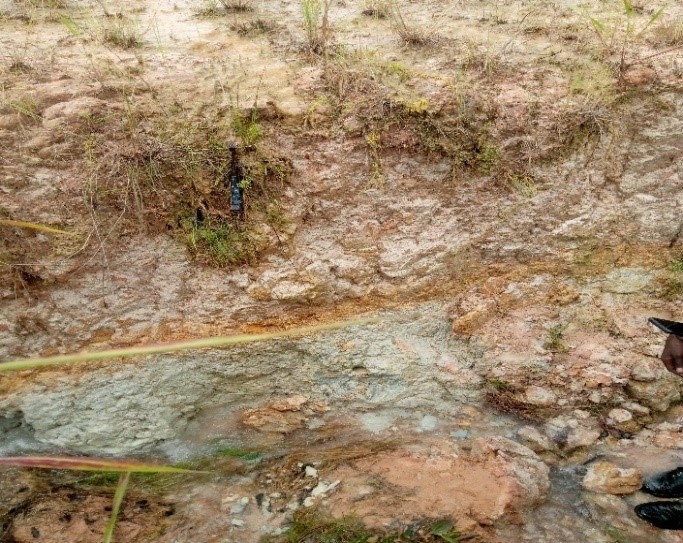
Akunza Mighili is a community in the outskirts of Lafia widely known for extensive coal mining activities. However, no assessment has been conducted on the impact of this mining on the environment and health hazards. This research aims to investigate the environmental and health impacts of coal exploitation in Akunza Mighili. Five representative rock samples were collected during field mapping and analyzed to determine their elemental and mineralogical constituents using X-ray fluorescence (XRF) and X-ray diffraction (XRD). Additionally, two coal samples were subjected to rock eval pyrolysis. A total of twenty groundwater samples were collected and analyzed using atomic absorption spectroscopy (AAS). Measurement of groundwater physical parameters was also conducted during the field mapping. Field results indicated that the area primarily consists of shale interbedded with coal seams, ferruginous sandstone, ferruginous siltstone, and minor occurrences of mudstone. Based on the XRD and XRF results, graphite is the dominant mineral in coal while SO3 and SiO2 represent the dominant major oxides. The coal samples in the area are immature for oil generation based on their maximum pyrolysis temperature (Tmax). In the groundwater of the area, the order of parameters is pH > Total Dissolved Solids (TDS) > Temperature (T) > Electrical Conductivity (EC), while the concentration of heavy metals follows this order: Fe > Zn > Cu > Co > Cd > Mn > Cr > Ni > Pb > Hg. The assessment of heavy metal pollution indicated that the groundwater in the area is significantly polluted, which poses serious health risks.
References
[1] A. Alhasan, I. Ozturk, M. F. Al-Zyoud & F. V. Bekun, ‘‘Coal consumption–environmental sustainability nexus in developed and developing major coal-consuming economies’’, Heliyon 10 (2024) e25619. https://doi.org/10.1016/j.heliyon.2024.e25619. DOI: https://doi.org/10.1016/j.heliyon.2024.e25619
[2] M. Song, J. Chen, Y. Feng, S. Xu, S. Zhao & Q. Xing, ‘‘Global emissions from coal consumption’’, in China’s coal consumption, emissions, and energy security, Resources, Climate and Sustainable Development Series, Springer, Singapore, 2025, pp. 131. https://doi.org/10.1007/978-981-99-3407-9_8. DOI: https://doi.org/10.1007/978-981-96-5577-9_4
[3] L. Li, Y. Lei & D. Pan, ‘‘Economic and environmental evaluation of coal production in China and policy implications’’, Nat. Hazards 77 (2015) 1125. https://doi.org/10.1007/s11069-015-1644-9. DOI: https://doi.org/10.1007/s11069-015-1650-9
[4] S. Goswami, ‘‘Impact of coal mining on environment’’, European Researcher 92 (2015) 185. https://doi.org/10.13187/er.2015.92.185. DOI: https://doi.org/10.13187/er.2015.92.185
[5] P. Gopinathan, T. Subramani, S. Barbosa & D. Yuvaraj, ‘‘Environmental impact and health risk assessment due to coal mining and utilization’’, Environmental Geochemistry and Health (2023). https://doi.org/10.1007/s10653-023-01744-z. DOI: https://doi.org/10.1007/s10653-023-01744-z
[6] S. I. Chibuisi, ‘‘Environmental and health implications of coal mining at Maiganga, Gombe State, Nigeria’’, Journal of Environmental Pollution and Human Health 5 (2017) 1. https://doi.org/10.12691/jephh-5-1-2.
[7] I. L. Oltean, T. Goldan & C. M. Nistor, ‘‘Prevention and monitoring environmental impact of open pit coal mining activities’’, Research Journal of Agricultural Science 50 (2018) 259. https://rjas.ro/wp-content/uploads/2018/07/38.pdf.
[8] M. Davies, ‘‘Assessment of the impact of mining activities on land use and land cover changes in Gatumba area, Rwanda’’, International Journal of Innovative Science and Research Technology 8 (2023) 723. https://ijisrt.com/assessment-of-the-impact-of-mining-activities-on-land-use-and-land-cover-changes. DOI: https://doi.org/10.53819/81018102t2419
[9] S. Goswami, ‘‘Environmental impact assessment of coal mining: Indian scenario’’, European Researcher 83 (2014) 1651. https://doi.org/10.13187/er.2014.83.1651. DOI: https://doi.org/10.13187/er.2014.83.1651
[10] R. O. Mkpuma, O. C. Okeke & E. M. Abraham, ‘‘Environmental problems of surface and underground mining: a review’’, International Journal of Engineering Science 4 (2015) 12. https://www.theijes.com/papers/vol4-issue12/Version-1/C0412012020.pdf.
[11] R. B. Finkelman, ‘‘Potential health impacts of burning coal beds and waste banks’’, International Journal of Coal Geology 59 (2004) 19. https://doi.org/10.1016/j.coal.2003.11.002. DOI: https://doi.org/10.1016/j.coal.2003.11.002
[12] C. Kamanzi, M. Becker, M. Jacobs, P. Konečný, P. von Holdt & J. Broadhurst, ‘‘The impact of coal mine dust characteristics on pathways to respiratory harm: investigating the pneumoconiotic potency of coals’’, Environmental Geochemistry and Health (2023). https://doi.org/10.1007/s10653-023-01583-y. DOI: https://doi.org/10.1007/s10653-023-01583-y
[13] D. Jin & Z. Bian, ‘‘Quantifying the emissions impact of coal mining activities on the environment and human health’’, Journal of Coal Science and Engineering 19 (2013) 421. https://doi.org/10.1007/s12404-013-0405-2. DOI: https://doi.org/10.1007/s12404-013-0326-x
[14] M. Bortolotti, L. Lutterotti & G. Pepponi, ‘‘Combining XRD and XRF analysis in one Rietveld-like fitting’’, Powder Diffr. 32 (2017) S225. https://doi.org/10.1017/S0885715617000276. DOI: https://doi.org/10.1017/S0885715617000276
[15] T. Radu & D. Diamond, ‘‘Comparison of soil pollution concentrations determined using AAS and portable XRF techniques’’, Journal of Hazardous Materials 171 (2009) 1168. https://doi.org/10.1016/j.jhazmat.2009.06.062. DOI: https://doi.org/10.1016/j.jhazmat.2009.06.062
[16] V. Singh & H. M. Agrawal, ‘‘Qualitative soil mineral analysis by EDXRF, XRD and AAS probes’’, Radiation Physics and Chemistry 81 (2012) 1796. https://doi.org/10.1016/j.radphyschem.2012.07.002. DOI: https://doi.org/10.1016/j.radphyschem.2012.07.002
[17] A. M. Abdelgawad, K. Watanabe, S. Takeuchi & T. Mizuno, ‘‘The origin of fluoride-rich groundwater in Mizunami area, Japan—mineralogy and geochemistry implications’’, Engineering Geology 108 (2009) 76. https://doi.org/10.1016/j.enggeo.2009.06.016. DOI: https://doi.org/10.1016/j.enggeo.2009.06.016
[18] D. P. Singh & N. Sharma, ‘‘Heavy metal pollutants in water and their detection techniques’’, International Journal of Chemical Studies 9 (2021) 669. https://www.chemijournal.com/archives/2021/vol9issue1/PartK/9-1-144-921.pdf.
[19] S. Cornaby et al., ‘‘An XRD/XRF instrument for the microanalysis of rocks and minerals’’, Measurement Science and Technology 12 (2001) 676. https://doi.org/10.1088/0957-0233/12/6/304. DOI: https://doi.org/10.1088/0957-0233/12/6/304
[20] B. N. Hupp & J. J. Donovan, ‘‘Quantitative mineralogy for facies definition in the Marcellus Shale (Appalachian Basin, USA) using XRD–XRF integration’’, Sedimentary Geology 371 (2018) 16. https://doi.org/10.1016/j.sedgeo.2018.04.007. DOI: https://doi.org/10.1016/j.sedgeo.2018.04.007
[21] O. B. Kaba, F. Souissi, D. Keita, L. O. Filippov, M. S. M. Conté & N. Kanari, ‘‘Mineral weathering and metal leaching under meteoric conditions in F-(Ba–Pb–Zn) mining waste of Hammam Zriba (NE Tunisia)’’, Materials 16 (2023) 7443. https://doi.org/10.3390/ma16237443. DOI: https://doi.org/10.3390/ma16237443
[22] A. Kamata&M. Katoh, ‘‘Arsenic release from marine sedimentary rock after excavation from urbanized coastal areas: oxidation of framboidal pyrite and subsequent natural suppression of arsenic release’’, Sci. Total Environ. 670 (2019) 752. https://doi.org/10.1016/j.scitotenv.2019.03.217. DOI: https://doi.org/10.1016/j.scitotenv.2019.03.217
[23] D. A. Purwaningsih, I. W. Redana, K. D. Harmayani & N. N. Pujianiki, ‘‘Evaluation of the potential for acid mine drainage formation from pit lake walls and its interaction with the aquifer system’’, J. Penelit. Pendidik. IPA 11 (2025) 839. https://doi.org/10.29303/jppipa.v11i5.11057. DOI: https://doi.org/10.29303/jppipa.v11i5.11057
[24] E. Marguí, I. Queralt & E. de Almeida, ‘‘X-ray fluorescence spectrometry for environmental analysis: basic principles, instrumentation, applications and recent trends’’, Chemosphere 303 (2022) 135006. https://doi.org/10.1016/j.chemosphere.2022.135006. DOI: https://doi.org/10.1016/j.chemosphere.2022.135006
[25] Y. A. Uvarova, J. S. Cleverley, A. Baensch & M. Verrall, ‘‘Coupled XRF and XRDanalyses for rapid and low-cost characterization of geological materials in the mineral exploration and mining industry’’, EXPLORE Newsl. Assoc. Appl. Geochem. 162 (2014) 1. https://www.appliedgeochemists.org/images/stories/explore/EXPLORE_162.pdf. DOI: https://doi.org/10.70499/IMTJ3814
[26] L. Findoráková, O. Šestinová, J. Hančul’ák, E. Fedorová & A. Zorkovská, ‘‘Assessment of sediment heavy metals pollution using screening methods (XRF, TGA/MS, XRPD and earthworms bioassay)’’, IOP Conf. Ser. Earth Environ. Sci. 44 (2016) 052024. https://doi.org/10.1088/1755-1315/44/5/052024. DOI: https://doi.org/10.1088/1755-1315/44/5/052024
[27] A. Haghighizadeh et al., ‘‘Comprehensive analysis of heavy metal soil contamination in mining environments: impacts, monitoring techniques, and remediation strategies’’, Arab. J. Chem. 17 (2024) 105777. https://doi.org/10.1016/j.arabjc.2024.105777. DOI: https://doi.org/10.1016/j.arabjc.2024.105777
[28] V. S. Kanwar, A. Sharma, A. L. Srivastav & L. Rani, ‘‘Phytoremediation of toxic metals present in soil and water environment: a critical review’’, Environ. Sci. Pollut. Res. 27 (2020) 44835. https://doi.org/10.1007/s11356-020-10713-3. DOI: https://doi.org/10.1007/s11356-020-10713-3
[29] N. L. Binbol, ‘‘A climate of Nasarawa State: report of geographical perspective on Nasarawa State’’, Department of Geography, Nasarawa State University, Keffi, Nigeria, 2006.
[30] S. C. Mohammed & M. Ali, ‘‘Hydrogeochemistry of the Middle Benue Trough, Nigeria’’, J. Water Resour. Ocean Sci. 7 (2019) 70. DOI: https://doi.org/10.11648/j.wros.20180705.11
[31] C. S. Nwajide, ‘‘Sedimentation and paleogeography of the Central Benue Trough, Nigeria’’, in The Benue trough: structure and evolution, C. Ofoegbu (Ed.), Vieweg, Braunschweig, Germany, 1990, pp. 19.
[32] M. E. Offodile & R. A. Rayment, ‘‘Stratigraphy of the Keana–Awe area of the Middle Benue region of Nigeria’’, Bull. Geol. Inst. Univ. Uppsala NS 7 (1977) 37.
[33] N. Obaje, Geology and mineral resources of Nigeria, Springer, Berlin, Germany, 2009. https://doi.org/10.1007/978-3-540-92685-6. DOI: https://doi.org/10.1007/978-3-540-92685-6
[34] N. D. Umar, O. Igwe & I. G. Idris, ‘‘Evaluation and characterization of groundwater of the Maastrichtian Lafia formation, Central Benue Trough, Nigeria’’, J. Earth Syst. Sci. 128 (2019) 168. https://doi.org/10.1007/s12040-019-1199-1. DOI: https://doi.org/10.1007/s12040-019-1199-1
[35] S. E. Obrike, A. I. Saleh, S. Iyakwari, K. G. Anudu&A. I. Magaji, ‘‘Hydrogeochemical evaluation, quality, and health risk assessment of groundwater in crystalline basement aquifer in Keffi, Nigeria’’, Int. J. EnergyWater Resour., 2023. DOI: https://doi.org/10.1007/s42108-023-00266-9
[36] S. Aliyu, ‘‘Hydrogeochemical processes and health risk assessment of groundwater within Federal University of Lafia and environs’’, M.Sc Thesis, Nasarawa State University, Keffi, Nigeria, 2024.
[37] O. R. Ekwule, G. D. Akpen & G. M. Ugbede, ‘‘The effect of coal mining on the water quality of water sources in Nigeria’’, Bartın Univ. Int. J. Nat. Appl. Sci. 2 (2019) 251.
[38] O. A. Opasola & E. Otto, ‘‘Evaluation of heavy metal levels and contamination indices of groundwater sources in Kaduna South Local Government Area, Kaduna State, Northern Nigeria’’, J Appl Sci Env. Manage 28 (2024) 1841. DOI: https://doi.org/10.4314/jasem.v28i6.25
[39] R. Appiah-Opong et al., ‘‘Heavy metals concentration and pollution index (HPI) in drinking water along the southwest coast of Ghana’’, Appl. Water Sci. 11 (2021) 57. https://doi.org/10.1007/s13201-021-01386-5. DOI: https://doi.org/10.1007/s13201-021-01386-5
[40] A. E. Edet & O. E. Offiong, ‘‘Evaluation of water quality pollution indices for heavy metal contamination monitoring: a study case from Akpabuyo- Odukpani area, Lower Cross River Basin, Southeastern Nigeria’’, GeoJournal 57 (2002) 295. DOI: https://doi.org/10.1023/B:GEJO.0000007250.92458.de
[41] S. Mishra, A. Jumar, S. Yada&M. K. Singhal, ‘‘Assessment of heavy metal contamination in water of Kali river using principle component and cluster analysis, India’’, J Sustain Water Resour Manag, 2017. https://doi.org/10.1007/s40899-017-0141-4. DOI: https://doi.org/10.1007/s40899-017-0141-4
[42] S. V. Mohan, P. Nithila & S. J. Reddy, ‘‘Estimation of heavy metals in drinking water and development of heavy metal pollution index’’, J Env. Sci Health 2 (1996) 283. DOI: https://doi.org/10.1080/10934529609376357
[43] WHO, Guidelines for Drinking Water Quality: Fourth Edition Incorporating the First Addendum, Geneva, Switzerland, 2017.
[44] J. C. Egbueri, C. K. Ezugwu, P. D. Ameh & C. O. Unigwe, ‘‘Appraising drinking water quality in Ikem rural area (Nigeria) based on chemometrics and multiple indexical methods’’, Env. Monit Assess 193 (2020) 1. https://doi.org/10.1007/s10661-020-08277-3. DOI: https://doi.org/10.1007/s10661-020-08277-3
[45] M. A. Akpanowo, N. Benson, G. B. Ekong, I. Umaru, S. Iyakwari & S. D. Yusuf, ‘‘Effect of artisanal mining on water quality: an assessment of water sources in local communities in Anka, Northwest Nigeria’’, ISABB J. Health Environ. Sci. 10 (2025) 13. https://doi.org/10.5897/ISAAB-JHE2023.0085. DOI: https://doi.org/10.5897/ISAAB-JHE2023.0085
[46] H. Blatt, G. Middleton & R. Murray, Origin of Sedimentary Rocks, Prince Hall, 1980.
[47] M. M. Herron, ‘‘Geochemical classification of terrigenous sands and shales from core or log data’’, J. Sediment. Petrol. 58 (1988) 820. DOI: https://doi.org/10.1306/212F8E77-2B24-11D7-8648000102C1865D
[48] J. Espitalié, G. Deroo & F. Marquis, ‘‘Rock-Eval pyrolysis and its applications’’, Rev. Institut Français Pet. 40 (1985) 563. https://doi.org/10.2516/ogst:1986003. DOI: https://doi.org/10.2516/ogst:1985035
[49] M. R. Shalaby, M. I. Haji Irwan, L. N. Osli&M. Aminul Islam, ‘‘Geochemical characteristics and depositional environments of the Narimba Formation source rock, Bass Basin, Australia’’, J. Pet. Explor. Prod. Technol., 2020. https://doi.org/10.1007/s13202-020-00992-4. DOI: https://doi.org/10.1007/s13202-020-00992-4
[50] F. F. Langford & M. M. Blanc-Valleron, ‘‘Interpreting Rock-Eval pyrolysis data using graphs of pyrolizable hydrocarbons vs. total organic carbon’’, AAPG Bull 76 (1990) 799. DOI: https://doi.org/10.1306/0C9B238F-1710-11D7-8645000102C1865D
[51] I. Y. Anzaku, T. B. Gbatse & N. G. Obaje, ‘‘Biomarker and bulk organic geochemical analysis of hydrocarbon generative potentials of the Ahoko Shales, Patti Formation, Bida Basin, Central Nigeria’’, DJOSTER 4 (2015) 1.
[52] B. P. Tissot & D. H. Welte, Petroleum Formation and Occurrence: A New Approach to Oil and Gas Exploration, Springer-Verlag, Berlin, 1978. DOI: https://doi.org/10.1007/978-3-642-96446-6
[53] SON, Nigerian Standard for Drinking Water Quality, Nigerian Industrial Standards, 2015.
[54] N. Subba Rao, Hydrogeology – Problems with Solutions, PHI Learning Private Limited, 2016.
[55] D. K. Todd, Groundwater Hydrology, Wiley, New York, 1980.
[56] B. J. Alloway, ‘‘Sources of heavy metals and metalloids in soils’’, in Heavy Metals in Soils, Dordrecht: Springer, 2013, pp. 11. DOI: https://doi.org/10.1007/978-94-007-4470-7_2
[57] K. Andreas, T. W. Richard & P. Thomas, ‘‘Cadmium in soil and groundwater: a review’’, Appl. Geochem. 108 (2019) 104388. https://doi.org/10.1016/j.apgeochem.2019.104388. DOI: https://doi.org/10.1016/j.apgeochem.2019.104388
[58] C. Tokatli & F. Ustaoglu, ‘‘Health risk assessment of toxicants in Meriç river delta wetland, Thrace region, Turkey’’, Env. Earth Sci. 7 (2020) 1. https://doi.org/10.1007/s12665-020-09171-4. DOI: https://doi.org/10.1007/s12665-020-09171-4
[59] A. Kabata-Pendias & A. Mukherjee, Trace Elements from Soil to Human, Springer-Verlag, 2007. DOI: https://doi.org/10.1007/978-3-540-32714-1
[60] ATSDR, Toxicological Profile for Chromium, U.S Department of Health and Human Services, Public Health Service, 2012.
[61] P. Maria, Eleni Vasileiou & B. Georgios, ‘‘Tracing the origin of chromium in groundwater: current and new perspectives’’, Curr. Opin. Environ. Sci. Health 22 (2021) 100267. https://doi.org/10.1016/j.coesh.2021.100267. DOI: https://doi.org/10.1016/j.coesh.2021.100267
[62] R. Ali, H. Hossein, H. Sara, J. Nima, F. M. Seyedah Belgheys & Samira Rezaei, ‘‘Evaluation of groundwater quality and heavy metal pollution indices in Bazman Basin, Southeastern Iran’’, Groundw. Sustain. Dev. 9 (2019) 100245. https://doi.org/10.1016/j.gsd.2019.100245. DOI: https://doi.org/10.1016/j.gsd.2019.100245
[63] V. Sheykhi & F. Moore, ‘‘Geochemical characterization of Kor River water quality, Fars Province, South Iran’’, Water Qual. Expo Health 4 (2012) 25. https://doi.org/10.1007/s12403-012-0063. DOI: https://doi.org/10.1007/s12403-012-0063-1
[64] C. I. Umoru, A. S. Atodo, A. S. Usman, S. Abdulrahman & C. Bitrus, ‘‘The impact of coal mining on water around Okobo and Odagbo area, Ankpa, North-Central Nigeria’’, FUDMA J. Sci. 8 (2024) 550. https://doi.org/10.33003/fjs-2024-0806-3018. DOI: https://doi.org/10.33003/fjs-2024-0806-3018
[65] A. Rashid et al., ‘‘Heavy metal contamination in agricultural soil: environmental pollutants affecting crop health’’, Agronomy 13 (2023) 1521. https://doi.org/10.3390/agronomy13061521. DOI: https://doi.org/10.3390/agronomy13061521
[66] W. Xu, Y. Jin & G. Zeng, ‘‘Introduction of heavy metals contamination in the water and soil: a review on source, toxicity and remediation methods’’, Green Chem. Lett. Rev. 17 (2024) 2404235. https://doi.org/10.1080/17518253.2024.2404235. DOI: https://doi.org/10.1080/17518253.2024.2404235
[67] WHO, World Health Organization End of Year Report, Geneva, 2003.
[68] ATSDR, Toxicological Profile for Cobalt, U.S Department of Health and Human Services, Public Health Service, 2020.
[69] IARC, Cobalt in hard metals and cobalt sulfate, Gallium Arsenide, Indium Phospide and Vanadium Pentoxide, IARC Monograph on the Evaluation of Carcinogenic Risks to Humans, 2006.
[70] L. Leyssens, B. Vinck, C. Van Der Straeten, F. Wuyts & L. Maes, ‘‘Cobalt toxicity in humans – a review of the potential sources and health effects’’, Toxicology 387 (2017) 43. https://doi.org/10.1016/j.tox.2017.05.015. DOI: https://doi.org/10.1016/j.tox.2017.05.015
[71] A. Linna, P. Oska, P. Palmroos, P. Roto, P. Laippala & J. Uitti, ‘‘Respiratory health of cobalt production workers’’, Am J Ind Med 44 (2003) 124. https://doi.org/10.1002/ajim.10258. DOI: https://doi.org/10.1002/ajim.10258
[72] ATSDR, Toxicological Profile for Cadmium, U.S Department of Health and Human Services, Public Health Service, 2012.
[73] J. Chen et al., ‘‘Coal utilization in China: environmental impacts and human health’’, Environ. Geochem. Health 36 (2014) 35. DOI: https://doi.org/10.1007/s10653-013-9592-1
[74] E. M. Muhammad, ‘‘Human health and environmental impacts of coal combustion and post-combustion wastes’’, J. Sustain. Min. 17 (2018) 87. https://doi.org/10.1016/j.jsm.2017.12.007. DOI: https://doi.org/10.1016/j.jsm.2017.12.007
[75] S. Mukherjee, ‘‘Concept of geomedicine and medicinal mineralogy’’, in Applied Mineralogy: Applications in Industry and Environment, New Dehli: Capital Publishing Company, 2011, pp. 526. DOI: https://doi.org/10.1007/978-94-007-1162-4_19
[76] D. G. Badman & E. R. Jaffe MD, ‘‘Blood and air pollution: state of knowledge and research needs’’, Otolaryngol.-Head Neck Surg. 114 (1996) 205. https://doi.org/10.1016/S0194-5998(96)70166-3. DOI: https://doi.org/10.1016/S0194-59989670166-3
[77] IPCC, Climate Change 2021: The Physical Science Basis, Cambridge University
Press, 2021.
[78] Y. Chen et al., ‘‘Spatiotemporal distribution, sources apportionment and ecological risks of PAHs: a study in the Wuhan section of the Yangtze River’’, Environ. Geochem. Health, 2023. https://doi.org/10.1007/s10653-023-01500-3. DOI: https://doi.org/10.1007/s10653-023-01500-3
[79] N. Mahlangeni, T. Kapwata, T. Laban & C. Y. Wright, ‘‘Health risks of exposure to air pollution in areas where coal-fire power plants are located: protocols for scoping review’’, 19 (2024) 1. https://doi.org/10.1136/bmjopen-2024-084074. DOI: https://doi.org/10.1136/bmjopen-2024-084074
[80] Y. Qian, K. Yuan, J.Wang, Z. Xu, H. Liang & C. Tie, ‘‘Parent and alkylated polycyclic aromatic hydrocarbon emissions from coal seam fire at Wuda, Inner Mongolia, China: characteristics, spatial distribution, sources, and health risk assessment’’, Environ. Geochem. Health, 2023. https://doi.org/10.1007/s10653-023-01476-0. DOI: https://doi.org/10.1007/s10653-023-01476-0
[81] C. Chen-Lin, ‘‘Sulfur in coals: a review of geochemistry and origins’’, Int. J. Coal Geol. 100 (2012) 1. https://doi.org/10.1016/j.coal.2012.05.009. DOI: https://doi.org/10.1016/j.coal.2012.05.009
[82] B. Ryan & L. Angelo, ‘‘A review of sulphur in coal: with specific reference to the Telkwa deposit, North-Western’’, Br. Columbia Geol. Fieldwork, (1997) 1998.
[83] Y. Shen, Y. Hu, M. Wang, W. Bao, L. Chand & K. Xie, ‘‘Speciation and thermal transformation of sulfur-coal and its utilization in coal-blending coking process: a review’’, Chin. J. Chem. Eng., 2021. https://doi.org/10.1016/j.cjche.2021.04.007. DOI: https://doi.org/10.1016/j.cjche.2021.04.007
[84] G. Twagirayezu et al., ‘‘A critical review of acid rain: causes, effects, and mitigation measures’’, Nov. Perspect. Geogr. Environ. Earth Sci. 6 (2024) 23. https://doi.org/10.9734/bpi/npgees/v6/5127A. DOI: https://doi.org/10.9734/bpi/npgees/v6/5127A
[85] P. Sedyaaw et al., ‘‘A review on acid rain, its causes, effects and management measures’’, Int. J. Creat. Res. Thoughts 12 (2024) 959. DOI: https://doi.org/10.18805/BKAP732
[86] M. Scheiber, M. Otto, P. S. Fedotov & R. Wennrich, ‘‘Dynamic studies on the mobility of trace elements in soil and sediment samples influenced by dumping of residues of the flood in the Mulde River region in 2002’’,Chemosphere 61 (2005) 107. https://doi.org/10.1016/j.chemosphere.2005.02.096. DOI: https://doi.org/10.1016/j.chemosphere.2005.02.096
[87] T. Arao, S. Ishikawa, M. Murakami, K. Abe, Y. Maejima & T. Makino, ‘‘Heavy metal contamination of agricultural soil and countermeasures in Japan’’, Paddy Water Environ. 8 (2010) 247. https://doi.org/10.1007/s10333-010-0205-7. DOI: https://doi.org/10.1007/s10333-010-0205-7
[88] S. Sen, R. Mitra, S. Mukherjee, P. K. Das&S. Moittra, ‘‘Silicosis in current scenario: a review of literature’’, Curr. Respir. Med. Rev. 12 (2016) 56. DOI: https://doi.org/10.2174/1573398X11666151026221845
[89] E. Hnizdo & V. Vallyathan, ‘‘Chronic obstructive pulmonary disease due to occupational exposure to silica dust: a review of epidemiological and pathological evidence’’, Occup Env. Med 60 (2003) 237. https://doi.org/10.1136/oem.60.4.237. DOI: https://doi.org/10.1136/oem.60.4.237
[90] C. Zinman, G. A. Richards, J. Murray, J. I. Phillips, D. J. Rees & R. G. Thomas, ‘‘Mica dust as a cause of severe pneumoconiosis’’, Am. J. Ind. Med. 41 (2002) 139. DOI: https://doi.org/10.1002/ajim.10032
[91] DHHS, Coal Mine Dust Exposures and Associated Health Outcomes, Centers for Disease Control and Prevention National Institute for Occupational Safety and Health, 2011.
[92] R. Cohen, E. Petsonk, C. Rose, B. Young, M. Ragier & F. Green, ‘‘Lung pathology in U.S. coal workers with rapidly progressive pneumoconiosis implicates silica and silicates’’, American Journal of Respiratory and Critical Care Medicine 15 (2016) 673. https://stacks.cdc.gov/view/cdc/202233. DOI: https://doi.org/10.1164/rccm.201505-1014OC
[93] E. Petsonk, C. Rose & R. Cohen, ‘‘Coal mine dust lung disease. New lessons from old exposure’’, Am J Respir Crit Care Med 1 (2013) 1178. https://doi.org/10.1164/rccm.201301-0042CI. DOI: https://doi.org/10.1164/rccm.201301-0042CI
[94] C. J. B. Gomes, C. A. B. Mendes & J. F. C. L. Costa, ‘‘The environmental impact of coal mining: a case study in Brazil’s Sangao watershed’’, Mine Water Environ. 30 (2011) 159. DOI: https://doi.org/10.1007/s10230-011-0139-3
[95] B. D. Johnson & B. K. Hallberge, ‘‘Acid mine drainage remediation options: a review’’, Sci. Total Environ. 338 (2005) 3. https://doi.org/10.1016/j.scitotenv.2004.09.002. DOI: https://doi.org/10.1016/j.scitotenv.2004.09.002
[96] J. M. Hammarstrom, R. R. Seal II, A. L. Meier & J. M. Kornfeld, ‘‘Secondary sulfate minerals associated with acid drainage in the Eastern US: recycling of metals and acidity in surficial environments’’, Chem. Geol. 215 (2005) 407. https://doi.org/10.1016/j.chemgeo.2004.06.053. DOI: https://doi.org/10.1016/j.chemgeo.2004.06.053
[97] J. Wang, L. Guo, Z. Bai, R. Yang & M. Zhang, ‘‘Succession law of reclaimed soil and vegetation on opencast coal mine dump of Loess area’’, Trans. Chin. Soc. Agric. Eng 29 (2013) 223.
[98] Z. Bian, H. Inyang, J. L. Daniels, F. Otto & S. Struthers, ‘‘Environmental issues from coal mining and their solutions’’, Min. Sci. Technol. China 20 (2010) 215. https://doi.org/10.1016/S1674-5264(09)60187. DOI: https://doi.org/10.1016/S1674-5264(09)60187-3
[99] Y. Huang, F. Tian, Y. Wang, M. Wang & Z. Hu, ‘‘Effect of coal mining on vegetation disturbance and associated carbon loss’’, Env. Earth Sci 73 (2015) 2329. https://doi.org/10.1007/s12665-014-3584-z. DOI: https://doi.org/10.1007/s12665-014-3584-z
[100] A. Roy, ‘‘Impact of coal mining on vegetation’’, Int. J. Ecol. Environ. Sci.
4 (2022) 74.
Published
How to Cite
Issue
Section
Copyright (c) 2025 S. Iyakwari, S. Aliyu, F. O. Balogun, I. Y. Anzaku, N. Musa

This work is licensed under a Creative Commons Attribution 4.0 International License.