
Temporal investigation of effects of wildfires and aerosols on air pollution changes in Nigeria: a multivariate modelling approach
Keywords:
AOD, Wildfires, Multivariate Regression, Black carbon, Sea saltAbstract
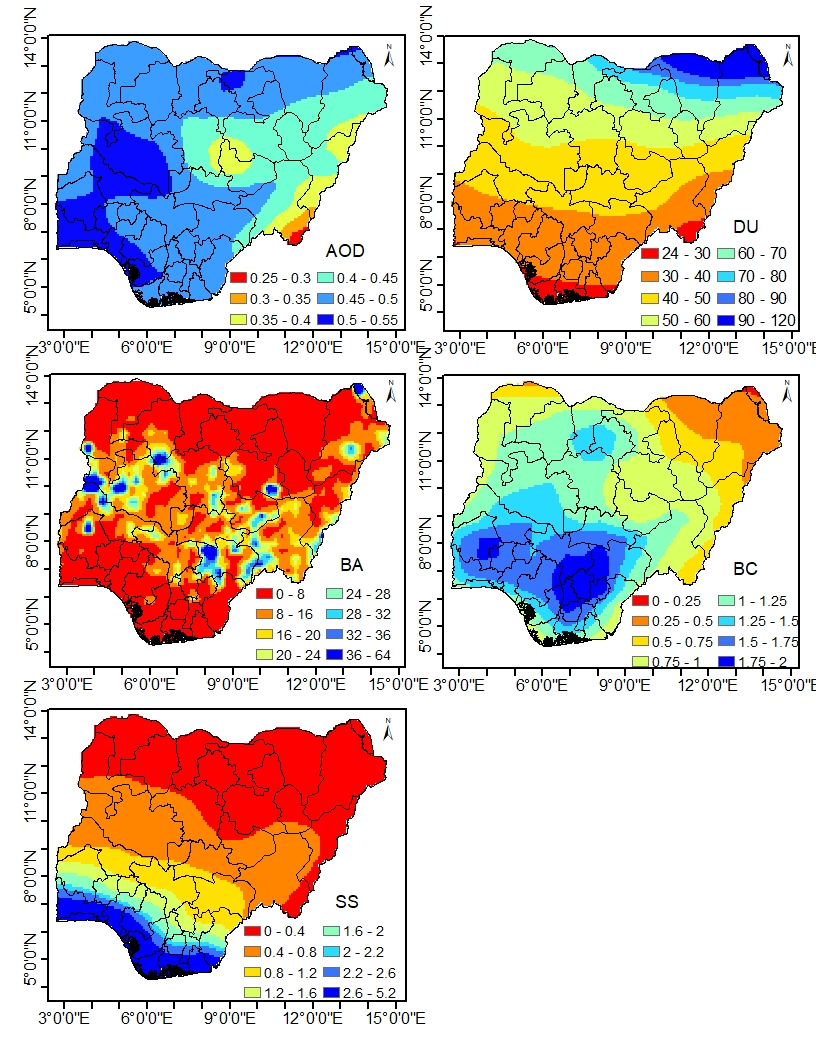
Understanding the factors that influence Aerosol Optical Depth (AOD) is essential for addressing air pollution and effectively managing air quality. This study examines the impacts of dust aerosol (DU), sea salt (SS), black carbon (BC), and burned areas (BA) on AOD across different Köppen climate zones in Nigeria from 2001 to 2019. Results from a multivariate regression analysis revealed that DU consistently had a strong and significant impact on AOD across all zones (coefficients: between 0.00106 and 0.00779, p < 0.001), indicating the influence of dust from the Sahara Desert and the Bodélé Depression. BC and SS increased AOD in southern and coastal zones, although BC had a negative impact in Aw climate zones. The influence of BC was less consistent, indicating its varied sources, including gas flaring and urban emissions. BA showed mixed effects on AOD across different climate zones. In some zones, BA had a positive but often insignificant impact on AOD, while in others, it exhibited negligible or negative coefficients. This suggests that although biomass burning contributes to aerosol levels, its direct effect on AOD may be mitigated by factors such as precipitation and aerosol interactions during the burning season. SS generally had a significant positive relationship with AOD, especially in coastal and Csb zones. Peaks in SS levels in the mid-2000s and mid-2010s correlated with higher AOD, emphasizing the maritime influence on aerosol levels in these regions. However, the impact of SS on AOD was less pronounced in the BWh zone, reflecting regional differences in aerosol composition and sources. These findings demonstrate the major impact of dust aerosols and the complex contributions of other sources, offering insights for climate-sensitive air quality management in Nigeria.
References
[1] H. Liao & W. Chang, “Integrated assessment of air quality and climate change for policy-making: highlights of IPCC AR5 and research challenges”, National Science Review 1 (2014) 176. https://doi.org/10.1093/NSR%2FNWU005. DOI: https://doi.org/10.1093/nsr/nwu005
[2] C. Black, Y. Tesfaigzi, J. A. Bassein & L. A. Miller, “Wildfire smoke exposure and human health: Significant gaps in research for a growing public health issue”, Environmental toxicology and pharmacology 55 (2017) 186. https://doi.org/10.1016/j.etap.2017.08.022. DOI: https://doi.org/10.1016/j.etap.2017.08.022
[3] V. A. Ginzburg, M. S. Zelenova, V. N. Korotkov, “Estimated black carbon emissions from priority source categories in Russia”, Russian Meteorology and Hydrology 47 (2022) 781. https://doi.org/10.3103/S1068373922100065. DOI: https://doi.org/10.3103/S1068373922100065
[4] S. Kang, Y. Zhang, P. Chen, J. Guo, Q. Zhang, Z. Cong, S. Kaspari, L. Tripathee, T. Gao, H. Niu, X. Zhong, X. Chen, Z. Hu, X. Li, Y. Li, B. Neupane, F. Yan, D. Rupakheti, C. Gul, W. Zhang, G. Wu, L. Yang, Z. Wang & C. Li, “Black carbon and organic carbon dataset over the Third Pole”, Earth System Science Data 14 (2022) 683. https://doi.org/10.5194/essd-14-683-2022. DOI: https://doi.org/10.5194/essd-14-683-2022
[5] S. P. Urbanski, “Combustion efficiency and emission factors for wildfire-season fires in mixed conifer forests of the northern Rocky Mountains, US”, Atmospheric Chemistry and Physics 13 (2013) 724. https://doi.org/10.5194/acp-13-7241-2013. DOI: https://doi.org/10.5194/acp-13-7241-2013
[6] L. Kirago, O. Gustafsson, S. M. Gaita, S. L. Haslett, H. L. Dewitt, J. Gasore, K. E. Potter, R. G. Prinn, M. Rupakheti, J. D. Ndikubwimana, B. Safari & A. Andersson, “Atmospheric black carbon loadings and sources over Eastern Sub-Saharan Africa are governed by the regional savanna fires”, Environmental Science & Technology 56 (2022) 15460. https://doi.org/10.1021/acs.est.2c05837. DOI: https://doi.org/10.1021/acs.est.2c05837
[7] R. Ramo, E. Roteta, I. Bistinas, D. van Wees, A. Bastarrika, E. Chuvieco & G. R. van der Werf, “African burned area and fire carbon emissions are strongly impacted by small fires undetected by coarse resolution satellite data”, Proceedings of the National Academy of Sciences 118 (2021) e2011160118. https://doi.org/10.1073/pnas.2011160118. DOI: https://doi.org/10.1073/pnas.2011160118
[8] S. V. Kostrykin, A. Revokatova, A. Chernenkov, V. A. Ginzburg, P. D. Polumieva & M. A. Zelenova, “Black carbon emissions from the Siberian fires 2019: Modelling of the atmospheric transport and possible impact on the radiation balance in the Arctic region”, Atmosphere 12 (2021) 814. https://doi.org/10.3390/atmos12070814. DOI: https://doi.org/10.3390/atmos12070814
[9] E. M. Volodin, E. V. Mortikov, S. V. Kostrykin, V. Y. Galin, V. N. Lykossov, A. S. Gritsun & N. G. Iakovlev, “Simulation of the present-day climate with the climate model INMCM5”, Climate Dynamics 49 (2017) 3715. https://doi.org/10.1007/s00382-016-3189-y. DOI: https://doi.org/10.1007/s00382-017-3539-7
[10] I. B. Konovalov, D. A. Lvova, M. Beekmann, H. Jethva, E. F. Mikhailov, J. D. Paris, B. D. Belan, V. S. Kozlov, P. Ciais & M. O. Andreae, “Estimation of black carbon emissions from Siberian fires using satellite observations of absorption and extinction optical depths”, Atmospheric Chemistry and Physics 18 (2018) 14889. https://doi.org/10.5194/acp-18-14889-2018. DOI: https://doi.org/10.5194/acp-18-14889-2018
[11] N. Yusuf & R. S. Sa’id, “Spatial distribution of aerosols burden and evaluation of changes in aerosol optical depth using multi-approach observations in tropical region”, Heliyon 8 (2023) e18815. https://doi.org/10.1016/j.heliyon.2023.e18815.
[12] L. Menut, C. Flamant, S. Turquety, A. Deroubaix, P. Chazette & R. Meynadier, “Impact of biomass burning on pollutant surface concentrations in megacities of the Gulf of Guinea”, Atmospheric Chemistry and Physics 18 (2018) 2687. https://doi.org/10.5194/acp-18-2687-2018. DOI: https://doi.org/10.5194/acp-18-2687-2018
[13] A. Ayanlade, G. Atai & M. O. Jegede, “Spatial and seasonal variations in atmospheric aerosols over Nigeria: Assessment of influence of intertropical discontinuity movement”, Journal of Ocean and Climate 9 (2019) 1. https://doi.org/10.1177/175931311882030. DOI: https://doi.org/10.1177/1759313118820306
[14] G. Atai, A. Ayanlade, I. A. Oluwatimilehin & O. S. Ayanlade, “Geospatial distribution and projection of aerosol over Sub-Saharan Africa: assessment from remote sensing and other platforms”, Aerosol Science and Engineering 5 (2021) 357. https://doi.org/10.1007/s41810-021-00107-4. DOI: https://doi.org/10.1007/s41810-021-00107-4
[15] Y. A. Aliyu & J. O. Botai, “Appraising the effects of atmospheric aerosols and ground particulates concentrations on GPS-derived PWV estimates”, Atmospheric Environment 193 (2018) 24. https://doi.org/10.1016/j.atmosenv.2018.09.001. DOI: https://doi.org/10.1016/j.atmosenv.2018.09.001
[16] A. Ayanlade, G. Atai & M. O. Jegede, “Variability in atmospheric aerosols and effects of humidity, wind and intertropical discontinuity over different ecological zones in Nigeria”, Atmospheric Environment 201 (2019) 369. https://doi.org/10.1016/j.atmosenv.2018.12.039. DOI: https://doi.org/10.1016/j.atmosenv.2018.12.039
[17] N. Yusuf & R. S. Sa’id, “Spatial distribution of aerosols burden and evaluation of changes in aerosol optical depth using multi-approach observations in tropical region”, Heliyon 9 (2023) e18815. https://doi.org/10.1016/j.heliyon.2023.e18815. DOI: https://doi.org/10.1016/j.heliyon.2023.e18815
[18] O. C. Ibe, O. K. Nwofor & U. K. Okoro, “Aerosol loading in the Guinea Coast climate region of Nigeria: comparison of MODIS and AERONET data sources”, Discover Atmosphere 2 (2024) 14. https://doi.org/10.1007/s44292-024-00018-2. DOI: https://doi.org/10.1007/s44292-024-00018-2
[19] Copernicus Climate Change Service, “Fire burned area from 2001 to 2019 (Version 3.1) [Burned area]”, Climate Data Store (2020). https://doi.org/10.24381/cds.f333cf85.
[20] Global Modeling and Assimilation Office (GMAO), “instM 2d gas Nx: MERRA-2 2D, diurnal, instantaneous, single-level, assimilated aerosol optical depth analysis (0.625x0.5), version 5.12.4.”, Greenbelt, MD, USA: Goddard Space Flight Center Distributed Active Archive Center (GSFC DAAC), 2023. https://doi.org/10.5067/XOGNBQEPLUC5.
[21] Global Modeling and Assimilation Office (GMAO), “tavgM 2d aer Nx: MERRA-2 2D, monthly mean, time-averaged, single-level, assimilated aerosol diagnostics (0.625x0.5), version 5.12.4.”, Greenbelt, MD, USA: Goddard Space Flight Center Distributed Active Archive Center (GSFC DAAC), 2023. https://doi.org/10.5067/FH9A0MLJPC7N.
[22] H. E. Beck, T. R. McVicar, N. Vergopolan, A. Berg, N. J. Lutsko, A. Dufour, Z. Zeng, X. Jiang, A. I. J. M. van Dijk & D. G. Miralles, “High-resolution (1 km) Köppen-Geiger maps for 1901–2099 based on constrained CMIP6 projections”, Scientific Data 10 (2023) 724. https://doi.org/10.1038/s41597-023-02549-6. DOI: https://doi.org/10.1038/s41597-023-02549-6
[23] D. Stockemer, “Multivariate regression analysis”, in Quantitative methods for the social sciences, D. Stockemer (Ed.), Springer, Cham, Switzerland, 2019, pp. 129–142. https://doi.org/10.1007/978-3-319-99118-4_9. DOI: https://doi.org/10.1007/978-3-319-99118-4_9
[24] A. J. Duleba & D. L. Olive, “Regression analysis and multivariate analysis”, Seminars in Reproductive Endocrinology 14 (1996) 139. https://doi.org/10.1055/s-2007-1012915. DOI: https://doi.org/10.1055/s-2007-1016322
[25] A. C. Cameron & F. A. G. Windmeijer, “An R-squared measure of goodness of fit for some common nonlinear regression models”, Journal of Econometrics 77 (1997) 329. https://doi.org/10.1016/S0304-4076(96)01818-0. DOI: https://doi.org/10.1016/S0304-4076(96)01818-0
[26] G. McTainsh, “Harmattan dust deposition in Northern Nigeria”, Nature 286 (1980) 587. https://doi.org/10.1038/286587a0. DOI: https://doi.org/10.1038/286587a0
[27] M. Aklesso, K. R. Kumar, L. Bu & R. Boiyo, “Analysis of spatial-temporal heterogeneity in remotely sensed aerosol properties observed during 2005–2015 over three countries along the Gulf of Guinea Coast in Southern West Africa”, Atmospheric Environment 182 (2018) 313. https://doi.org/10.1016/j.atmosenv.2018.03.062. DOI: https://doi.org/10.1016/j.atmosenv.2018.03.062
[28] S. Engelstaedter, I. Tegen & R. Washington, “North African dust emissions and transport”, Earth-Science Reviews 79 (2006) 73. https://doi.org/10.1016/j.earscirev.2006.04.002. DOI: https://doi.org/10.1016/j.earscirev.2006.06.004
[29] A. Konare, A. S. Zakey, F. Solmon, F. Giorgi, S. Rauscher, S. Ibrah & X. J. J. Bi, “A regional climate modeling study of the effect of desert dust on the West African monsoon”, Journal of Geophysical Research: Atmospheres 113 (2008) D12. https://doi.org/10.1029/2007JD009322. DOI: https://doi.org/10.1029/2007JD009322
[30] K. B. Raji, K. O. Ogunjobi & A. A. Akinsanola, “Radiative effects of dust aerosol on West African climate using simulations from RegCM4”, Modeling Earth Systems and Environment 3 (2017) 34. https://doi.org/10.1007/s40808-017-0295-y. DOI: https://doi.org/10.1007/s40808-017-0295-y
[31] E. T. N’Datchoh, I. Diallo, A. Konaré, S. Silué, K. O. Ogunjobi, A. Diedhiou & M. Doumbia, “Dust induced changes on the West African summer monsoon features”, International Journal of Climatology 38 (2018) 452. https://doi.org/10.1002/joc.5187. DOI: https://doi.org/10.1002/joc.5187
[32] A. T. Yakubu & N. Chetty, “Optical properties of atmospheric aerosol over Cape Town, Western Cape of South Africa: Role of biomass burning”, Atmósfera 34 (2021) 395. https://doi.org/10.20937/atm.52811. DOI: https://doi.org/10.20937/ATM.52811
[33] O. G. Fawole, X. Cai, J. G. Levine, R. T. Pinker & A. R. MacKenzie, “Detection of a gas flaring signature in the AERONET optical properties of aerosols at a tropical station in West Africa”, Journal of Geophysical Research: Atmospheres 121 (2016) 14512. https://doi.org/10.1002/2016JD025584. DOI: https://doi.org/10.1002/2016JD025584
[34] Y. Wang, W. Xia, X. Liu et al., “Disproportionate control on aerosol burden by light rain”, Nature Geoscience 14 (2021) 72. https://doi.org/10.1038/s41561-020-00675-z. DOI: https://doi.org/10.1038/s41561-020-00675-z
[35] H. Jeoung, C. E. Chung, T. Van Noije & T. Takemura, “Relationship between fine-mode AOD and precipitation on seasonal and interannual time scales”, Tellus B: Chemical and Physical Meteorology 66 (2014) 23037. https://doi.org/10.3402/tellusb.v66.23037. DOI: https://doi.org/10.3402/tellusb.v66.23037
[36] S. Provençal, P. Kishcha, A. M. da Silva, E. Elhacham & P. Alpert, “AOD distributions and trends of major aerosol species over a selection of the world’s most populated cities based on the 1st version of NASA’s MERRA Aerosol Reanalysis”, Urban Climate 20 (2017) 168. http://dx.doi.org/10.1016/j.uclim.2017.04.001. DOI: https://doi.org/10.1016/j.uclim.2017.04.001
[37] I. Koren, Y. J. Kaufman, R. Washington, M. C. Todd, Y. Rudich, J. V. Martins & D. Rosenfeld, “The Bodélé depression: a single spot in the Sahara that provides most of the mineral dust to the Amazon forest”, Environmental Research Letters 1 (2006) 1. https://doi.org/10.1088/1748-9326/1/1/014005. DOI: https://doi.org/10.1088/1748-9326/1/1/014005
[38] B. Li, S. Su, H. Yuan & S. Tao, “Spatial and temporal variations of AOD over land at the global scale”, International Journal of Remote Sensing 33 (2012) 2097. https://doi.org/10.1080/01431161.2011.605088. DOI: https://doi.org/10.1080/01431161.2011.605088
[39] N. D. Onyeuwaoma, O. K. Nwofor, T. C. Chineke, E. O. Eguaroje & V. N. Dike, “Implications of MODIS impression of aerosol loading over urban and rural settlements in Nigeria: Possible links to energy consumption patterns in the country”, Atmospheric Pollution Research 6 (2015) 484. https://doi.org/10.5094/apr.2015.054. DOI: https://doi.org/10.5094/APR.2015.054
Published
How to Cite
Issue
Section
Copyright (c) 2025 Tertsea Igbawua

This work is licensed under a Creative Commons Attribution 4.0 International License.